Trump’s 25% Iran Tariff Shockwave: How Indian Markets Brace for Impact

Geopolitical tremors hit global finance as a proposed 25% tariff on Iran sends shockwaves through emerging markets.
The Ripple Effect Hits Mumbai
Indian equities and currency markets flinch—traditional corridors of trade face sudden friction. Supply chain recalculations begin in real-time, with energy and commodity imports under the microscope. Capital looks for exits, or at least, alternative routes.
Digital Assets: The Unlikely Pressure Valve?
While traditional markets shudder, a parallel narrative emerges. Sanction-heavy environments have historically acted as inadvertent growth hackers for decentralized finance. Cross-border settlement mechanisms that bypass legacy banking rails suddenly look less like a niche experiment and more like a critical contingency plan. Volatility in one sector often seeds opportunity in another.
The Hedging Game Intensifies
Portfolio managers aren't just rebalancing—they're rethinking. Geopolitical risk premiums are being repriced across asset classes. The search for non-correlated assets accelerates, pushing capital toward instruments perceived as insulated from traditional state-driven economic warfare. It's the oldest play in the book: diversify or suffer.
A New Calculus for Global Trade
This isn't just about a tariff. It's a stress test for a fragmented global economic system. Nations with heavy exposure to sanctioned trade partners are forced to innovate or stagnate. The move underscores a brutal truth in modern finance: political headlines are now direct market-moving inputs, and agility is the only true currency. After all, in high finance, a 'strategic recalibration' is just a polite term for a panic-induced pivot.
The ultimate takeaway? In an era of economic shocks, the most resilient markets might just be the ones built to operate outside the system causing the disruption. A cynical view, perhaps, but then again, cynicism has always been the highest-yielding asset in geopolitics.
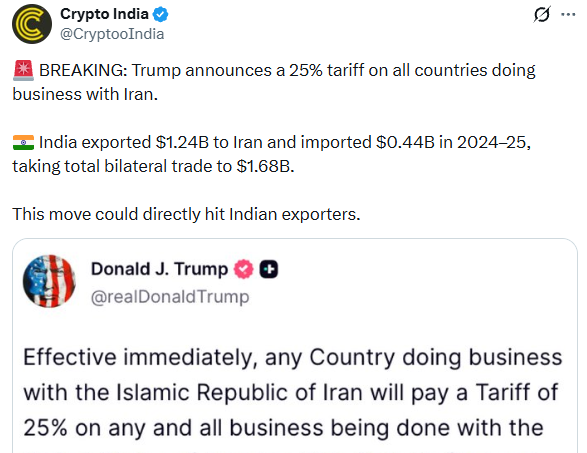
This isn't just a suggestion; Trump called it "final and conclusive." For India, which has spent years building trade ties with Iran, the message is loud and clear: it’s time to choose a side.
From Rice to Pharma: Why the Trump 25% Iran Tariff Hits Home for India
For Indian business owners, the math is getting scary. We are already dealing with a 50% tax from 2025 because of our oil deals with Russia. If you add this new Trump 25% Iran tariff on top, some Indian products could be hit with a 75% total tax just to get into the U.S. market. That is a massive wall that could stop trade in its tracks.
A Direct Hit to Your Kitchen and Medicine Cabinet
As per Economic Times, Our trade with Iran isn't just about big machines; it’s about the things we use every day. Last year alone, India and Iran traded roughly $1.68 billion worth of goods.
Basmati Rice: If you're a farmer or an exporter, this is bad news. Prices in local markets (mandis) are already dropping because everyone is worried about how they’ll get paid.
Chabahar Port: This is India’s big "doorway" to Central Asia. We have a legal "pass" to use it until April 2026, but this new tariff makes the whole project feel very unstable.
Stock Market Jitters: Sensex and Nifty Reaction
The stock market felt the pinch immediately. On Tuesday, the Sensex slid over 545 points, and the Nifty dropped about 0.6%. Investors are now in "wait-and-see" mode. They are just figuring out if this is just a tough negotiating tactic or if the rules of the game have changed for good.
The Crypto Angle: A New Way to Hedge?
Here’s where it gets interesting. As the traditional banks get nervous and the Rupee starts to feel the pressure, some people are looking at digital assets.
Crypto as a Bridge: When normal banks won't touch Iran-linked money because of these new tariffs, crypto often becomes a "backup plan" for moving funds across borders.
Stable Sentiment: Even as stocks dipped, the crypto market stayed relatively steady. More people are starting to see Bitcoin as a "neutral" place to put money when the US Dollar is being used as a political tool.
However, thanks to the new India crypto KYC rules, it's getting much harder for anyone to MOVE large amounts of money "under the radar."
Why is Trump Doing This Now?
The timing isn't an accident. Right now, Iran is facing massive protests and internal unrest. Trump is using America’s economic power to squeeze Tehran even harder, hoping to cut off their cash Flow completely.
But for India, this is a nightmare. We import 85% of our oil, and we can't afford for the Middle East to go into chaos. We need the U.S. because they are our biggest customer, but we also need a stable energy supply. It’s a classic case of being stuck between a rock and a hard place.
Conclusion: A Trial for India
The next few months are going to be tough for Indian trade. Whether it’s the 50% Russian oil tax or this new Trump 25% Iran tariff, New Delhi has to figure out how to keep its exporters SAFE without making its best customer the U.S. unhappy. India's economy is strong, but if our products become 75% more expensive in the U.S., we are definitely going to feel the pain.
