DTCC Scores SEC No-Action Letter for Tokenized Securities Test - A Major Step for Wall Street’s Blockchain Future

The plumbing of Wall Street just got a blockchain upgrade. The Depository Trust & Clearing Corporation (DTCC)—the behemoth that settles most U.S. securities trades—has secured a crucial no-action letter from the Securities and Exchange Commission (SEC). This greenlights a live pilot for tokenizing traditional assets. Forget theoretical white papers; this is about moving real value on-chain.
Cutting Through the Regulatory Fog
The SEC's letter provides a temporary safe harbor. It allows the DTCC to test the issuance, settlement, and custody of tokenized versions of mainstream instruments—think mutual fund shares—without immediately triggering a full suite of securities regulations. The pilot isn't playing in the crypto sandbox; it's building a bridge from the old world to the new.
Why This Test Changes the Game
This move bypasses years of regulatory hesitation. By anchoring the experiment in a regulated, systemically critical utility like the DTCC, the SEC gets a controlled environment to study real-world impacts. The test focuses on operational efficiency, settlement finality, and whether blockchain can indeed strip out layers of costly intermediation—or just add new ones for consultants to bill hours on.
The Provocative Close
This isn't just a test for technology; it's a test of legacy finance's ability to evolve. If successful, it proves that the immutable ledger can handle the trillion-dollar dance of traditional markets. If it fails, it will be a masterclass in how incumbent giants can adopt a disruptive technology's label while neatly sidestepping its revolutionary potential—a classic move for an industry that perfected the art of charging fees for risk it no longer actually bears.
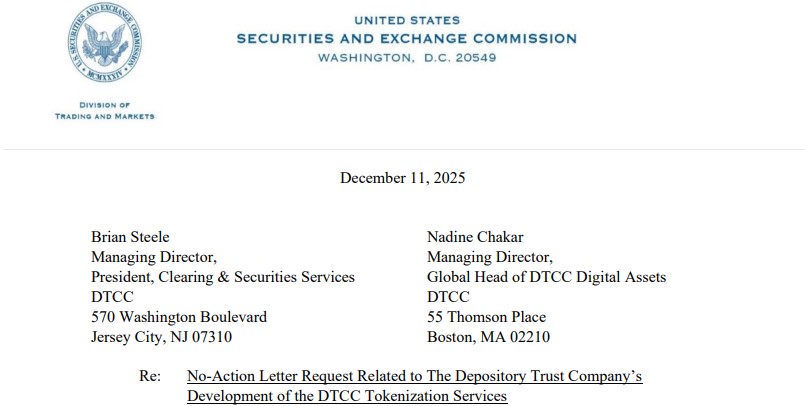
SEC No-Action Letter: What Did the SEC Actually Approve?
The SEC No-Action Letter gives DTC legal room to test blockchain-based settlement without putting multiple Exchange Act rules enforcements. Through this, for the first time, DTCC participants will be allowed to register compliant wallet addresses and settle tokenized securities through DLT instead of relying solely on the centralized DTC ledger.
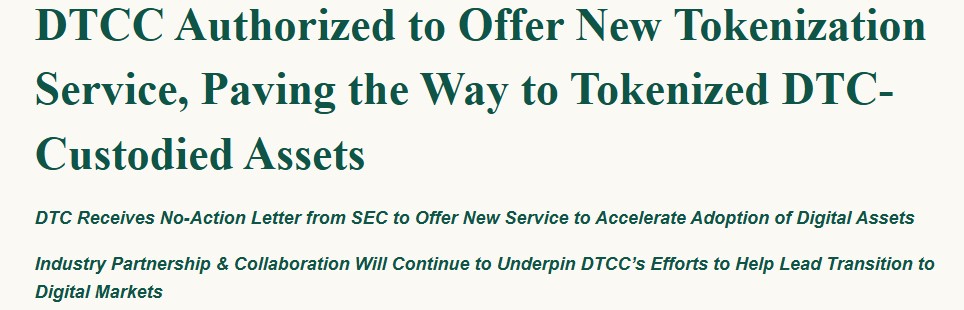
The approval is not sudden, it follows years of DTCC experimentation. Projects like:
Project Ion (2020): Tested faster settlement via DLT
Project Whitney (2020): Explored tokenized money market funds
Project Lithium (2022): Simulated tokenized equity settlement with major banks
Smart NAV (2024): Shared mutual fund NAV data on blockchain
Treasury Collateral Pilot (2024): Tokenized government bonds across Canton Network nodes
DTCC’s acquisition of Securrency in 2023 further strengthened its tokenization stack.
This groundwork shaped the current pilot model, which will record ownership on-chain while maintaining legal continuity through DTC’s nominee, Cede & Co.
Why This Decision Matters for Traditional Finance
DTCC is the backbone of global financial markets, processing over $2 quadrillion worth of securities annually. Any shift in its infrastructure carries enormous significance.
Other than that, the current U.S. settlement system operates on T+1, meaning trades settle the next business day. This creates delays, counterparty risk, and capital lockups.
With the SEC No-Action Letter to DTCC Tokenization pilot:
Instant settlement becomes possible
24/7 trading is supported
Reconciliation errors are reduced
Liquidity efficiency improves
DTCC’s earlier blockchain tests proved this, which showed settlement could shift from days to minutes or seconds, fundamentally upgrading financial market plumbing.
How DTCC Prepared for Blockchain Tokenization
Initially, the SEC No-Action Letter DTCC Tokenization program will cover:
Russell 1000 stocks
Major ETFs tracking S&P 500 and Nasdaq-100
U.S. Treasury bills, notes, and bonds
Participation is voluntary and limited to existing DTC members such as banks and broker-dealers.
As the pilot is expected to go live in the second half of 2026 and run for three years, it includes:
Wallet registration with compliance screening
Token minting in a digital omnibus account
Reversible transactions through a root wallet
Supported L1/L2 blockchains meeting security and recovery standards
A New System Approaching: Action and Reaction
The approval has already stirred broader market and reviews. DTCC called it an “historic milestone,” while SEC Commissioner Hester Peirce praised it as a careful step toward on-chain markets. Social media hype suggests trillions crypto inflows, but analysts note the pilot remains limited and tightly controlled, with infrastructure tokens like HBAR, XRP, LINK, and ethereum L2s, drawing early interest.
This decision is less about HYPE and more about infrastructure. It lays the regulatory plumbing required for U.S. markets to gradually shift toward blockchain-based settlement, without compromising security, or legal protections.
