HashKey IPO Launch Date Revealed: How to Subscribe and What the Listing Price Means for Crypto

Mark your calendars—the HashKey IPO launch date is finally out. This isn't just another listing; it's a potential watershed moment for regulated crypto finance.
The Subscription Playbook
Getting in requires more than just capital. The subscription process demands attention to detail—deadlines, allocation mechanisms, and eligibility criteria that separate the prepared from the sidelined. Miss a step, and you're watching from the sidelines.
Decoding the Listing Price
The final listing price isn't a random number. It's a calculated signal, reflecting underwriter confidence, institutional appetite, and a delicate balance between raising capital and leaving room for that coveted first-day pop. It tells you what the pros really think before the opening bell rings.
The Bigger Picture
This IPO cuts through the noise of memecoins and speculative frenzy. It represents a maturing asset class stepping onto a traditional stage, offering a regulated gateway for institutional money that's been circling the crypto space for years. It's a legitimacy play, plain and simple.
Success here could pave the way for others, proving that major crypto-native firms can bypass the venture capital merry-go-round and go straight to the public markets—just like any other grown-up industry. Failure, on the other hand, would be a stark reminder that Wall Street still views crypto with a mix of fascination and deep-seated suspicion.
So, watch the launch, track the price, but remember: in finance, every 'groundbreaking' debut is just one earnings report away from being labeled a 'value trap' by the same analysts who praised it. The real test begins after the confetti settles.
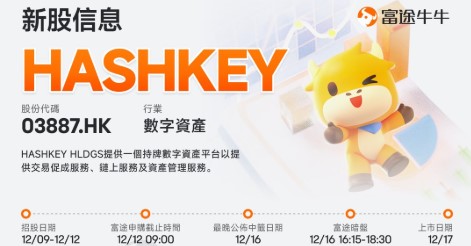
IPO Structure: Strong Demand and Institutional Confidence
Before the official launch the platform has opened the HashKey IPO subscriptions from December 9–12, with shares priced between HK$5.95–$6.95.
Lot Size: 400 shares
Subscription Amount per Lot: HK$2,808.04
Planned Fundraising: $1.426 billion to $1.67 billion in HK
Valuation at Upper Range: ~HK$19 billion
The exchange is offering nearly 241 million shares globally, with 10% (24.0572 million shares) for the native public and the remaining 90% (approx. 217 million shares) for international placement.
The IPO is co-sponsored by JPMorgan Asia and Guotai Junan, signalling confidence from major financial institutions. But this is not the end of strong confidence, it's just a start.
Heavyweight Institutional Support
A defining feature of the exchnage's IPO is its strong lineup of cornerstone investors, who are subscribing to $584 million worth of shares, representing 37.63% of the total offering. Participants include:
UBS AM Singapore, Fidelity Investments, CDH, Xinting Fund, Infini, Space 2 PTE LTD, Zhiyuan, Litong, and Shining Light Grace Limited.
This blend of asset managers, private equity firms, and global funds shows rising institutional confidence in regulated crypto infrastructure.
Platform’s Expanding Web3 Footprint: Growth Plans
Founded in 2018, the exchange operates across crypto trading, custody, asset management, brokerage, and tokenisation. It holds regulated licenses in HongKong, Singapore, Japan, and Bermuda, and is pursuing approvals in the EU and MENA, where its Global MENA exchange launched in May 2025.
In the first half of 2025, the platform processed HK$214 billion ($27.5 billion) in trading volume, over 3× more than OSL, its closest regulated competitor.
And now with its HashKey IPO funds, the company plans to:
Scale technology and infrastructure
Strengthen risk management systems
Expand Workforce globally
Support tokenization and RWA programs
This reflects HashKey’s ongoing growth trajectory, while more importantly, the platform is helping pave the way for HongKong’s broader development in the digital asset space.
A Major Test of Hong Kong’s Crypto Ambitions
Hong Kong aims to establish itself as a digital-asset hub, with 11 licensed exchanges operating under its regime. The HashKey IPO will be a crucial indicator of investor appetite for regulated crypto businesses amid market volatility and China’s ongoing restrictions.
A successful listing could accelerate:
Virtual asset regulation adoption
Stablecoin legislation
RWA (real-world asset) tokenisation programs
Institutional participation in Hong Kong’s Web3 economy
With strong global backing and high trading volumes, the exchange is emerging as a central player in Hong Kong’s regulated future.
