Trump’s H200 Greenlight Ignites Nvidia Chip War - China Exports Heat Up

The geopolitical chessboard just got a hardware upgrade. Former President Trump's administration has reportedly cleared a path for Nvidia's advanced H200 AI chips to flow into China—a move that throws gasoline on the simmering semiconductor conflict and reshapes the global tech power balance.
The Geopolitical Gambit
This isn't just about exporting processors; it's a strategic power play. By greenlighting the H200, the decision effectively bypasses prior stringent export controls, creating a new front in the U.S.-China tech cold war. Analysts see it as a calculated maneuver—one that could temporarily ease trade tensions while forcing competitors to scramble.
Market Calculus & The Ripple Effect
For Nvidia, the gate swings open to a massive, hungry market. Chinese tech giants, from Alibaba to Tencent, have been starved for top-tier AI hardware to fuel their own ambitions. This move doesn't just sell chips; it sells influence and cements technological dependencies. Meanwhile, rival chipmakers are recalculating their entire market strategy overnight.
The Supply Chain Shuffle
Global logistics networks are already bracing for impact. Expect a surge in specialized freight, tightened component supplies elsewhere, and a frantic race to secure auxiliary tech. The approval cuts through red tape but potentially knots up supply lines for everyone else—classic case of solving one bottleneck by creating three others.
A New Phase of Digital Sovereignty
The long-term implication? Nations are watching. This decision underscores that advanced AI hardware is the new currency of geopolitical leverage. It will accelerate global efforts to achieve chip independence, from the EU's Chips Act to India's semiconductor subsidies. The era of relying on a single geographic corridor for critical tech is over.
The bottom line: Washington just rewired the circuit board of global tech competition. While quarterly earnings reports might get a sugar rush, the strategic decoupling of the world's two largest economies just entered its most complex, hardware-defined chapter yet. Another reminder that in modern finance, the most volatile asset isn't crypto—it's geopolitical goodwill.
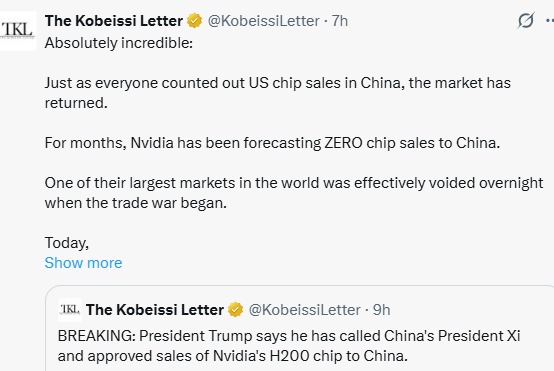
Source: The Kobeissi Letter
Back in August, Nvidia and AMD agreed to hand over 15% of their China chip revenue to the U.S. government in exchange for export licenses. The TRUMP news has raised questions about whether this moment marks the start of a new US-China chip war or the beginning of a slow healing process in global tech trade.
Trump’s New Policy and China’s Reaction
Trump said he personally informed the President Xi Jinping and received a “positive” response. He stressed that the MOVE will protect U.S. national security while also supporting American jobs, manufacturing, and taxpayers. He added that the same rule will apply to AMD, Intel, and other chipmakers.
This shift effectively resets part of the export rules that had earlier blocked Nvidia’s best AI chips from China during the US-China tariff war. For months, the company expected zero sales to nation as restrictions froze the market. With H200 chips now allowed under a fee-based model, the Nvidia Chip War is entering a new phase.
Why This Move Matters in the 2025 Tech Conflict
The United States has been worried that advanced AI processors could help China’s military. China, on the other hand, has been working hard to reduce reliance on American chips while pushing Huawei, Cambricon, and Moore Threads as local alternatives.
However, analysts say that the H200 chip is still far ahead of anything they can produce today. This keeps the manufacturer competitively strong in Asia even as the trade talks continues to shape global AI leadership.
Some U.S. lawmakers fear this approval could still benefit count’s military progress, calling the step a “national security mistake.” Others argue it is a practical middle ground that prevents that Chinese government from fully turning to Huawei chips.
How the Stock Reacted
Nvidia stock experienced a strong rally immediately after Trump’s announcement. Shares closed the day up 1.73% and jumped another 2.33% in after-hours trading, touching $187. The sharp rise shows that investors see the news as a major win for the AI processor producer in the ongoing tensions.

Source: Google Finance
The chart reflects renewed confidence after months of uncertainty, especially when the company forecast zero revenue from the country. The reopening of even a limited channel to the country could help stabilize future sales.
Market Outlook
With partial access to China restored, the company's financial performance may see stronger quarterly numbers in early 2026. If the nation begins ordering large H200 shipments, analysts expect the stock to break above $200–$210. But if US-China tensions spike again, the Nvidia Chip War could cause sharp volatility.
Nvidia is one of the biggest suppliers of AI chips in the world, so its return to the previous market matters a lot for the global blockchain and crypto industry. Faster chips help power smarter blockchain tools, stronger security systems, and quicker transaction networks.
This article is for informational purposes only, kindly do your own research before investing.
