CFTC Crypto Regulation: USA Launches Digital Assets Pilot Program

Regulators are finally getting in the game. The Commodity Futures Trading Commission (CFTC) just greenlit a landmark pilot program for digital assets—a move that could reshape the entire crypto landscape in the United States.
From Sandbox to Main Street
This isn't just another bureaucratic study. The pilot creates a controlled environment where registered entities can test new crypto derivatives and trading products. Think of it as a regulatory sandbox with real stakes. The goal? To gather hard data on market structure and risk before writing the permanent rulebook.
Why This Changes Everything
For years, the U.S. crypto industry operated in a gray zone, with innovation often outpacing clarity. This program flips the script. It signals a shift from reactive enforcement to proactive framework-building. By inviting firms to build under supervised conditions, the CFTC is acknowledging that digital assets aren't a passing fad—they're the next chapter of finance.
The Institutional Floodgates
Watch for traditional finance to move. A clear testing pathway removes a major barrier to entry for big banks and asset managers sitting on the sidelines. The pilot provides the regulatory predictability they've been demanding before deploying serious capital. It’s the missing link between Wall Street's balance sheets and blockchain's potential.
A Global Race for Clarity
The U.S. is playing catch-up. Jurisdictions from Singapore to the EU have been more aggressive in establishing crypto frameworks. This pilot is America's counter-punch—an attempt to foster domestic innovation while still protecting investors. The subtext is clear: we want the business, but on our terms.
The Fine Print and The Future
Success isn't guaranteed. The program has strict reporting requirements and oversight mechanisms. Participants will be under a microscope, with every trade and token analyzed. Get it right, and you help draft the future rules. Get it wrong, and you provide ammunition for the skeptics. It’s a high-stakes experiment where the data collected will either justify crypto's complexity or expose its flaws—likely a bit of both.
The bottom line? After years of regulatory ambiguity, Washington is finally building a runway. Now we see who's ready to take off. Just don't expect them to hold your hand—this is finance, after all, where every 'pilot program' is really just a bet dressed up as policy.
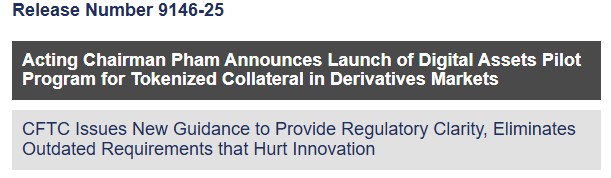
This milestone builds on the agency’s rapid-fire initiatives under the GENIUS Act and strengthens the regulatory foundation of America’s digital asset ecosystem.
With this the United States moving closer to support its stance of becoming a leading player in the broader cryptocurrency markets. But how is this CFTC crypto collateral distinctive?
Digital Assets Pilot Program: BTC ETH & USDC Approved as Collateral
Acting Chairman Caroline D. Pham announced a comprehensive pilot program establishing clear guardrails for tokenized collateral in futures and swaps trading.
Permission to use Bitcoin, Ether, and USDC as margin collateral
Guidance for tokenized real-world assets like U.S. Treasuries
Strict rules for custody, segregation, valuation, and operational risk
A three-month introductory phase requiring weekly reporting from FCMs
Immediate withdrawal of outdated 2020 virtual-currency restrictions
The CFTC emphasized that its regulations remain technology-neutral, meaning each tokenized asset must be evaluated within the existing framework rather than creating entirely new rules.
Pham stated that the initiative will “protect customer assets, strengthen oversight, and ensure SAFE US markets amid rising losses on foreign exchanges.”
Industry Leaders Praise Strong Direction in CFTC's Regulation
The announcement drew broad support from major industry figures.praises by saying CFTC validates that digital assets can “reduce settlement risk and improve financial efficiency,” whilehighlighted that tokenized stablecoins will enhance 24/7 risk management and reduce liquidity squeezes.
also noted that long-awaited regulatory certainty has finally arrived for America clearing operations, wherestressed on more improvement in capital efficiency and anchors America’s leadership in digital-asset adoption.
Their responses show that CFTC crypto regulations, by presenting the new Digital Assets Pilot, are increasingly shaping institutional strategies across the sector.
And the results of these efforts are clearly being seen with the numbers that the country has created.
U.S. Crypto Market: A Rapidly Expanding Landscape
Just days earlier, the CFTC made history by authorizing listed spot crypto trading on US registered exchanges for the first time. And now this Digital Assets Pilot Program serves as a follow-through step.
The need for these types of structures are important now, especially as the country’s dream grows faster than any other major economy.
TRM Labs reports that the U.S. virtual product transactions surged 50% year-over-year, crossing $1 trillion in the first seven months of 2025, where Bitcoin ETFs added momentum significantly with $15 billion in early-2025 inflows.
Revenue projections by The Grand View Research, reflect the same trajectory. The U.S. crypto market is set to nearly double from $1,350.8M in 2024 to 2,723M by 2030, supported by a steady 12.7% CAGR.
While the nation already holds 23.7% of global cryptocurrency revenue, this share is expected to rise more if adoption continues at current speed.
In simple terms, the combination of regulatory clarity plus rising market activity is creating a strong feedback loop, enabling the U.S. digital asset industry to grow faster, attract more capital, and build a more stable long-term foundation.
