Bitcoin Battles to Reclaim Critical Support Levels Against Intense Market Pressure

Bitcoin's fighting to hold ground. The digital asset's locked in a tug-of-war with market forces, clawing back toward key support zones that could dictate its next major move.
The Struggle for Stability
Forget the moon for a minute—Bitcoin's just trying to find solid footing. The asset's price action resembles a heavyweight bout, absorbing blow after blow from broader market sentiment and regulatory whispers. Every rally gets tested, every dip gets scrutinized. It's a high-stakes game of technical chess where support levels aren't just lines on a chart; they're psychological battlegrounds.
Pressure from All Sides
The pressure isn't coming from one direction. Macroeconomic headwinds, the usual chorus of naysayers, and that ever-present volatility are all piling on. Meanwhile, traditional finance watches from the sidelines, offering thoughts and prayers—and the occasional cynical jab about 'digital tulips'—while moving at a glacial pace. Some things never change.
What Comes Next?
This isn't just noise. The battle for these support levels signals a broader fight for legitimacy in a skittish market. A successful defense could pave the way for consolidation and the next leg up. A failure to hold? That invites a deeper correction and a fresh wave of doubt. One thing's clear: Bitcoin isn't going down without a fight. The market's watching to see if it's a battle it can win.

Summarize the content using AI

ChatGPT

Grok
ContentsImminent Market ShiftsUnderstanding Bitcoin’s Trajectory
Bitcoin is currently struggling to reclaim the $88,000 mark, while an impending address by Trump is anticipated to influence market trends. In discussions for the chairmanship of the Federal Reserve, Trump’s announcement expected within weeks could significantly impact cryptocurrency markets. Additionally, a renowned cryptocurrency forecaster maintains a bearish outlook, predicting catastrophic effects on altcoins if proven right.
Imminent Market Shifts
A slew of potential setbacks could adversely affect the cryptocurrency landscape within a month, including a Supreme Court ruling, MSCI’s classification of crypto reserve companies as funds, and a possible interest rate increase in Japan. Japan’s decision is due on Friday, coinciding with the release of the U.S. inflation report, indicating a period of heightened volatility and risk aversion in the crypto markets.
This negative sentiment has already seen Bitcoin lose its $88,000 support, consistent with a prediction by Roman Trading that anticipated a minor rebound, which came to fruition. Furthermore, the renowned forecaster reasserted a $76,000 target for Bitcoin.
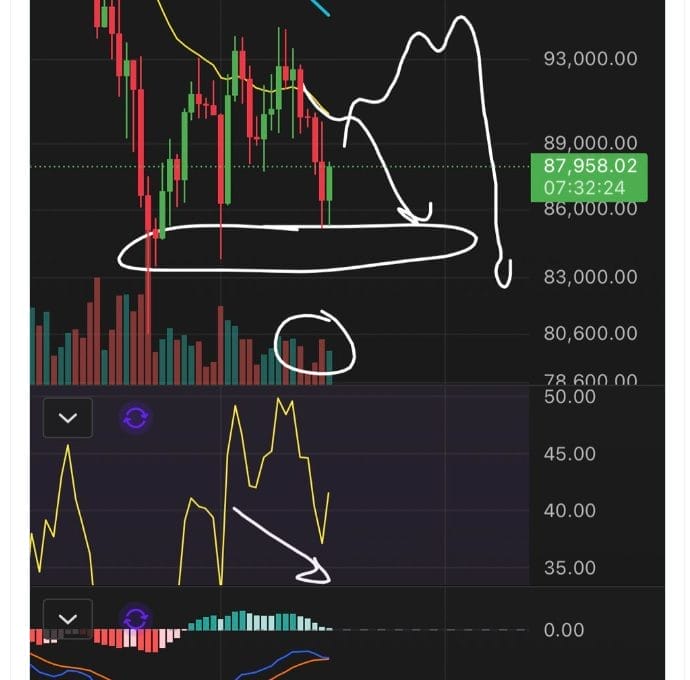

According to the forecaster, the bullish waves and low volumes on the downturn suggest only a temporary bounce, not a significant recovery. Therefore, bitcoin may potentially dip to $76,000 in the near future.
Understanding Bitcoin’s Trajectory
Mark Cullen posits that the short liquidity concentrated above $95,000 will soon dissipate, potentially triggering an $8,000 rise from this region. However, prior to this movement, a smaller adjustment NEAR $83,000 might be expected. If his projections hold, substantial short liquidations may push the spot price to over $98,000.

Technically, Mark’s outlook remains unchanged as well.

The recent sell-off has seen Bitcoin reach the Fib golden zone during an uptrend. A rebound and a higher low are desirable; however, persistent market pain may see Bitcoin revisit bottom levels at the end of November.
Upcoming announcements, including U.S. inflation figures on Thursday and Japan’s interest rate decision on Friday, will continue to exert pressure on cryptocurrencies. These factors bolster Mark’s expectation of short-term bottom retests in the market.
You can follow our news on Telegram, Facebook, Twitter & Coinmarketcap Disclaimer: The information contained in this article does not constitute investment advice. Investors should be aware that cryptocurrencies carry high volatility and therefore risk, and should conduct their own research.