Bitcoin Defies Market Forces: The Surge Is Coming

Bitcoin isn't just surviving the market's headwinds—it's gearing up to punch through them.
The Setup for a Breakout
Forget the sideways chatter. While traditional assets get tossed by every Fed whisper and inflation report, Bitcoin's building its own momentum. The pressure's mounting, and the technicals are coiling tighter than a spring. This isn't about hoping for a rally; it's about recognizing the mechanics that precede one. The market's playing a different game now, and the old rules look increasingly fragile.
Why This Time Feels Different
Institutional adoption isn't a future promise anymore—it's the bedrock. Real capital is flowing in, building infrastructure that doesn't collapse at the first sign of volatility. This creates a floor. Meanwhile, the macro landscape, with its endless debt ceilings and currency devaluations, acts as a relentless, if cynical, advertisement for a hard-capped alternative. It's the ultimate hedge against financial theater.
The Path Forward
Watch for the catalysts. They won't be the usual suspects. Look for network activity, not just price swings. Watch where the smart money allocates, not what the talking heads say. The surge won't be announced; it'll be confirmed. It cuts through the noise, bypasses the doubters, and redefines resistance on its own terms. The battle isn't against the market forces—it's to expose them as outdated. Get ready.

Summarize the content using AI

ChatGPT

Grok
ContentsImpending Market MovementsShort-term Bitcoin Expectations
The price of Bitcoin is currently striving to reclaim the $88,000 mark as various market dynamics unfold. Notable developments include President Trump’s upcoming national address and discussions with Waller regarding the Federal Reserve Chair, with Trump’s decision expected in the coming weeks. Meanwhile, a noted cryptocurrency forecaster remains steadfast in predicting a downturn, potentially spelling significant consequences for altcoins if their predictions hold true.
Impending Market Movements
Key events affecting the cryptocurrency sector include the high court’s decision on classifying cryptocurrency reserve companies as funds by MSCI and potential interest rate hikes in Japan. This coming Friday is crucial as Japan will announce its decision, while the US will release its inflation report. These factors are contributing to an atmosphere of uncertainty and diminished risk appetite in the cryptocurrency markets.
Amid these developments, bitcoin (BTC) has lost its $88,000 support as predicted. Roman Trading foresaw a slight rebound from the lows, which materialized as expected. Today, the cryptocurrency forecaster has reiterated their forecast of a target set at $76,000.
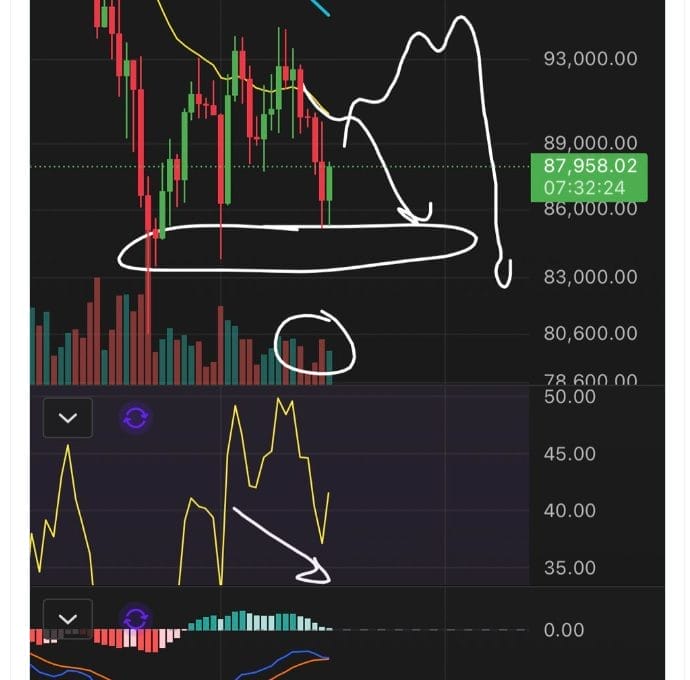

The forecaster commented on recent bullish waves and low volume during the decline, indicating their precise prediction of the rebound point. However, they caution that this could be a temporary bounce, leading to Bitcoin reaching $76,000 in the NEAR future.
Short-term Bitcoin Expectations
Mark Cullen believes the significant short liquidity concentrated above $95,000 will soon be cleared, potentially resulting in an $8,000 upward movement. Before this occurs, a smaller liquidity clean-up might happen around $83,000. If Cullen’s predictions transpire, the subsequent short liquidation could propel the spot price above $98,000.

Cullen’s technical analysis also suggests similar expectations.

He notes that recent sales have brought BTC into the Fib’s golden zone of the upward movement. He anticipates a bounce and a higher low, although current market pains could revisit late November’s lows.
As US inflation figures are expected on Thursday and Japan’s interest decision on Friday, pressure remains intense in the cryptocurrency arena. These developments corroborate Mark’s short-term expectations of a potential dip.
You can follow our news on Telegram, Facebook, Twitter & Coinmarketcap Disclaimer: The information contained in this article does not constitute investment advice. Investors should be aware that cryptocurrencies carry high volatility and therefore risk, and should conduct their own research.