Vitalik Buterin Challenges Elon Musk: A Clash Over Free Speech Dynamics

Ethereum's co-founder throws a philosophical gauntlet at the world's richest man. This isn't about code or rockets—it's about the fundamental rules of the digital public square.
The Core Disagreement
Buterin's challenge cuts to the heart of a modern paradox: how do you build a platform that's both truly open and responsibly governed? He pushes Musk to move beyond simplistic 'free speech absolutism' and grapple with the messy reality of content moderation, algorithmic amplification, and community health. The implication is clear: running a global town square requires more than just flipping a 'censorship off' switch.
Why This Matters for Tech
The debate bypasses corporate PR and hits a raw nerve for the entire tech industry. It forces a reckoning between Silicon Valley's libertarian roots and the societal pressures now crashing against its platforms. Every decision—from shadow-banning to trending topics—shapes discourse, markets, and even elections. Ignoring that impact isn't freedom; it's negligence wrapped in a slogan.
The Ripple Effect
This public sparring between two iconoclasts sends shockwaves beyond tech circles. It reframes the conversation for developers, regulators, and users. The outcome could influence everything from future blockchain-based social media experiments to how traditional platforms defend their policies. When giants clash, the entire ecosystem feels the tremors.
Ultimately, Buterin isn't just asking for reflection—he's demanding a better blueprint. In an era where online words can move billion-dollar markets in minutes, defining 'free speech' isn't academic; it's the bedrock of digital society. And if the best plan the tech elite can muster is 'let it rip,' maybe we should short their stock—both literally and philosophically.

Summarize the content using AI

ChatGPT

Grok
In the realm of cryptocurrency, Vitalik Buterin, the founder of Ethereum $3,314, stands as a monumental figure. With a significant crypto fortune and remarkable achievements at a young age, Buterin shares similarities with the elusive Satoshi Nakamoto.
Elon Musk’s Controversial Moves
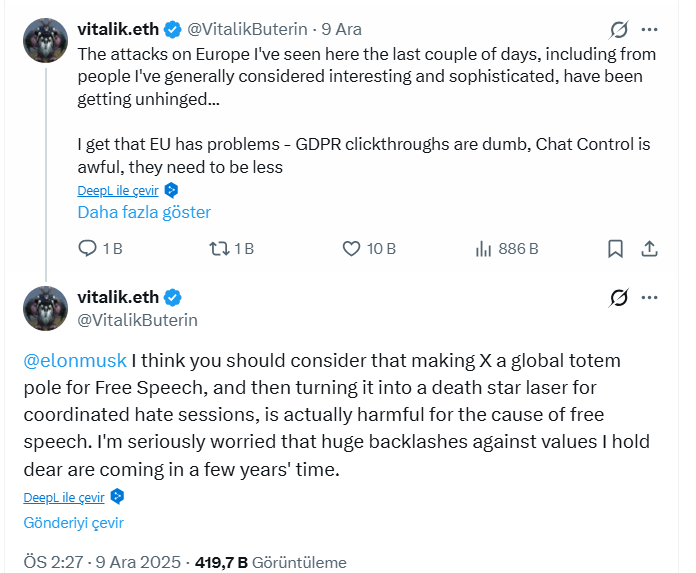
Buterin is known for his focus on the freedom and future opportunities that cryptocurrencies present, often likened to a living version of Satoshi Nakamoto. Recently, he voiced concerns about Europe’s challenges, criticizing certain regulatory and bureaucratic practices. He mentioned that the criticism aimed at European policies might be excessive and seeks to delegitimize them.
He also addressed the issue of animosity on social media, particularly criticizing X (formerly Twitter) for becoming a hub of hate campaigns under Elon Musk’s leadership. Despite Musk’s initial promises to liberate and innovate the platform, Buterin feels the reality diverged, expressing his concerns directly to Musk on Twitter.
He cautioned Musk that transforming X into a “death star laser” for coordinated hate campaigns under the guise of free speech is counterproductive. He fears a future backlash against values he holds dear, emphasizing the impact of such dynamics on global discourse.

Engaging in Constructive Debate
Micah Zoltu responded to Buterin’s comments, accusing him of proposing censorship, suggesting that promoting kindness over incendiary content through algorithmic adjustments could be more effective.
Critics argue that X’s algorithm promotes debates, encouraging extended user engagement by presenting conflicting perspectives. This intentional stoking of conflict has been a topic of conversation for some time.
Buterin’s point of view highlights the potential dangers of allowing extreme and divisive ideas to thrive. Within the cryptocurrency community, the notion of censoring extreme views remains contentious, drawing parallels with traditional finance’s historic apprehension towards crypto.
The issue of what constitutes an “extreme view” varies and presents a conundrum. While Meta’s censorship policies contrast with X’s more liberal stance, the platforms serve different interests by allowing or restricting certain narratives.
Buterin’s reflections stress the moral implications surrounding free speech, hate speech, and their regulation online. Whether Musk’s hands-off approach or a more controlled one like Meta’s is preferable remains debatable, urging Buterin to articulate his stance further.
Amidst these concerns, the ethical dilemma becomes profound. On one side lies acknowledging war crimes as hate speech, while on the other, ignoring hate speech toward Europe. The situation, compounded by the EU’s penalties on X, opens a broader discussion about Musk’s influence in shaping global discourse.
You can follow our news on Telegram, Facebook, Twitter & Coinmarketcap Disclaimer: The information contained in this article does not constitute investment advice. Investors should be aware that cryptocurrencies carry high volatility and therefore risk, and should conduct their own research.