The 2026 Strategy Playbook Looks Radically Different—Here’s Why

Forget everything you knew about portfolio management. The 2026 playbook isn't an update—it's a rewrite.
The New Core Holding
Digital assets have moved from the speculative fringe to the strategic core. Institutions aren't just dipping toes; they're building foundations. The narrative shifted from 'if' to 'how much' and 'in what structure.' Yield generation, once the domain of stables and DeFi gambits, is now baked into custody solutions from names your CFO actually recognizes.
Regulation: The Framework, Not The Fence
Clarity arrived, wrapped in bureaucracy but welcome nonetheless. The patchwork of advisories solidified into frameworks. Compliance is a feature, not a bug—enabling the very scale that was previously impossible. The smart money isn't bypassing the rules; it's using them as a moat. (Take that, legacy finance with your 'innovation-killing red tape' rhetoric—turns out, rules just kill lazy arbitrage.)
Infrastructure Eats Everything
The battle isn't for the next 100x token. It's for the rails. Interoperability protocols, institutional-grade data oracles, and privacy-preserving settlement layers are the real trophies. Applications bloom on reliable infrastructure. The playbook prioritizes the picks and shovels over the fleeting gold rush.
The Integration Mandate
Isolation is a liability. The winning strategy seamlessly integrates digital asset exposure with traditional risk models, tax planning, and estate logistics. It's not a separate 'crypto bucket.' It's a re-tuned allocation model where asset classes talk to each other. The tooling finally exists to make this more than a theoretical exercise.
The old playbook asked how to survive volatility. The 2026 edition demands how to architect resilience and compound advantage. The game changed. Catching up is no longer a strategy.
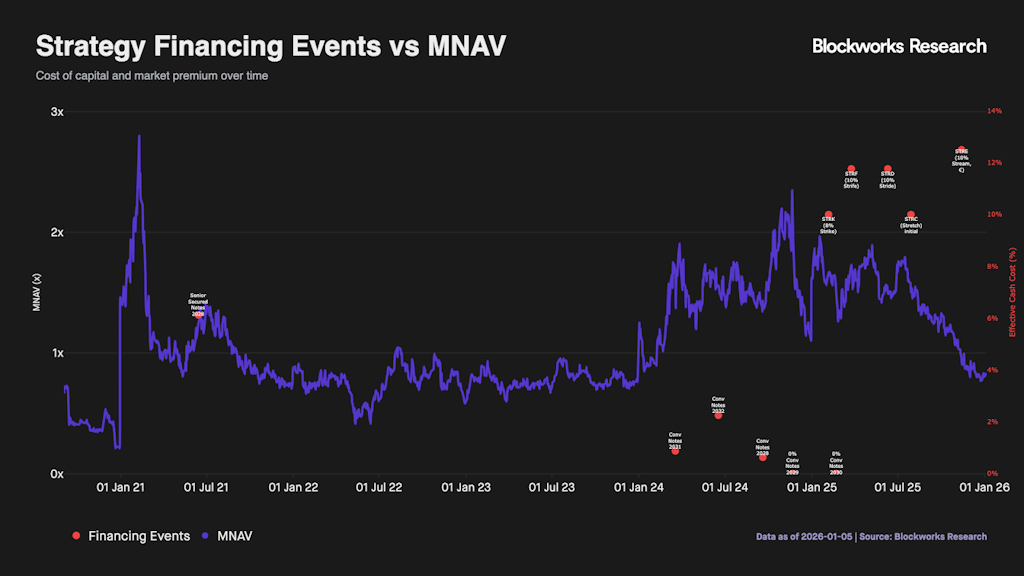
Interestingly, Strategy is still funding buys by issuing common via the ATM even at an mNAV discount, accepting short-term dilution to keep accumulating and maintain liquidity. When mNAV is below 1 and marginal funding costs are double-digit, scaling purchases becomes both more dilutive and more expensive. That makes Strategy a less-reliable, less-price-setting buyer compared to prior premium regimes. It will still matter as a sentiment marker, but unless the premium reopens, its FLOW is more likely to be episodic clips than a sustained engine for the tape.
Zooming out, 2025’s marginal bid was essentially a two-horse race: spot ETFs and Strategy. On the accumulation chart, Strategy’s cumulative purchases tracked in the same range as ETFs for much of the year, meaning Strategy was comparable in Flow impact to the ETF complex at points.
The setup for 2026 looks materially weaker. With mNAV compressed and financing shifting toward double-digit preferred costs plus dilutive ATM common issuance, Strategy’s bid becomes harder to scale without worsening BTC-per-share dilution. Strategy is still a sentiment marker, but the buying pressure should be more muted and episodic, leaving ETF flows and broader crypto risk appetite as the more reliable price-setting forces.
- The Breakdown: Decoding crypto and the markets. Daily.
- 0xResearch: Alpha in your inbox. Think like an analyst.
