Ranger’s ICO Goes Live Today as MetaDAO Plots a Major Protocol Reset

Two narratives are clashing in the crypto markets this morning—one betting on a fresh start, the other launching into the wild.
MetaDAO's Hard Fork Gambit
MetaDAO isn't just tweaking parameters. It's initiating a full-protocol reset, a scorched-earth move aimed at shedding legacy code and governance deadlock. The goal? To rebuild from a cleaner, more efficient base layer. It's a high-stakes maneuver that either unlocks new scalability or alienates its existing validator set. Call it governance theater or genuine innovation—the market will vote with its tokens soon enough.
Ranger Throws Open the ICO Gates
Meanwhile, Ranger's initial coin offering kicks off its public sale phase today. The project promises a novel DeFi middleware layer, aiming to sit between liquidity pools and end-users. No vesting schedules for early contributors were mentioned, a detail that will either be hailed as fair launch ethos or red-flagged by cautious investors. Every new token sells a dream; this one is betting that infrastructure is the narrative that still sells.
One project resets, another begins. In crypto, the only constant is the relentless pitch for a brighter, decentralized tomorrow—often funded by yesterday's profits. A cynical take? Perhaps. But in a sector where 'fundamentals' can mean a trending hashtag, today's launches are tomorrow's case studies in momentum versus merit.

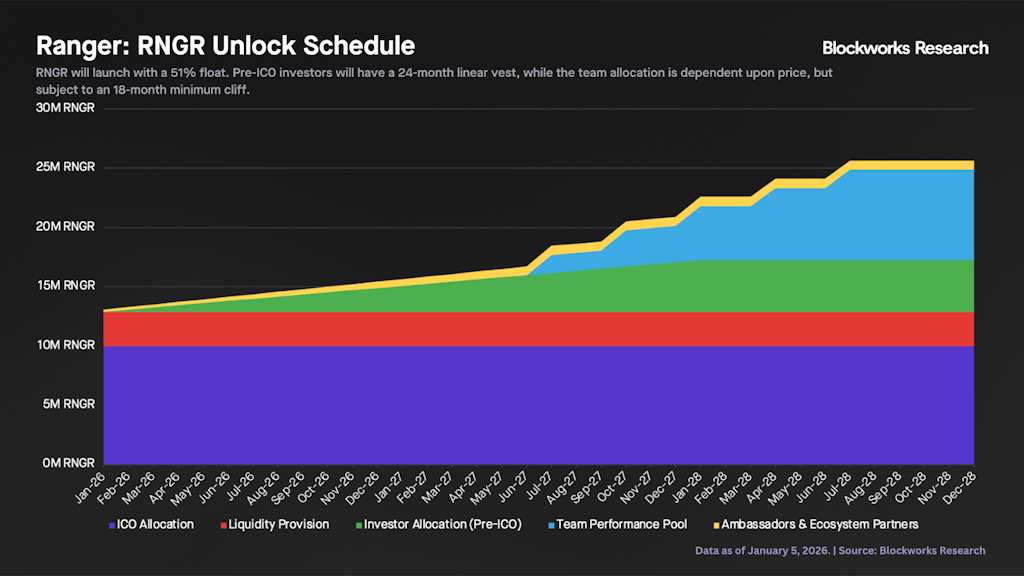
ICO participants who receive an allocation will be 100% liquid at TGE (no vesting), while pre-ICO investors will follow a 24-month linear unlock schedule with no cliff. Notably, the team allocation will be tied to price performance: Up to 7.6M RNGR (30% of total supply) becomes unlockable for the team via five milestone tranches triggered at 2x / 4x / 8x / 16x / 32x of the ICO price. Each milestone must be maintained via a three-month TWAP, and there is a minimum 18-month cliff before any team tokens can unlock.
The chart below shows RNGR’s unlock schedule. The team performance pool is an estimate based on the parameters above, but realized unlocks will ultimately depend on RNGR’s sustained price performance post-ICO.
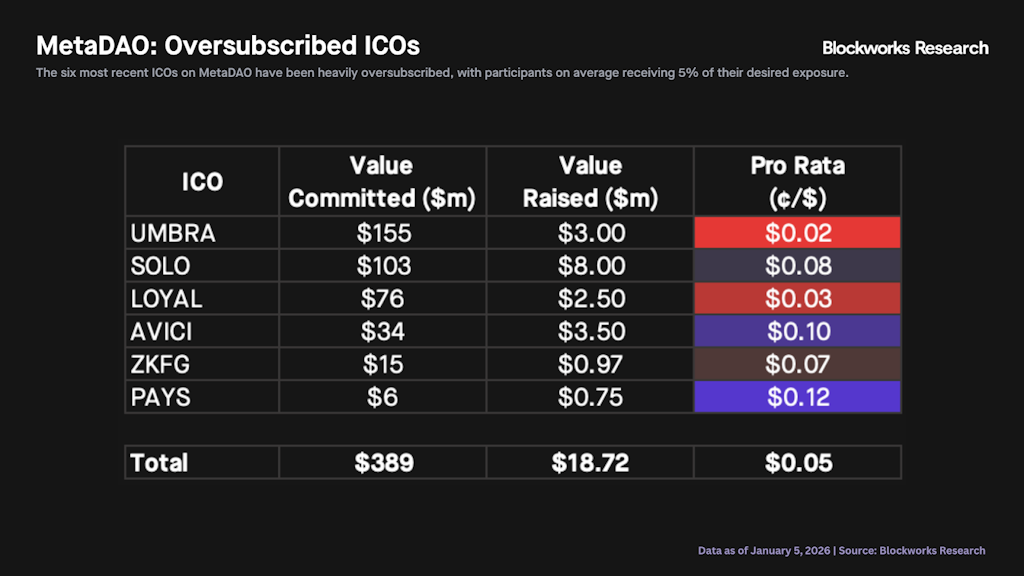
The last six MetaDAO ICOs have been heavily oversubscribed, with allocations settled pro rata. This allocation mechanism favors whales, who can afford to overcommit capital to secure a meaningful allocation. As the chart below shows, across the past six MetaDAO ICOs, participants have received an average of ~5% of their desired exposure.
Ranger will guarantee point holders access to the ICO via a dedicated allocation bucket, directly addressing the oversubscription dynamic above. I’m constructive on this structure: It rewards early users and contributors through preferential access rather than giving away 10-30% of supply via an airdrop, which can introduce unnecessary sell pressure and weaker alignment. In this regard, any allocation not taken by point holders will roll over and be pro-rated to public ICO buyers.
While the Ranger ICO is compelling on its own (and likely worth participating in, particularly for points holders), the bigger story, in my view, is what it means for MetaDAO: a catalyst that could reaccelerate launch cadence and revenue to start the year.
MetaDAO monetizes ICOs through swap fees on its Futarchy AMM and its LP position on Meteora. The Futarchy AMM charges a 0.5% fee on volume, which was originally split evenly between MetaDAO and the project raising (e.g., 0.25% to MetaDAO, 0.25% to Ranger). On Dec. 28, after mutual agreement with teams, the split was retroactively adjusted so that the full 0.5% now accrues to MetaDAO.
Since the Futarchy AMM went live on Oct. 10, 2025, MetaDAO has generated about $2.4 million in revenue, with roughly 60% coming from the Futarchy AMM and 40% from its Meteora LP position.
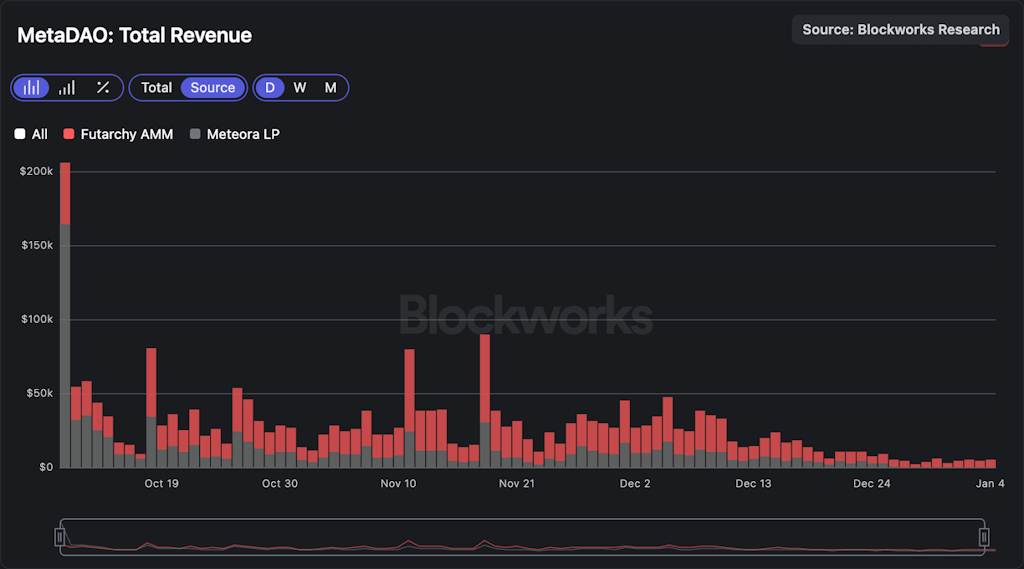
That said, MetaDAO’s revenues have declined sharply since mid-December as ICO activity slowed. Today, MetaDAO’s ICOs remain curated, placing far more weight on founder quality, credibility and long-term alignment than on simply maximizing the number of launches. This approach was necessary to validate the product, but it has come with a clear tradeoff: Without a steady stream of new launches, it’s difficult for revenues to increase, and MetaDAO has fallen short on cadence over the past few weeks.
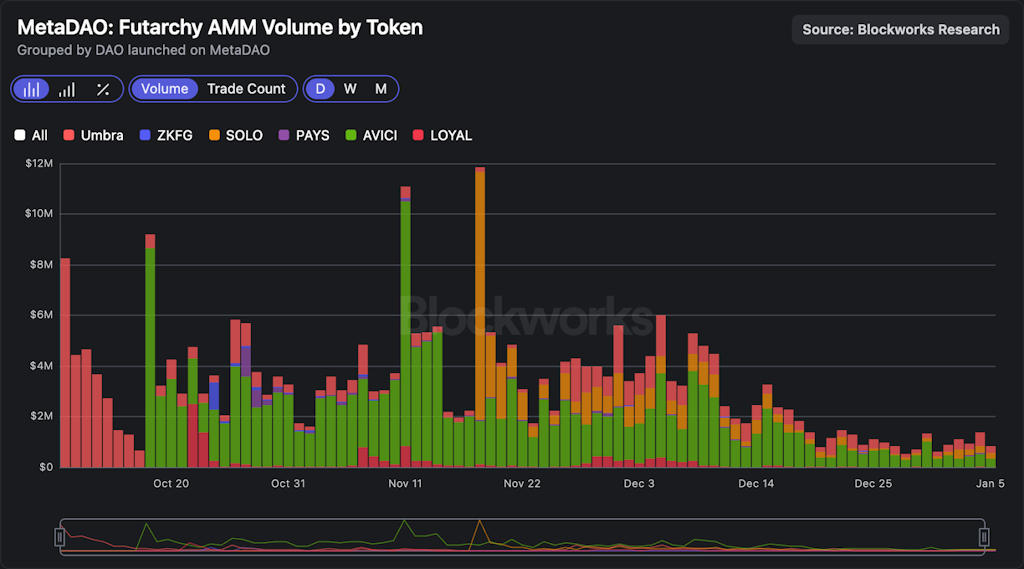
The chart below highlights why. Token volumes tend to be highest around TGE and the days immediately following, meaning sustained Futarchy AMM volumes, and by extension, revenues, are highly dependent on new launches coming through the pipeline.
Despite declining daily revenue, Meta has performed remarkably well, rallying roughly 40% over the past week. As a result, META’s 30-day trailing P/S has increased to ~36x, well above its prior two-month range of ~10-15x.
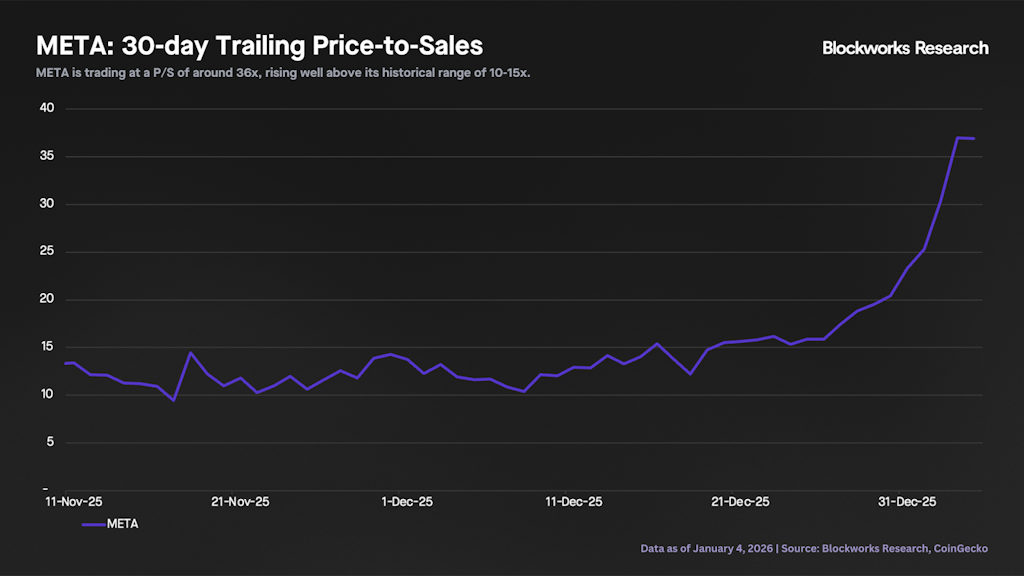
Markets are forward-looking, though, and I expect META’s P/S to compress back toward its historical range over the coming weeks and months as revenue reaccelerates (i.e., not through a price decline, but through higher trailing revenues).
The near-term catalysts are twofold. First is Ranger’s ICO, which will likely be oversubscribed and lead to a spike in Futarchy AMM volumes post-TGE. Second is the Omnibus proposal, which passed last night and will
Beyond the next few days and into the coming months, I expect MetaDAO’s revenues to trend higher as launch cadence accelerates by an order of magnitude. Two catalysts stand out: permissionless launches and Colosseum’s STAMP.
MetaDAO has debated in public comms whether to preserve a fully curated (permissioned) model or experiment with permissionless launches. The latter, despite the risk of lower-quality projects, is a necessary experiment to increase throughput and validate the platform’s scalability, and is probably the direction the team will ultimately pursue.
Finally, I think the market is underpricing what Colosseum’s STAMP could mean for MetaDAO. Colosseum sits upstream of Solana’s startup funnel, spanning hackathons, an accelerator and a venture fund. Many of the ecosystem’s top teams trace their roots back to hackathons (e.g., Jito, Kamino, Drift, Exponent, Hylo). STAMP effectively plugs MetaDAO into that deal flow, creating a steadier pipeline of high-quality launches to complement permissionless ICOs and normalize launch cadence over time.
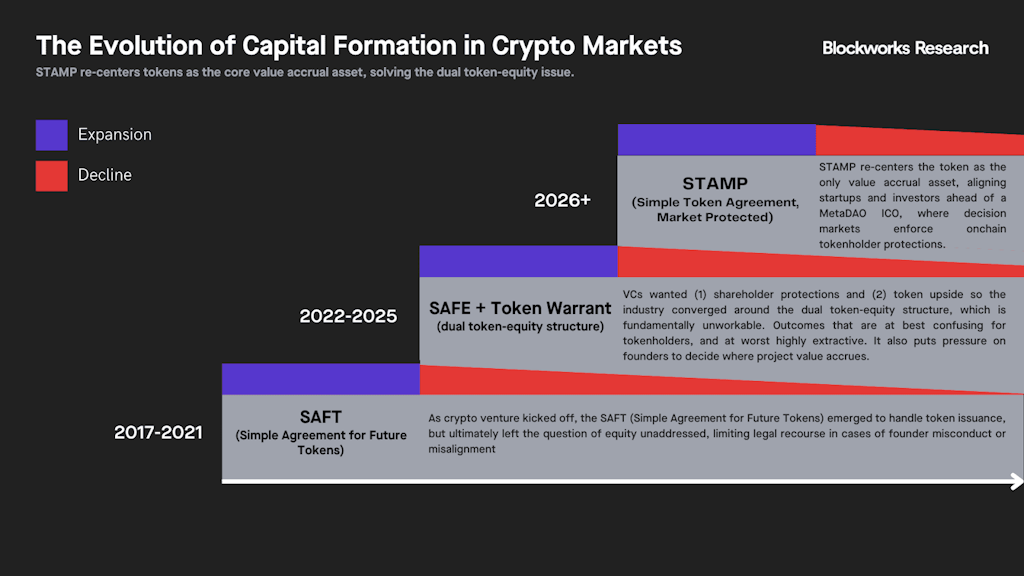
In conclusion, Ranger and the Omnibus proposal may help reaccelerate revenues in the NEAR term, but permissionless launches and STAMP are what could ultimately drive a tenfold increase in MetaDAO’s ICO cadence (and, by extension, volumes and revenue) over the coming months.
- The Breakdown: Decoding crypto and the markets. Daily.
- 0xResearch: Alpha in your inbox. Think like an analyst.
