New Chains, Old Problems: Why Blockchain’s Next Wave Faces Familiar Hurdles

The crypto ecosystem keeps spawning new blockchains—each promising faster speeds, lower fees, and a fresh start. But beneath the technical hype, a nagging question lingers: are we just building better roads to the same old traffic jams?
Scaling Dreams, Centralization Realities
Every new layer-1 or layer-2 solution launches with a manifesto for decentralization. Yet, the path to scale often cuts corners. Validator sets shrink. Key development teams hold disproportionate influence. The trade-off between throughput and true distribution remains the industry's original sin—repackaged with a new token ticker.
The Liquidity Mirage
Fresh chains sparkle with high APY incentives, luring TVL with what some cynical finance veterans might call 'yield subsidies dressed as innovation.' When the emission taps slow, the capital frequently proves to be fair-weather. It flows out as quickly as it flowed in, searching for the next temporary high, leaving ghost towns of depleted pools.
Interoperability's Promise, Fragmentation's Toll
Bridges and cross-chain protocols aim to weave these islands into a continent. But each new connection adds complexity—and risk. Security assumptions multiply. Users face a labyrinth of wrapped assets and network switches, a usability tax that hinders mainstream adoption. The quest for seamless composability often creates more fragile links in the chain.
The Bullish Undertow
Don't mistake this for pessimism—it's a call for rigor. This iterative churn is how the space evolves. Each 'old problem' encountered on a new chain forces better solutions: more robust consensus, smarter incentive design, and tougher security audits. The market is ruthlessly testing architectures in real-time. The chains that honestly confront these legacy issues, rather than just marketing past them, are the ones that will define the next cycle. The future isn't a single chain to rule them all, but an ecosystem where genuine innovation finally solves for durability, not just novelty.
Weekend Reading
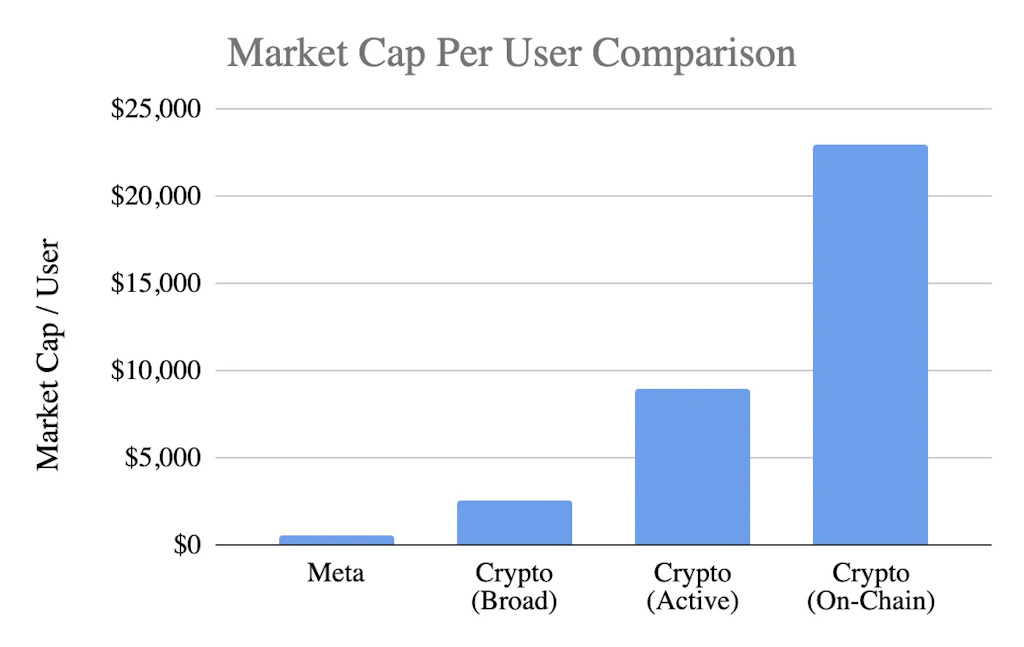
Santiago argues that crypto already trades as if it has Facebook-level network effects, with non-BTC crypto at a roughly $1 trillion market cap. This implies about $2,500 per broad user, $9,000 per active user and $23,000 per monthly onchain user, despite much weaker monetization and retention. He shows L1s are around 90% of market cap but their fee share has fallen from roughly 60% to 12% as DeFi and other apps capture most fees on a small share of value. That shift suggests real network effects sit in forkable aggregation layers rather than bases, and that while ethereum and Solana are building stronger flywheels, the asset class is already priced for an internet scale settlement role it has not yet earned.

Four Pillars reviewed several Tether investments to argue that USDT’s relentless growth and $135 billion Treasury portfolio shows Tether is building a digital financial empire. In capitalizing on MiCA friendly issuers in Europe, on- and off-ramps and wallets in several countries, and bets on BTC backed lending, Bitcoin mining and gold royalties, Tether is stitching together global rails for USDT that serve both retail users and institutions. The piece concludes that instead of being weakened by regulation, Tether is becoming a too-big-to-fail onchain extension of the dollar system, with bitcoin and gold as strategic reserves.
Coin Metrics’ State of the Network argues that ZEC’s nearly 10x rally since October is a repricing of onchain privacy. Shielded supply has climbed to 4.9 million ZEC, or about 30% of circulating supply — up from 11% at the start of 2025. It highlights how the Orchard shielded pool, unified address wallets like Zashi and crosschain rails (such as NEAR Intents) have lowered friction for partially shielded flows, even as fully shielded transfers remain a small share of activity. The report also frames Zcash as a bitcoin-like, 21 million cap asset whose improving UX, faster proofs and growing anonymity set are finally being recognized by the market.
Pine Analytics walks through Solana’s SIMD-0411 proposal, which doubles the disinflation rate from 15% to 30% so that inflation reaches the 1.5% terminal level in about three years instead of six. The proposal roughly cuts 22 million SOL of emissions, or about $3 billion at current prices. The piece contrasts this minimal parameter tweak with the more complex SIMD-0228 idea, arguing that a deterministic schedule is easier to model, govern and explain. It notes that slightly lower staking yields and pressure on weaker validators are worth the trade for less dilution, better capital efficiency and a stronger long-term monetary profile for SOL.
Monad Mainnet, L1 Valuations, and Berachain News

Takeaways from Monday’s 0xResearch livestream:
- Monad mainnet launch: The hosts highlight a few early apps, but TVL is tiny, with day one typically representing a gap between huge expectations and limited initial utility until incentives and more products arrive.
- ICO pricing and perps: The panelists discuss Monad’s Coinbase sale priced around a $2.5 billion FDV, while MegaETH still trades near $3.5 billion pre-TGE and is expected to reprice once spot liquidity appears.
- Throughput vs. value: The discussion highlights new L1s like Monad and MegaETH promising higher TPS, yet the hosts argue raw speed alone no longer justifies multi-billion valuations without clear economic activity and value capture.
- Who captures fees: The group notes Solana has seen more ZEC spot volumes than Hyperliquid, but Hyperliquid likely earns more per unit of trading activity because it owns the orderbook, which shows why chains need canonical revenue apps.
- Neutral infra or app owner: The group prefers models where chains also ship their own DEX, lending and stablecoin rails, pointing to Berachain’s stack as directionally right and questioning why many L1s let external apps take most of the economics.
- Berachain refund scoop: Reports that Brevan Howard’s Nova fund had a post-TGE refund on a $25 million allocation is being called highly unusual, raising MFN questions for other investors and highlighting how some funds face limited downside.
- L1 tokens and launch design: James Christoph argues most new L1 tokens still trade on narratives and flows, that very few will reach Ethereum or Solana style valuations, and that future launches need lower FDV, broader public float and earlier onchain price discovery if they want anything other than down-only charts.
Look for the full podcast on YouTube, Spotify, Apple Podcasts and X.
- The Breakdown: Decoding crypto and the markets. Daily.
- 0xResearch: Alpha in your inbox. Think like an analyst.
