Bitcoin Soars Past $92,000 Milestone as Bank of America Greenlights Crypto Portfolios

Wall Street's seal of approval just sent shockwaves through the digital asset space.
The Institutional Floodgates Open
Forget the whispers in dark corners of the internet. When a banking titan like Bank of America publicly endorses allocating capital to cryptocurrencies, the game changes. This isn't fringe speculation; it's a mainstream mandate. The endorsement acts as a catalyst, signaling to traditional portfolios that digital assets are no longer a speculative sideshow but a legitimate strategic component.
Price as a Consequence, Not a Cause
The rebound above $92,000 isn't the story—it's the market's verdict. It's the numeric proof of institutional validation translating into buy-side pressure. This price action reflects a fundamental shift in perception, where crypto allocations are being reclassified from 'high-risk gamble' to 'necessary hedge and growth engine.' The move bypasses years of skeptical analyst reports and cuts straight to portfolio construction.
The New Allocation Playbook
Gone are the days of asking 'if.' The question for fund managers is now 'how much' and 'in what.' This endorsement provides the cover needed for cautious institutional money to finally move—transforming crypto from a narrative-driven asset to one with a seat at the asset allocation table, right beside stocks and bonds. It’s a staggering legitimization event, the kind that makes traditional finance's previous dismissals look, well, a bit outdated.
A cynical take? It's classic finance: fight an innovation tooth and nail, then rush to monetize it once the train has left the station. The rebound is just the first ripple. The real wave of capital is still lining up at the door.

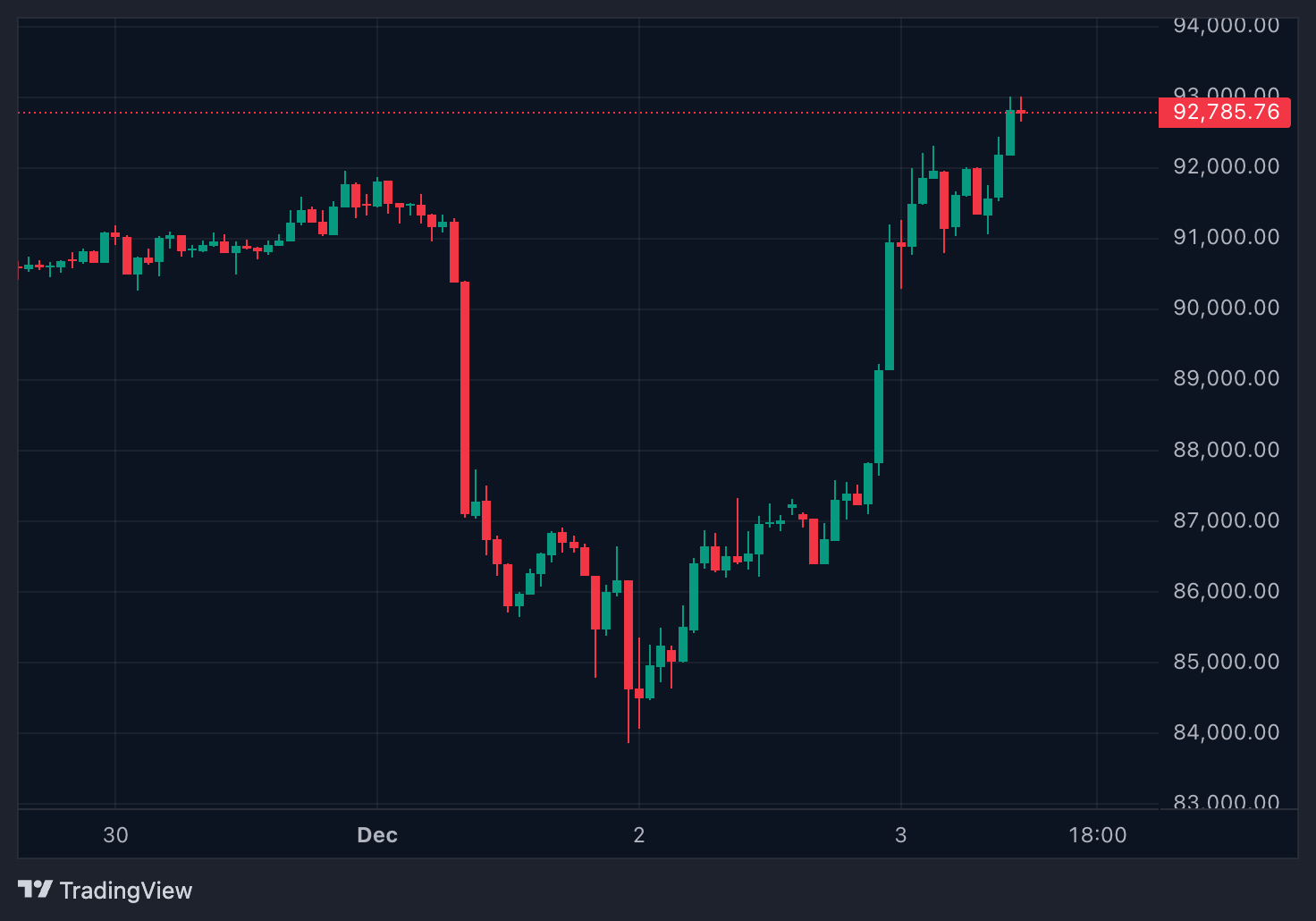
Bitcoin surged past $92,000 on Wednesday, rebounding sharply from Monday's flash crash as Bank of America became the latest major financial institution to recommend cryptocurrency allocations for wealth management clients.
The largest cryptocurrency gained over 7% in 24 hours to trade around $92,690 as of publication time, per Coinmarketcap data, marking its strongest daily performance since April. Ethereum rose 8% to $3,023, while Solana jumped 10% to $140. Total cryptocurrency market capitalization climbed 6.2% to $3.13 trillion, recovering roughly $190 billion from Monday's lows.
Despite the recovery Wednesday morning, Bitcoin remains roughly 26% below its October 2025 all-time high above $126,270.
The rebound comes as Bank of America announced Tuesday it will endorse a 1%-4% digital asset allocation for clients of its Merrill, Bank of America Private Bank, and Merrill Edge platforms. Starting January 5, the firm's investment strategists will begin covering four bitcoin ETFs: Bitwise's BITB, Fidelity's FBTC, Grayscale's BTC, and BlackRock's IBIT.
"For investors with a strong interest in thematic innovation and comfort with elevated volatility, a modest allocation of 1% to 4% in digital assets could be appropriate," Chris Hyzy, chief investment officer at Bank of America Private Bank, said in a statement.
Previously, the bank's wealthy clients could only access crypto products upon request, meaning its network of over 15,000 wealth advisers could not proactively recommend exposure.
The policy shift follows similar moves by other major institutions. Morgan Stanley's global investment committee recommended 2%-4% crypto allocations in October, while BlackRock suggested 1%-2% at the start of 2025. Fidelity Investments has recommended 2%-5% allocations, increasing to 7.5% for investors under age 30.
On Tuesday, Vanguard reversed its longstanding opposition to digital assets, announcing it WOULD allow cryptocurrency ETFs and mutual funds to trade on its platform for more than 50 million brokerage customers. The world's second-largest asset manager had been the last major U.S. brokerage to resist offering crypto access.
U.S. stocks also recovered Tuesday, with the S&P 500 rising 0.3% and the Nasdaq Composite gaining 0.6%. Crypto-linked stocks including Coinbase and Robinhood rebounded after getting hit during Monday's selloff.
Markets are pricing in an 87% probability of a Federal Reserve rate cut at the central bank's December 10-11 meeting, up significantly from mid-November, according to CME FedWatch data. The improved odds for monetary easing have supported risk assets including cryptocurrencies.
Bitcoin had plunged to as low as $84,000 on Monday in its worst daily performance since March, triggering over $350 million in liquidations of Leveraged positions. The flash crash wiped roughly $140 billion from total cryptocurrency market capitalization before buyers stepped in at lower levels.
The recovery comes as institutional adoption accelerates. Morgan Stanley, Charles Schwab, Fidelity Investments, and JP Morgan Chase already allow customers to invest in certain crypto ETFs, while fintech bank SoFi began offering direct crypto trading to retail customers last month. Several banks including Charles Schwab, Morgan Stanley, and PNC are expected to launch direct crypto trading services.
"This update reflects growing client demand for access to digital assets," said Nancy Fahmy, head of Bank of America's investment solutions group.
The institutional endorsements mark a significant shift in Wall Street's approach to cryptocurrencies. Major banks had largely avoided recommending crypto exposure until spot Bitcoin ETFs launched in January 2024, providing regulated investment vehicles that simplified custody and compliance requirements.
➢ Stay ahead of the curve. Join Blockhead on Telegram today for all the latest in crypto.+ Follow Blockhead on Google News