Robinhood Soars: Revenue Hits $1.27B Amid 300% Crypto Trading Boom

Robinhood just flexed its financial muscles—again. The trading platform’s revenue doubled to a staggering $1.27 billion, fueled by a crypto trading surge that left traditional markets in the dust. Here’s how they did it.
Crypto mania drives the bus
Retail traders aren’t just dabbling in crypto anymore—they’re diving in headfirst. Robinhood’s crypto volume exploded by 300%, proving once again that speculative assets outperform boring old stocks when volatility is the only game in town.
The irony? Wall Street still hates it
While Main Street piles into meme coins and BTC ETFs, institutional investors keep clutching their pearls. Too bad their ‘prudent’ portfolios can’t keep up with a platform built for degenerates. Robinhood wins—again.

Robinhood Markets reported revenue of $1.27 billion for the third quarter of 2025, doubling year-over-year results as cryptocurrency trading volumes surged and the company expanded into prediction markets and institutional crypto services.
The Menlo Park, California-based trading platform posted net income of $556 million, up 271% from the prior year, with diluted earnings per share climbing 259% to $0.61, beating analyst expectations of $0.51 per share. Total revenue exceeded the $1.2 billion Wall Street consensus.
Cryptocurrency revenue jumped 339% year-over-year to $268 million, representing roughly 20% of total company income and driving transaction-based revenues up 129% to $730 million. Options revenue contributed $304 million, up 50%, while equities revenue reached $86 million, up 132%.
"Our team's relentless product velocity drove record business results in Q3 and we're not slowing down—Prediction Markets are growing rapidly, Robinhood Banking is starting to roll out, and Robinhood Ventures is coming," said CEO Vlad Tenev during the earnings call.
Crypto trading volumes reached $80 billion for the quarter, split between $40 billion on the Robinhood app, up 176% year-over-year, and $40 billion through Bitstamp, the institutional crypto exchange Robinhood acquired in June. CFO Jason Warnick characterized the crypto performance as "a nice step-up in crypto volumes."
The company's prediction markets business, launched in August with event contracts on sports and other outcomes, recorded 2.3 billion contracts traded in the third quarter. October alone saw 2.5 billion contracts, exceeding the entire third quarter volume.
Both Bitstamp and prediction markets are now generating approximately $100 million or more in annualized revenues, Warnick said, bringing Robinhood's total to 11 business lines each producing that threshold.
Platform assets surged 119% year-over-year to $333 billion, driven by net deposits of $20.4 billion during the quarter and $68.3 billion over the trailing twelve months. The growth reflects Robinhood's expansion beyond trading into a comprehensive financial services platform for younger investors.
During an earnings call, Tenev said the company is evaluating "some options" to expand prediction markets globally, noting Robinhood's dual position as both a traditional scaled player and crypto platform gives it flexibility to choose optimal approaches in different jurisdictions.
On tokenized stocks, which Robinhood offers in Europe, Tenev acknowledged current interoperability limitations but expressed optimism: "Over time, I do expect greater interoperability. As you've seen with other assets in the crypto world, even if they're on other chains, the community tends to get involved and build bridges and wrappers."
The CEO also addressed ongoing discussions about potentially adding Bitcoin to the company's corporate treasury, a strategy popularized by firms like Strategy Inc. "Are we making that decision for them? Is it the best use of our capital?" Tenev asked, adding "the short answer is we're still thinking about it."
Treasurer Shiv Verma confirmed the debate continues internally: "We spend a lot of time thinking about this [and] have this debate constantly. We'll keep actively looking at it."
Adjusted EBITDA reached $742 million, up 177% year-over-year, while operating expenses increased 31% to $639 million primarily due to marketing investments and acquisition-related costs.
October momentum continued with record monthly trading volumes across equities, options, prediction markets, and futures, alongside new highs for margin balances exceeding $16 billion. Crypto volumes topped $32 billion for the month.
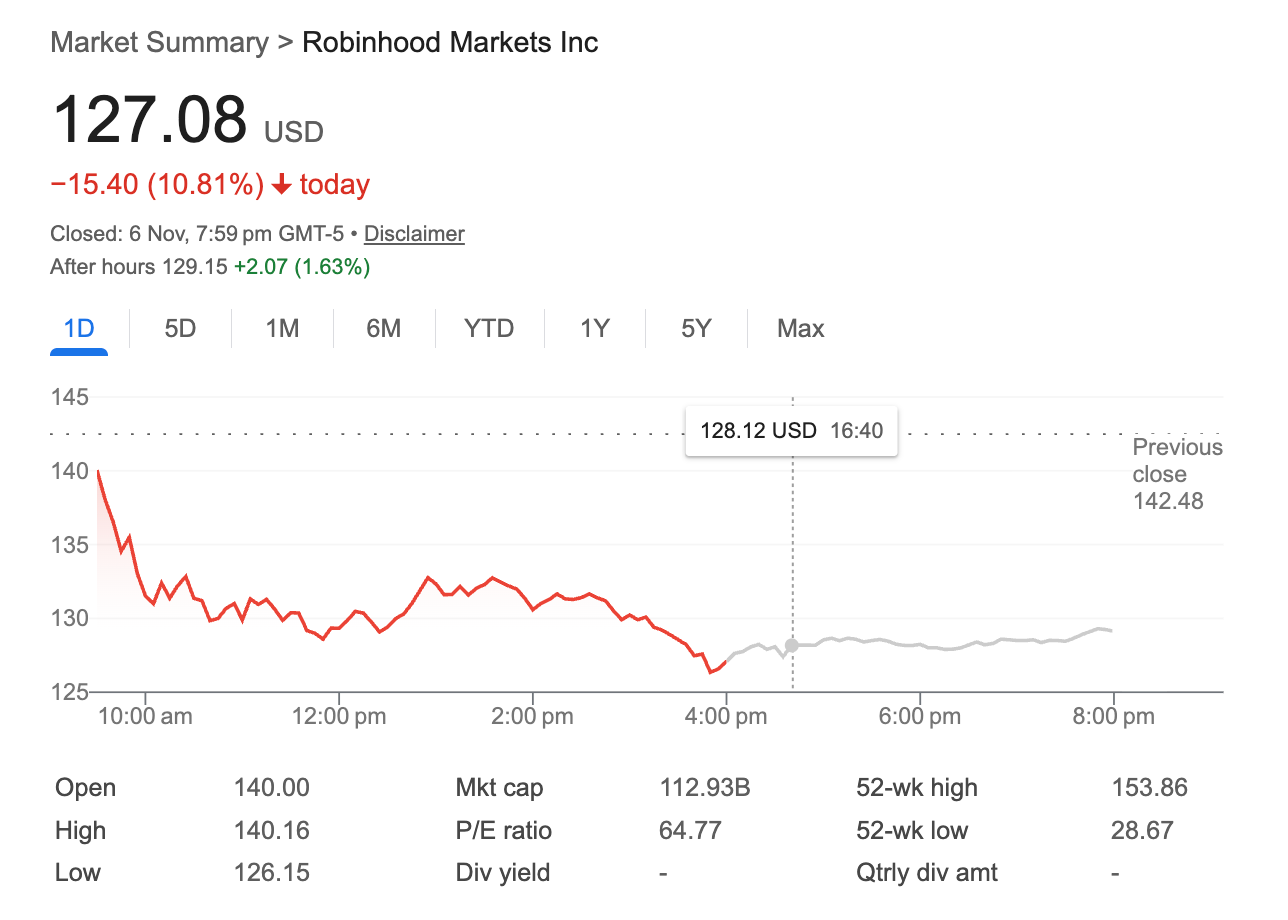
Despite the strong results, Robinhood shares fell 10.81% Thursday to close at $127.08, though the stock remains up 222% year-to-date. The company repurchased $107 million in shares during the quarter at an average price of $104.95, bringing total buybacks since the program's 2024 inception to $810 million.