A critical warning is flashing for Ethereum traders as the cryptocurrency tests key resistance above $2,200: exchange reserves are plummeting simultaneously across Coinbase, Binance, Gemini, and OKX, signaling a potential supply shock that could trigger a sharp 10% correction. This coordinated withdrawal of ETH from the world's most liquid trading venues represents a fundamental shift in market structure, removing sell-side liquidity precisely as price approaches a major decision point, according to CryptoQuant analysis tracking the unprecedented multi-exchange reserve decline.
The Numbers Behind the Drain Are Not Small.
The CryptoQuant data gives the multi-venue supply contraction its precise dimensions. On Coinbase, Ethereum reserves fell from 5.6 million to 3.2 million between early August 2025 and April 9, 2026 — a reduction of 2.4 million ETH removed from America’s largest institutional trading venue over eight months. On Binance, reserves dropped from 4.75 million to 3.3 million ETH over the same period — 1.45 million ETH withdrawn from the exchange, processing the largest share of global ETH derivatives volume.

Those two figures alone describe a sustained, eight-month supply drain of nearly 4 million ETH across the market’s two most systemically important venues. Then the other exchanges add their own data.
Gemini recorded a single-day reserve drop of approximately 74,000 ETH on February 19 — an institutional-scale withdrawal concentrated into a single session. OKX produced the most dramatic reading of all: reserves fell from approximately 990,000 ETH on March 20 to just 167,000 ETH by April 9 — an 83% collapse in under three weeks.
Taken together across all four venues, the scale of the withdrawal is not ambiguous. Millions of ETH have left the immediately available sell-side pool over the past eight months, and the pace has not slowed. The market pushing against resistance above $2,200 is doing so with a fraction of the sell-side depth that existed when the current cycle began. That is not a minor structural detail. It is the context in which every buyer and seller is currently operating.
Ethereum Holds Key Weekly Level as Structure Compresses
On the weekly timeframe, Ethereum is holding near the $2,200 level, a zone that is increasingly defining the market’s structural pivot. This level has acted as both support and resistance across multiple cycles, and the current interaction suggests a market in transition rather than trend continuation.
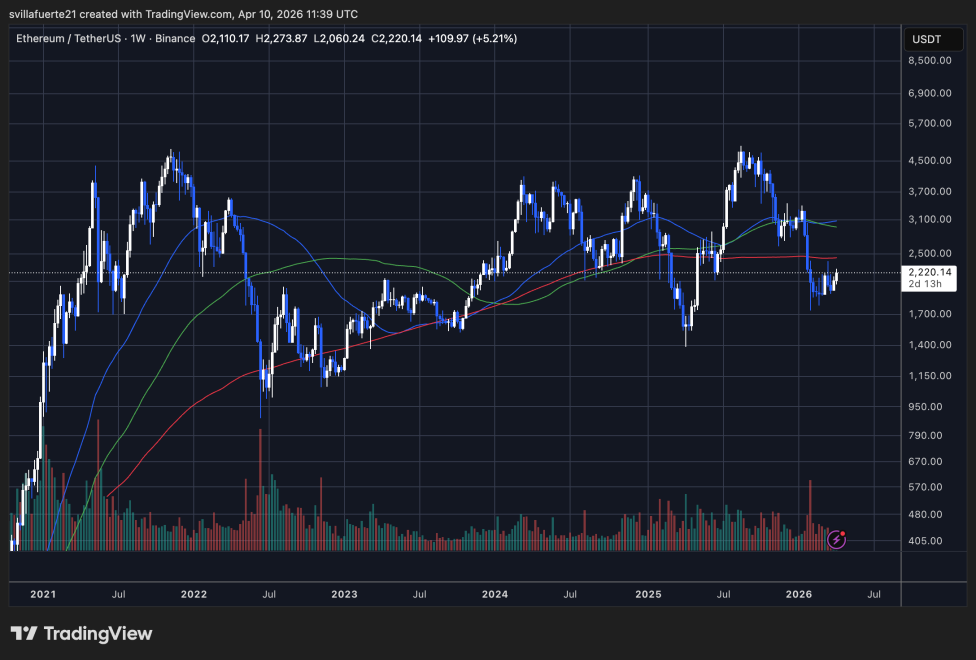
The broader structure shows that Ethereum remains below its prior cycle highs, with the recent rejection from the $4,000–$4,500 region confirming a lower high. However, the decline that followed found support above the rising 200-week moving average (red), which continues to act as a long-term structural floor. This is a critical detail: despite volatility, the macro trend has not fully broken down.
The 50-week (blue) and 100-week (green) moving averages are converging near current price levels, reflecting compression. Price is now trading around these averages, indicating equilibrium between buyers and sellers rather than directional control.
Volume patterns reinforce this interpretation. The spikes during sell-offs point to liquidation-driven moves, while the recent normalization suggests reduced stress but also limited conviction.
Structurally, Ethereum is coiling within a broad range. A sustained move above $2,500–$2,800 would signal renewed strength, while a loss of $2,000 would expose the 200-week support. For now, the market remains balanced, awaiting resolution.
Featured image from ChatGPT, chart from TradingView.com
Articles on this site are sourced from public networks or curated by AI for informational purposes only and do not represent BTCC’s views. Original rights belong to the respective authors. For copyright concerns, please contact
[email protected]. BTCC assumes no liability for the accuracy, timeliness, or completeness of this information, and disclaims all liability arising from reliance on such content. This content is for reference only and should not be taken as investment, legal, or commercial advice.



Log in to Reply
Log in to comment your thoughtsComments