Vitalik Reveals New Ethereum Rule Slashing Confirmations to 12 Seconds

Ethereum co-founder Vitalik Buterin has endorsed a new 'fast confirmation rule' that could guarantee a block is irreversible after just 12 seconds. This breakthrough, proposed by Ethereum Foundation researcher Julian Ma, aims to drastically cut one of the network's most significant practical bottlenecks for exchanges, bridges, and Layer-2 systems by narrowing the gap between Ethereum's robust security and its slower user-facing confirmation times.
New Ethereum Rule For Faster Confirmations
That distinction matters. Ethereum finality remains the chain’s strongest settlement guarantee, but it comes with a much longer wait time. Ma said the fast confirmation rule, or FCR, cuts deposit times from Ethereum mainnet to L2s and centralized exchanges to about 13 seconds, which he described as an “80-98% reduction for most L2s and exchanges.”
For users, the immediate consequence is speed. For infrastructure providers, the bigger story is efficiency. Ma argued that slow mainnet confirmation has forced exchanges, bridges and rollups to operate around delay and uncertainty, especially when handling deposits or syncing market activity across chains. “Bridging funds from Ethereum to L2s and centralized exchanges is slow. Users wait minutes when using the canonical bridges,” he wrote. “The new Fast Confirmation Rule (FCR) solves that. It reduces deposit time from Ethereum L1 to L2s or exchanges to about 13 seconds.”
He added that the rule is expected to become “the new industry standard for L2s and exchanges,” and said it can begin rolling out in the coming months without a hard fork. That is a notable design choice. Rather than introducing a consensus change that requires network-wide coordination, FCR can be activated as clients implement it, with nodes able to run the rule automatically once support is live.
Ma’s explanation frames FCR as a middle ground between today’s heuristics and Ethereum’s formal finality. Most exchanges, L2s and solvers do not wait for finality now. Instead, they rely on a block-depth rule, or “k-deep,” essentially waiting for a transaction to be buried under enough subsequent blocks. FCR takes a different route: it counts attestations rather than blocks. According to Ma, that makes it structurally faster while also giving it a provable security model that k-deep lacks.
The trade-off is explicit. A fast-confirmed block is not finalized, and the guarantee depends on stricter assumptions than finality does. FCR assumes a synchronous network, which in practice means attestations arrive within about eight seconds, and it assumes no adversary controls more than 25% of staked ETH. Finality, by contrast, is designed to hold under asynchrony and up to a 33% adversarial threshold.
Even so, Ma argued the system degrades gracefully when conditions worsen. “If the network is slow, FCR has a built-in fallback mode. Instead of fast-confirming a block within 13 seconds, it may take slightly longer,” he wrote. “As soon as sufficiently many attestations are delivered, the block is fast-confirmed. In the worst-case, FCR falls back to finality.”
That fallback is central to the pitch. The mechanism does not pretend reorg risk disappears; it claims to reduce waiting time dramatically while retaining deterministic guarantees when its assumptions hold. Ma also stressed that if those assumptions do hold, a fast-confirmed block “will be finalized with certainty.”
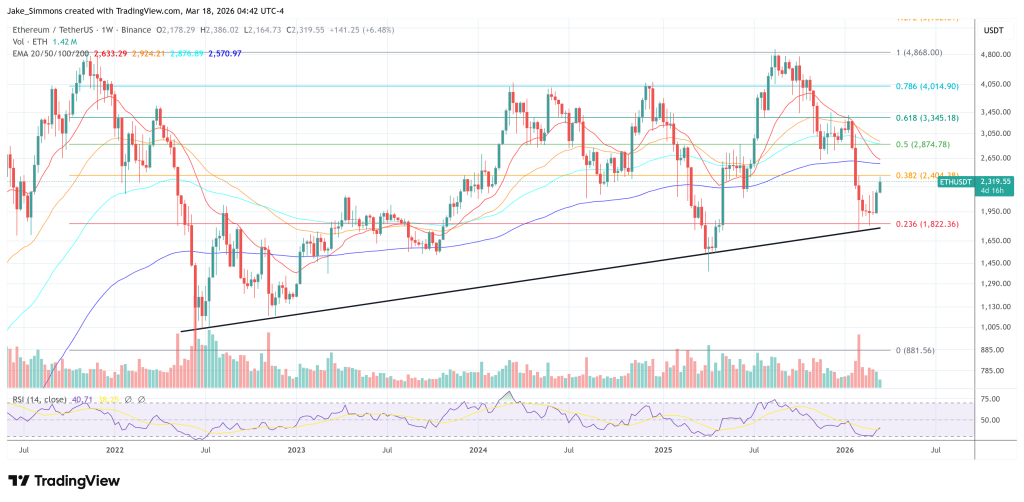
At press time, ETH traded at $2,319.