Ripple CEO Reveals: Epstein Files Prove ’They Were Afraid Of Us’

Fear is a powerful motivator—especially when it comes from the establishment.
The Unsealed Truth
Brad Garlinghouse isn't mincing words. The release of documents tied to the Jeffrey Epstein case, according to the Ripple CEO, wasn't just about exposing a financier's crimes. It was a tacit admission of fear from the old guard. The implication? The threat Ripple and its XRP ledger posed to entrenched financial power structures was real enough to warrant attention from the highest, darkest corners.
Disruption as a Threat Vector
Forget slow, costly cross-border settlements. Ripple's technology promised to bypass the correspondent banking system—a multi-trillion-dollar gravy train for incumbent players. That kind of efficiency doesn't just save money; it dismantles monopolies. When you challenge the plumbing of global finance, you don't make friends with the plumbers who've been overcharging for decades.
The Regulatory Weapon
The SEC's lawsuit against Ripple now reads differently in this light. Was it always about investor protection? Or was it a strategic, legalistic counter-attack against a protocol that could move value faster than lawyers could file motions? The timing of regulatory pressure often aligns suspiciously well with the moment a crypto project starts gaining real-world traction that hurts legacy profits.
A New Narrative for Crypto
This isn't just about one company. It frames the entire crypto ethos in a starker light. Innovation isn't merely disruptive; it's threatening. When the tools of state and media are potentially leveraged against you, you're not just a startup—you're a strategic adversary. It suggests that real decentralization isn't a feature; it's a defense mechanism.
The Finance Jab
After all, what's the traditional finance playbook? If you can't compete on innovation, compete on compliance paperwork. Bureaucracy is their moat.
The takeaway is blunt. If you're not making someone in a paneled office nervous, you're not doing it right. The Epstein file release, through Garlinghouse's lens, is a backhanded compliment to crypto's raw power. They weren't just watching. They were worried.
 @bgarlinghouse reveals:
“We laughed off @chrislarsensf‘s conspiracy theories back then. Then the Epstein files dropped.
Holy sh*t he was right.
They were afraid of us. The technology was ahead of its time, and powerful people were actively trying to suppress it. #XRP pic.twitter.com/qKVriTd262
— Xaif Crypto |
| (@Xaif_Crypto) March 7, 2026
The Connection Between Ripple And Epstein
The video is only now circulating widely in XRP circles, but the backdrop is the Justice Department’s Jan. 30 release of more than 3 million additional pages under the Epstein Files Transparency Act.
Expert Claims Ripple Is Next to Secure Fed Master Account After Kraken Win— Here’s Why
What, exactly, is the Ripple connection? Not a disclosed business partnership with Epstein, and not evidence that Epstein directed action against Ripple. The link comes from a 2014 email that surfaced in the file dump. Austin Hill, then a Blockstream co-founder, emailed Jeffrey Epstein and Joichi Ito, with Reid Hoffman copied, to complain about investor support for Ripple and Stellar. The email framed those rival projects as harmful to the Bitcoin-focused ecosystem Blockstream was trying to build and pushed recipients to reconsider their allocations.
That distinction is crucial. Ripple appears in the documents because it was part of an early power struggle over which crypto networks and companies would win capital, talent and legitimacy. In one quoted passage from the 2014 correspondence, Hill wrote: “Ripple, and Jed’s new Stellar are bad for the ecosystem we are building, and it does our company damage to have investors who are backing two horses in the same race.” He then reportedly urged investors to “reduce or take your allocation away,” effectively forcing a choice.
The context around Epstein’s presence on that chain is also more mundane, if no less uncomfortable for the industry. Fortune reported that emails in the DOJ release show Epstein had exposure to Blockstream through a fund associated with former MIT Media Lab director Joi Ito, while the broader file dump has renewed scrutiny of Epstein’s ties to early crypto investors, Bitcoin development circles and MIT-linked networks.
That helps explain Garlinghouse’s argument. His point was not that Epstein personally ran an anti-Ripple operation. It was that the newly public records seem to validate a long-held suspicion inside Ripple: that influential figures in the early Bitcoin orbit treated Ripple as something to be boxed out, not merely debated. Still, the released documentation stops well short of proving coordination with regulators or a hidden hand behind the SEC’s later case against Ripple.
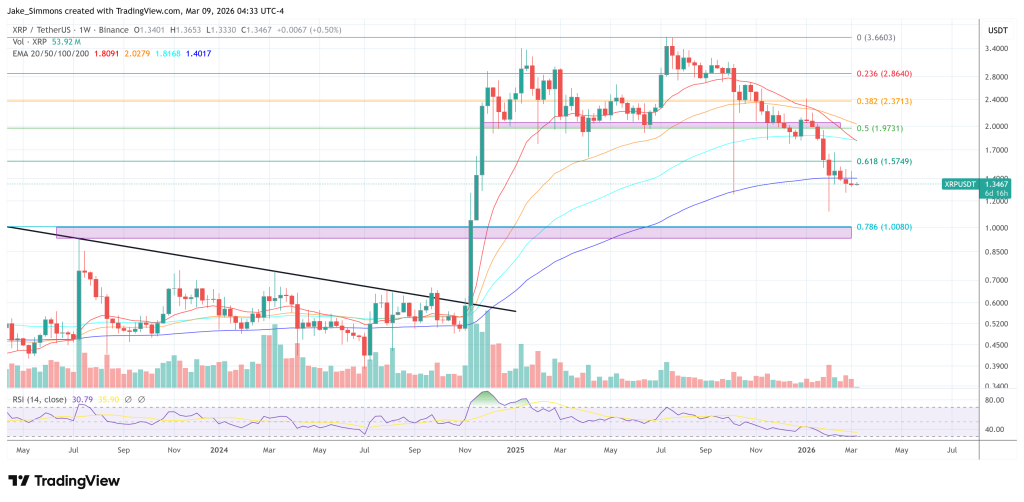
At press time, XRP traded at $1.34.