Ethereum Under Pressure As Researchers Issue Critical Report - What It Means for Your Portfolio

Ethereum faces mounting scrutiny as a new research report throws fuel on the fire of existing market anxieties. The network, long considered the bedrock of decentralized finance, is now navigating what analysts call a 'perfect storm' of technical and competitive challenges.
The Core Criticisms
Researchers aren't pulling punches. The report highlights persistent concerns around network congestion and soaring transaction fees—issues that have plagued Ethereum for years. It argues that while the shift to proof-of-stake was a necessary evolution, it hasn't been the silver bullet for scalability many hoped for. The analysis points to Layer 2 solutions as a band-aid, not a cure, suggesting the fundamental architecture still struggles under real-world demand.
The Competitive Landscape Heats Up
Timing is everything, and this critique lands as rival blockchains aggressively court developers and capital. These alternatives aren't just promising lower fees; they're delivering them today, chipping away at Ethereum's first-mover advantage. The report suggests Ethereum's 'digital oil' narrative is being tested by networks positioning themselves as faster, cheaper, and more efficient refineries.
What This Means for Investors
For the crypto faithful, this isn't a call to abandon ship—it's a reality check. Smart money views Ethereum not as an infallible protocol but as a constantly evolving ecosystem. The pressure from researchers may actually accelerate innovation, forcing core developers to double down on the next round of upgrades. It's a reminder that in crypto, technological debt can be just as dangerous as financial leverage—and sometimes, the most critical reports come from those who want to see a project succeed, not fail.
The bottom line? Ethereum isn't collapsing, but its throne is no longer uncontested. The coming months will test whether it can innovate under pressure or cede ground to hungrier rivals. After all, in decentralized finance, loyalty is often just a function of the lowest gas fee.
Culper Research Outlines Key Risks Facing Ethereum’s Ecosystem
Investment research firm Culper Research has released a critical report, revealing it has taken a short position on Ethereum. The CEO of Coinbureau, Nic, has shared on X that the reporter outlined that structural changes following the ETH Fusaka Upgrade have significantly expanded blockspace, causing transaction fees to collapse by nearly 90%.
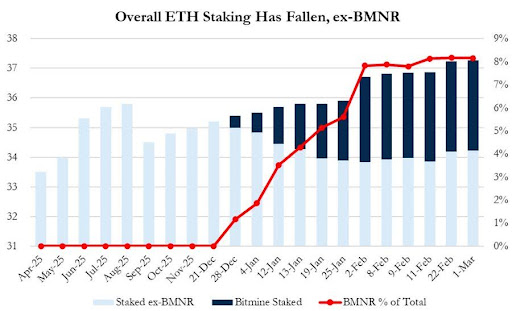
According to the firm, lower fees translate directly into lower validator income, leading to weaker staking economics. Culper further mentions BitMine and argues that the recent rise in transaction activity and active addresses cited as bullish is driven by spam transactions and address-poisoning attacks rather than real adoption.
The firm also reported that Vitalik Buterin sold around 19,000 ETH as if he knew what was going on. While it is a significant amount, representing roughly 8% of Buterin’s total holdings, it may not necessarily indicate an exit or loss of confidence.
At the same time, Nic highlighted that ETH’s design allows for future protocol changes of rules through coordinated upgrades or forks if any economic issues emerge. This won’t be easy politically or technically, but it’s possible. Nic emphasized that he is not taking sides. However, when a firm publishes a detailed thesis and then puts its money behind it, it is worth understanding the mechanics they’re pointing to.
How Gas-Limit Expansion Linked To Falling Transaction Fees
A crypto commentator and the host of the office space, MartyParty, has also offered insights into the matter. Culper Research has opened short positions in Ethereum, arguing that the network entered what is described as a potential “death spiral.” The firm’s thesis is based on on-chain data spanning from January 2025 to February 2026.
A major focus of the report is wallet growth following the Fusaka Upgrade, and Culper alleges that 95% of new wallet creation during the period is linked to dusting or address-poisoning attacks. The firm further claims that dusting-related activity now accounts for roughly 22.5% of all ETH transactions and more than half of the network’s recent transaction growth.
Furthermore, the firm analyzes the economic effects of gas limit increase on the network, contributing to an estimated 90% decline in transaction fees and 40-50% lower tips per gas. Meanwhile, these dynmics could put pressure on validator economics by reducing overall revenue from network activity.
Beyond internal network changes, competition from Solana has captured growing developer and user activity, and reports about Buterin’s ETH dump have drawn backlash from parts of the ETH community.
