Hormuz Standoff Unleashes Bitcoin’s Liquidity Drain - Defying Global Energy Shock in 2026

Bitcoin just flipped the script on conventional crisis economics.
While traditional markets brace for another energy shock—Hormuz tensions threatening global oil flows—digital gold is pulling liquidity out of the system instead of hemorrhaging it. This isn't your grandfather's inflation hedge; it's a full-scale financial bypass operation.
The Liquidity Vacuum Effect
Geopolitical storms usually send capital fleeing toward 'safe' fiat harbors. Not this time. Bitcoin's network is acting like a black hole for speculative capital, sucking liquidity away from traditional energy-correlated assets. The mechanism? A perfect storm of institutional custody solutions maturing, sovereign adoption whispers growing louder, and that relentless, protocol-level scarcity.
Energy Shock? What Energy Shock?
Here's the twist that has macro traders scratching their heads: Bitcoin's value proposition is decoupling from the very energy markets that supposedly underpin its mining cost floor. The narrative that rising oil prices threaten miner profitability? It's being drowned out by a louder signal—Bitcoin as a sovereign-grade liquidity sink. The network consumes energy, yes, but it's now seen as consuming financial risk more efficiently.
The New Safe Haven Playbook
Forget Treasury bonds and the Swiss Franc. The new crisis playbook involves allocating to an asset with no central bank balance sheet, no diplomatic corps, and a monetary policy written in code. It's cold, hard, and politically neutral—the ultimate trait when straits get narrow and alliances get shaky. Wall Street's old guard is left monitoring tanker routes while digital asset desks monitor hash rate and exchange net flows.
A cynical take? Traditional finance spent decades building a system that collapses if a few chokepoints get blocked. Bitcoin built a system where the 'chokepoint' is a 21 million unit limit, and everyone knows exactly where it is. One system fears blockades; the other is the blockade.
So while energy ministers conference-call and generals posture, Bitcoin executes. No press releases, no sanctions—just pure, unadulterated cryptographic sovereignty draining liquidity from a panicked system. The ultimate finance jab? In the race for safety, the asset created by an anonymous coder is outclassing the full faith and credit of nation-states. Again.
Energy Shock Triggers ETF Outflows While On-Chain Data Shows Resilience
The report further explains that the geopolitical escalation surrounding global energy supply has triggered immediate reactions across both traditional and crypto markets. Several macro indicators illustrate the scale of the shock. Bitcoin ETFs recorded a net outflow of approximately $139.2 million on March 5, reflecting a rapid shift toward risk aversion among institutional investors. At the same time, energy markets reacted strongly: Brent crude climbed to $85.41 while WTI reached $81.01, signaling that traders are pricing in potential logistical disruptions.

The ripple effects extend beyond energy markets. US gasoline prices rose by roughly $0.27 per gallon during the week, demonstrating how quickly supply shocks pass through to consumers. Meanwhile, fertilizer prices have also begun to climb, creating a dual cost shock that threatens to pressure global food supply chains.
Despite this macro-driven liquidity drain, Bitcoin’s on-chain structure shows signs of resilience. The report highlights the Bitcoin Exchange Netflow (Total) metric as a key indicator of market liquidity. When adjusted using a 7-day moving average to filter daily noise, exchange flows remain clearly negative even amid global risk-off sentiment.
Recent daily data shows a net balance of approximately -501 BTC leaving exchanges, while weekly cumulative withdrawals reached around -6,469 BTC. This suggests that long-term holders are not seeking immediate liquidity. Instead, coins continue moving into cold storage, reducing available supply and limiting near-term selling pressure as the market navigates the broader macro shock.
Bitcoin Tests Long-Term Support After Market Repricing
The weekly chart shows Bitcoin trading near $69,700 as the market attempts to stabilize following a sharp correction from the late-2025 highs. After reaching levels above $110,000 during the peak of the rally, BTC entered a corrective phase marked by lower highs and increasing volatility. The recent decline pushed price toward the $65,000 region before buyers stepped in, producing the current rebound attempt around the $70,000 level.
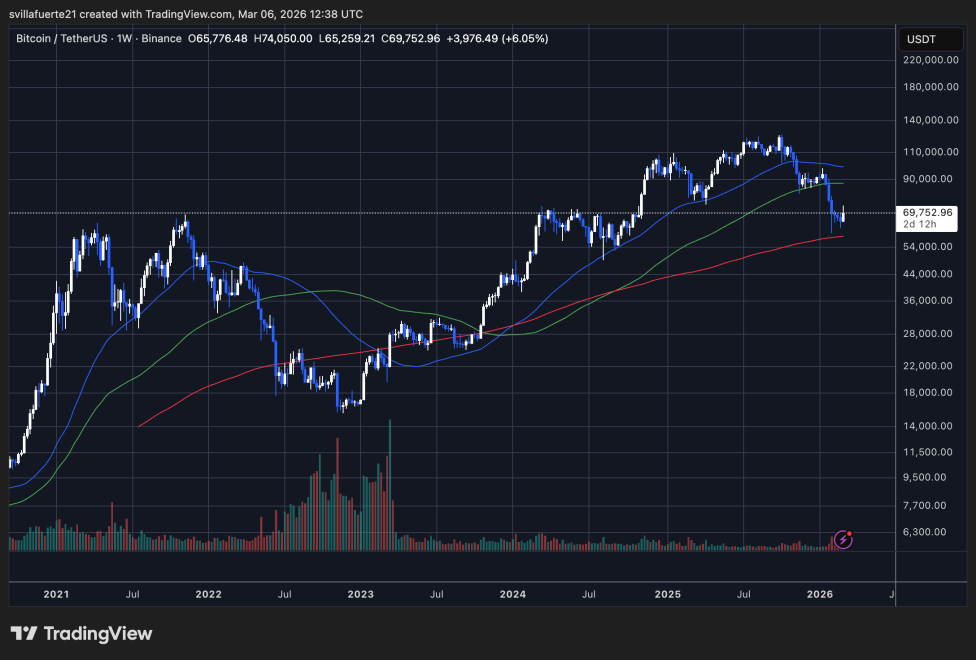
Technically, Bitcoin is now positioned between several key moving averages that define the broader trend. The price is currently trading below the 50-week moving average, which sits near the $90,000 region and is now acting as dynamic resistance. Meanwhile, the 100-week moving average is positioned around the mid-$80,000 zone, reinforcing the overhead pressure that emerged after the breakdown earlier this year.
On the downside, the 200-week moving average continues to trend upward near the $58,000–$60,000 range, forming a major long-term support level for the current cycle. Historically, this moving average has served as a structural floor during major market corrections.
From a macro perspective, Bitcoin remains within a broader multi-year uptrend despite the recent drawdown. The current consolidation around $70,000 suggests the market is attempting to establish a new support base before determining whether the next move will be a deeper correction or a renewed attempt to reclaim higher levels.
Featured image from ChatGPT, chart from TradingView.com
