Billionaire Chamath’s Bold Claim: Why Bitcoin ’Can’t’ Be A Central Bank Asset

Bitcoin just doesn't fit in the central banker's toolbox. That's the hard line from billionaire investor Chamath Palihapitiya, who argues the digital asset's core design clashes with institutional control.
Decentralization vs. The Old Guard
Think about it—central banks thrive on leverage, intervention, and fine-tuning economic dials. Bitcoin's protocol operates on a fixed supply and a consensus mechanism that laughs at unilateral policy changes. It's a system built for transparency and predictability, not backroom adjustments.
The Sovereignty Problem
Adopting Bitcoin as a reserve asset would mean ceding monumental power. Monetary policy? Handcuffed by code. Currency devaluation? Technically impossible. For institutions built on managing—and sometimes manipulating—the money supply, that's an existential threat, not an upgrade.
A Cynical Take on Finance
Let's be real: the traditional system loves its opaque levers and controlled narratives. Bitcoin's public ledger and algorithmic rules expose that game. It's less about technological incapability and more about a fundamental power shift—from centralized gatekeepers to a distributed network. The old guard isn't ready to retire its printing presses just yet.
The bottom line? Bitcoin wasn't built for the boardrooms of central banks. It was built to bypass them entirely.
Reactions From The Bitcoin Community
The reaction on X was swift and openly dismissive. Vijay Boyapati argued: “The truth is gold suffers more privacy constraints for central banks than Bitcoin does or ever will. Many countries literally keep their gold with the New York Fed, which knows *exactly* how much gold they have AND keeps possession of that gold – a huge geopolitical risk.”
Prominent Bitcoin educator Dan Held rejected the fungibility critique outright, calling Bitcoin “perfectly fungible” and saying there is “no pricing differential between coins.” On privacy, he argued the issue can be handled at other layers, writing that users seeking more privacy can rely on “L2s or ETF.”
ProCap CIO Jeff Park’s response went in a different direction. Rather than debating whether central banks need privacy, he challenged the premise that opacity is desirable at all. In his view, the only way to repair a system defined by growing distrust is “to build trust with radical transparency,” a line that turns Palihapitiya’s critique into a case for BTC rather than against it.
“This take-and yes Dalio too-fundamentally fails to understand why central banks are broken and why they need bitcoin. In an age where there is growing distrust everywhere, the only way – and i really mean the ONLY way- to fix the system is to build trust with radical transparency,” he wrote.
Bloomberg senior analyst Eric Balchunas compressed the pro-Bitcoin rebuttal into a simpler market structure answer: “ETF fixes this. Totally private. Next question.”
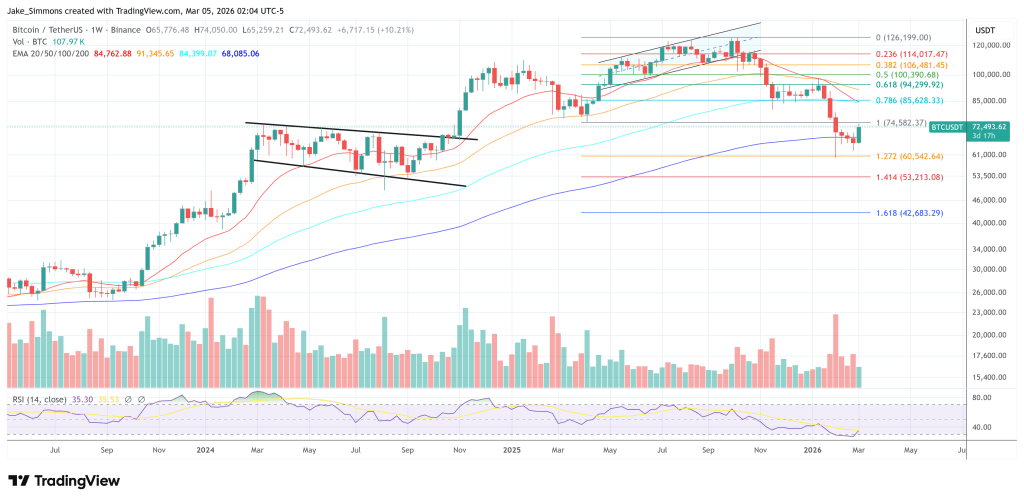
At press time, BTC traded at $72,493.