Ripple Reveals Critical XRP Ledger Bug Fix - Here’s What Happens Next

Ripple just dropped a bombshell—a critical bug in the XRP Ledger's batch amendment process could've rocked the network. Now they're scrambling to patch it.
The Vulnerability Exposed
Think of the ledger's amendment system as its rulebook. This bug? A loophole that let bad actors potentially bypass consensus and push through malicious changes. Not great for a network built on trust.
Ripple's Damage Control Playbook
The response was swift. First, they neutralized the immediate threat. Next, they're rolling out a permanent fix—a new amendment that slams the door shut on this exploit vector. Validators are already lining up to vote it in.
Why This Matters for XRP Holders
Beyond the tech jargon, this is about asset security. A compromised ledger undermines everything—transaction finality, token integrity, the whole shebang. Ripple's fix isn't just maintenance; it's a necessary defense of the network's value proposition.
The Bigger Picture: Trust in Code
Every blockchain faces these moments. The test isn't avoiding bugs—that's impossible—but how you handle them. Transparency and speed are key. Ripple's move here is a case study in crisis management, a nod to the institutional players they're chasing who'd rather see a quick fix than pretend nothing happened.
Let's be real—in crypto, a 'critical bug' headline usually sends traders into a panic. This time? The system's self-healing mechanism kicked in, proving these decentralized networks are more resilient than their critics think. Sometimes the market's fear is just another bug to be patched.
Ripple Responds To The Critical Bug
Akinyele did not try to soften the significance of the lapse. “The Batch amendment progressed further than it should have,” he wrote. “As active participants in the amendment lifecycle, we share responsibility for ensuring that review, signaling, and activation safeguards meet the highest standard. In this case, we must do better.”
At the same time, Ripple is framing the episode as a failure of early-stage review rather than of the XRPL governance model itself. Akinyele said “the amendment process functioned as designed,” noting that activation gating prevented harm to mainnet and the bug bounty disclosure route worked as intended. But he added a sharper warning: “Those safeguards matter, but they should serve as a final line of defense, not the primary one.”
That distinction runs through the rest of Ripple’s response. Rather than suggesting tighter centralized control, Akinyele argued that amendment security on XRPL must remain distributed across Core contributors, validators, the XRPL Foundation and outside researchers. “No single entity controls activation. No single entity owns risk in isolation,” he wrote, describing that structure as both a consequence of decentralization and a strength, provided it is matched by layered defenses and better coordination.
Ripple’s proposed fixes are broad. Akinyele said future releases that introduce features carrying “theoretical risk of disruption” will go through multiple independent audits with reputable security firms in coordination with the XRPL Foundation. The idea is straightforward: different teams catch different classes of issues, and redundancy reduces blind spots when code touches consensus-critical behavior.
The company also plans to expand the bug bounty program and formalize adversarial testing campaigns before activation. Akinyele pointed to initiatives such as the Lending attackathon and a UBRI-sponsored hackathon as models for that approach, arguing that incentivizing white-hat attackers before launch is far cheaper than reacting after the fact. He added that lessons from the Batch incident have already affected other roadmap items, saying Ripple “deliberately held lending back” to allow for more review, testing and scrutiny before moving toward activation.
Part of that next phase will rely more heavily on AI. Akinyele said Ripple is incorporating AI-assisted code review, automated invariant discovery, agentic fuzzing and simulated attack scenarios into its software development lifecycle. “AI does not replace expert C++ engineers, but rather augments them,” he wrote, especially when “subtle logic interactions at critical points can create outsized risk.”
Longer term, Ripple says it wants formal verification to become standard for high-risk ledger components. That includes modeling amendment behavior before activation, proving safety properties for critical components and integrating formal methods from XLS specification through implementation and testing. The broader aim, Akinyele said, is end-to-end assurance that amendment code is not only functionally correct but aligned with defined security and safety properties.
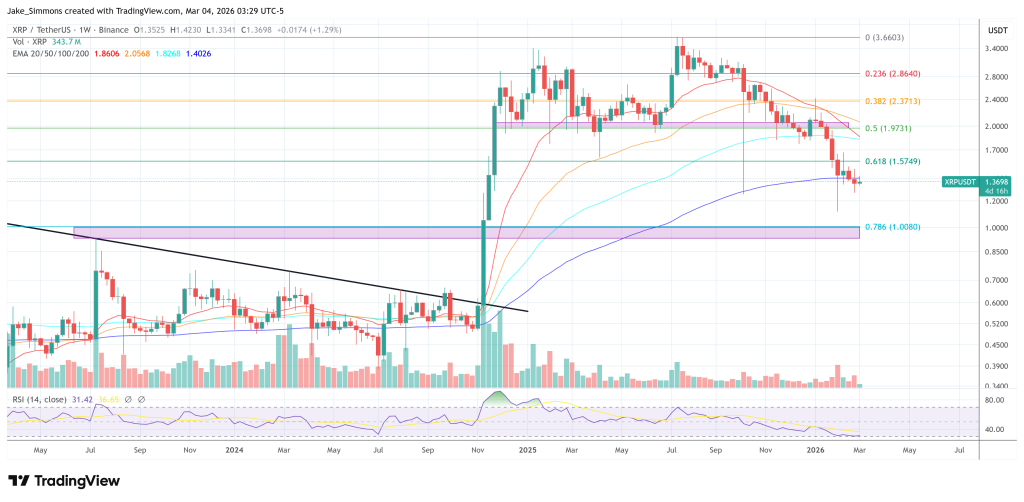
At press time, XRP traded at $1.3698.