Ethereum’s 2026 Déjà Vu: Why a 3.46M ETH Supply Floor Could Spark the Next Liquidity Crunch

Remember 2020? Ethereum's about to replay its greatest hit—and this time, the stakes are higher.
The Ghost of Scarcity Past
Flashback to the last bull cycle. A supply shock sent ETH prices parabolic. Now, analysts spot a chilling parallel: a 3.46 million ETH supply floor forming on-chain. That's not just a number—it's a liquidity black hole waiting to happen.
How a Floor Becomes a Ceiling
When that much ETH gets locked away—staked, held in smart contracts, or tucked into cold wallets by diamond-handed believers—it vanishes from active trading. The available pool shrinks. Buy orders hit a market with fewer sellers. The result? Volatility on steroids. Prices don't just climb; they rocket through thin order books.
It's basic economics with a crypto twist: artificial scarcity meets digital gold rush. Traditional finance types might call it 'irrational'—right before they quietly open a Coinbase account.
The 2026 Liquidity Void
Today's ecosystem is vastly larger than 2020's. More institutional capital, more DeFi protocols sucking up ETH, more staked assets. That same 3.46M ETH supply constraint now operates on a grander scale. The potential liquidity squeeze isn't a minor bottleneck; it's a system-wide pressure cooker.
Market makers can't magic ETH out of thin air. When demand spikes and accessible supply is hard-capped, the only direction left is up—fast. It creates a feedback loop: rising prices encourage more holding, which tightens supply further. A classic reflexive cycle, turbocharged by blockchain's transparent ledger.
The Bull Case in the Void
For traders? This isn't a bug; it's a feature. Supply shocks are the jet fuel of crypto rallies. That looming void isn't a threat to the thesis—it's the thesis. It represents a fundamental shift from an abundant, inflationary asset to a scarce, digital commodity. The network's utility grows while its liquid supply shrinks. That's the dream scenario.
Sure, it makes traditional valuation models useless—but when did Wall Street ever understand the internet? They're still trying to price NFTs with P/E ratios.
Ethereum's history is rhyming. The 2020 playbook is open. The only question left is who's positioned for the squeeze—and who gets left holding an empty bag when the music stops.
Ethereum Exchange Reserves Hit Six-Year Lows as Supply Tightens
The longer-term trajectory of Ethereum reserves on Binance reinforces the structural nature of this shift. From prior cycle peaks above 5 million ETH, exchange balances have trended steadily lower, interrupted only by brief countertrend rebounds that failed to establish higher highs. The pattern of successive lower highs signals persistent net outflows rather than episodic movements. At approximately 3.46 million ETH, reserves now sit at their lowest level in nearly six years, underscoring the magnitude of the contraction.

This evolution aligns with broader behavioral changes across the Ethereum ecosystem. The rise of self-custody solutions and the expansion of staking participation have structurally reduced the float available on centralized venues. Coins removed from exchanges are less likely to be deployed for immediate trading, particularly when allocated to long-term custody or yield-generating mechanisms.
The timing is notable. With ETH trading NEAR $2,027, the market occupies a technically sensitive zone. A continued decline in reserves at this level may indicate growing conviction among holders unwilling to sell into volatility. Should incremental demand emerge while exchange supply continues to tighten, the resulting imbalance could generate upward pressure.
Ethereum Struggles Below $2,000 as Bearish Structure Remains Intact
On the 4-hour timeframe, Ethereum remains structurally weak despite attempts to stabilize near the $1,950–$2,000 zone. Price continues to trade below the 50, 100, and 200-period moving averages, all of which are sloping downward — a clear alignment that confirms short-term bearish control.
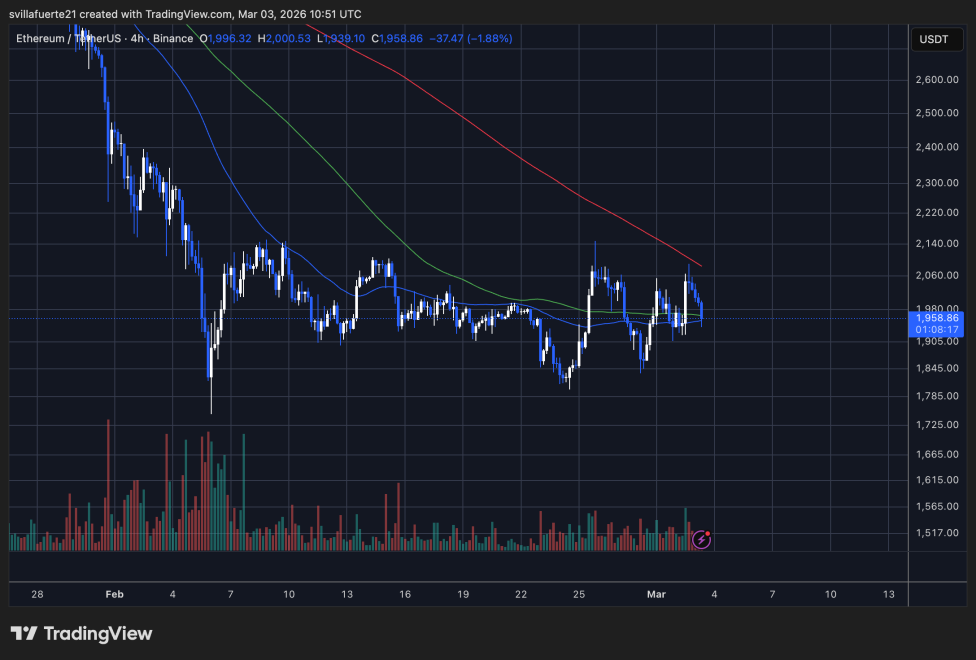
The early-February selloff established a lower high structure, and subsequent rebounds have failed to reclaim the 200-period moving average (red), currently positioned well above price near the $2,100 region. This level now acts as a decisive dynamic resistance ceiling. Meanwhile, the 100-period moving average (green) has repeatedly capped intraday recoveries, reinforcing the broader downtrend.
Support has developed around $1,900, where buyers previously stepped in following a sharp liquidation wick. However, each bounce has produced progressively weaker follow-through, suggesting demand remains reactive rather than proactive.
Volume expanded during the breakdown phases but has since tapered, indicating temporary equilibrium rather than accumulation. The compression between $1,900 and $2,000 reflects indecision under a bearish structure.
For momentum to shift meaningfully, ETH WOULD need a sustained break above $2,050–$2,100 to challenge the descending moving averages. A loss of $1,900, however, would likely reopen downside toward the $1,800 liquidity pocket.
Featured image from ChatGPT, chart from TradingView.com
