Bitcoin’s Seasonal Pattern Shattered: The February 2026 Structural Breakdown Explained

Bitcoin's supposed seasonal playbook got tossed out the window last month. The asset that was meant to ride historical momentum into February instead saw its technical foundations crack under pressure—a stark reminder that past performance is about as reliable as a banker's handshake.
The Anatomy of a Breakdown
For years, traders leaned on seasonal trends like a crutch. Then February 2026 hit. Key support levels that had held for cycles didn't just bend—they snapped. The move wasn't a slow bleed but a decisive structural shift, catching algorithmic models and chart-watching purists completely off guard.
Beyond the Charts: A Market Maturation
This wasn't just a failed technical pattern. It signals a deeper evolution. Institutional flows, shifting macro correlations, and a derivatives market now dwarfing spot volume are rewriting the rules. The old retail-driven seasonal cues are getting drowned out by larger, more complex forces—forces that don't care about calendar-based folklore.
The breakdown is a brutal lesson in market efficiency. As Bitcoin integrates further into global finance, its price action is becoming less about predictable cycles and more about real-time reactions to liquidity, regulation, and macro shocks. The 'season' that mattered most was the one of structural change.
Leverage Unwinds and Weak Spot Demand Undermine February’s Rebound
The mid-February drawdown was not simply a directional selloff; it was a leverage event. As the price weakened, liquidation cascades accelerated the decline, forcing long positions out of the market. Open Interest contracted sharply, confirming that the MOVE was driven by derivatives unwinds rather than steady spot distribution. In a thin liquidity regime, these leverage resets tend to exaggerate volatility. When order books are shallow, relatively modest flows can push prices disproportionately, amplifying downside extensions.

Although Fear & Greed dropped into Extreme Fear, sentiment exhaustion alone proved insufficient to engineer a durable reversal. Capitulation without follow-through demand often produces reflex bounces, not structural bottoms.
The more structural constraint was the absence of consistent spot participation. ETF flows recorded intermittent daily inflows, but they lacked sustained weekly momentum. At the same time, stablecoin supply growth remained muted, indicating limited sidelined capital ready to deploy. Consequently, rebounds were largely short-covering rallies, driven by position unwinds rather than fresh accumulation.
Macro context reinforced this fragility. Equity weakness and dollar strength framed Bitcoin as a high-beta liquidity proxy, not a defensive asset. In February, structural supply-demand imbalances overpowered historical seasonality. A durable shift now depends on persistent spot inflows and disciplined Open Interest rebuilding.
Bitcoin Tests Weekly Support as $69K Turns Into Overhead Resistance
On the weekly timeframe, price is attempting to stabilize near the $66,000 region after a sharp rejection from the $90,000–$100,000 supply zone. The structure shows a clear shift from expansion to distribution: following the late-2025 peak, Bitcoin printed a sequence of lower highs and ultimately lost the 50-week moving average (blue), which had previously acted as dynamic support throughout the uptrend.
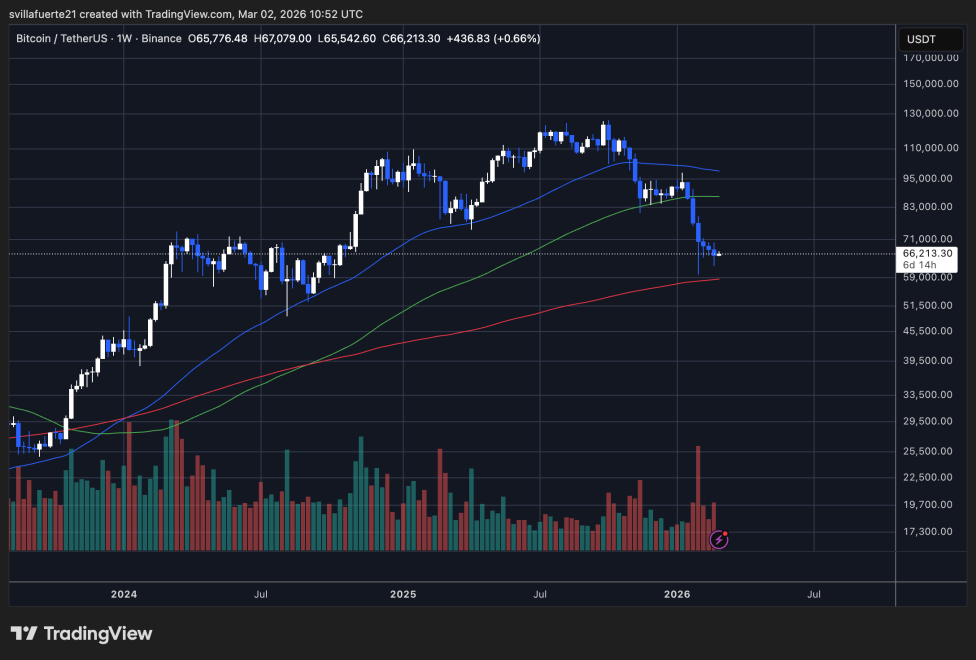
The breakdown accelerated once price slipped below the 100-week moving average (green), triggering a fast move toward the mid-$60K area. Notably, the 200-week moving average (red), currently rising near the high-$50K region, remains intact. This level historically defines macro bull-market structure. As long as the price holds above it, the broader cycle cannot be considered structurally broken.
Volume expanded meaningfully during the selloff, particularly on large red weekly candles, suggesting forced unwinds rather than gradual distribution. However, the most recent candles show compression and reduced downside momentum, indicating short-term equilibrium between buyers and sellers.
Technically, $69K now acts as immediate resistance, aligning with prior support turned overhead supply. A weekly close reclaiming that zone WOULD open room toward the 50-week average. Failure to hold $62K, however, would increase the probability of a deeper test of the 200-week baseline.
Featured image from ChatGPT, chart from TradingView.com
