Bitcoin Buying Just Ramped Up Into The Billions Again—Is It Time To Get Back In?

Institutional money floods back into Bitcoin—billions pour in as the market shakes off its hangover.
The On-Chain Signal You Can't Ignore
Forget the noise. When wallets holding over 1,000 BTC start accumulating again, it's not retail FOMO. It's capital with conviction moving in size. The recent surge in large transactions—we're talking billions, not millions—points to a fundamental shift in sentiment. The smart money isn't waiting for a CNBC segment; it's building positions now.
Timing the Tide, Not the Waves
Attempting to buy the exact bottom is a fool's errand, usually reserved for day traders and over-leveraged gamblers. The strategic move? Recognizing the tide change. This volume of institutional buying creates a new floor. It doesn't guarantee a smooth ride up, but it dramatically alters the risk-reward calculus for the next cycle. The market has memory, and these levels are getting etched in.
Liquidity Returns, Volatility Stays
Welcome back to the jungle. With liquidity returning, the wild price swings that define crypto aren't going anywhere. This isn't the S&P 500. This is a global, 24/7 asset class that still trades partly on meme magic and Twitter sentiment. The influx of billions brings stability to the base layer, but expect the same heart-stopping volatility on the way up—just with bigger players on the ride.
The Final Word: A Cynic's Take
So, is it time to get back in? The whales are voting with their wallets. Again. It's the same cycle of manic accumulation, euphoric distribution, and amnesiac re-entry that makes traditional finance look boring—and occasionally, sane. The game hasn't changed; the stakes have just gotten higher. Your move.
Bitcoin Accumulation Rise Amidst Price Downturn
The bitcoin price has been grinding lower in recent trading sessions, slipping below $64,000. The world’s largest cryptocurrency has failed to hold multiple support levels, with each leg down further suppressing any meaningful upside momentum.
Related Reading: Expert Trader Who Correctly Predicted Bitcoin Top Just Shared A Chart Pointing Below $4,000
Yet beneath the surface of this declining price and market sell-offs, certain holders are quietly accumulating BTC. On-chain data from Glassnode reveals that over the past three weeks, so-called ‘old supply,’ which refers to wallets holding BTC that have sat dormant for at least six months, has risen by a whopping 188,000 BTC. This substantial amount of coins is valued at more than $12.75 billion.
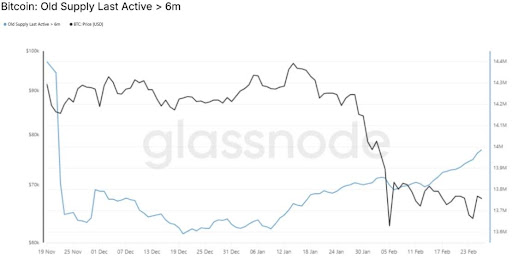
Notably, the recent rise in BTC accumulation among old supply indicates that many seasoned investors are choosing to sit and hold their coins rather than sell into weakness, as many retail participants have been doing. The renewed accumulation also comes as whales continue to execute large-scale BTC withdrawals, with Whale Alert recently reporting a recent outflow of more than $266 million from exchanges.
Adding more fuel to the ongoing accumulation trend, Spot Bitcoin ETFs have recorded significant inflows. Data from SoSoValue shows that Bitcoin ETFs had attracted a combined inflow of $1.02 billion between February 24 and 26. This rise in demand further indicates that investors are now entering the market, likely positioning for a potential rebound.
BTC Sell-Offs Show Signs Of Exhaustion
Prominent Bitcoin analyst Willy WOO has shared relatively good news, issuing a sobering outlook for BTC’s price. In a recent X post, Woo suggested that the market may be entering an extended period of weakness before any meaningful recovery takes shape. The bearish outlook comes as the analyst acknowledges that the recent wave of selling pressure from investors appears to have exhausted, potentially giving Bitcoin more room to consolidate sideways for about a month.
With the bearish sell-down easing, Woo predicts Bitcoin could initiate a brief rebound back to the mid-$70,000 range. However, he cautioned that such a recovery WOULD likely be rejected. The analyst pointed to deteriorating liquidity across both spot and futures markets as a key reason for this rejection. He stated that he had never seen Bitcoin rally when both sources of liquidity were trending bearishly at the same time.
Looking further ahead, Woo projected that Bitcoin’s current bearish trend could persist well into the year, with a potential turning point expected to arrive sometime in Q4 2026. Subsequently, he suggested that BTC’s bullish momentum may also return in either Q1 or Q2 of 2027.
On the question of how far current prices could fall, Woo estimated that a plunge to $45,000 could mark a bear market bottom for BTC. He also stated that if global macro breaks down, $30,000 could be the fallback support level, with $16,000 highlighted as the final line of defense to maintain Bitcoin’s bull trend.
