Ethereum Network Secures Its Throne As The Undisputed Home Of On-Chain AI Agents

Move over, centralized servers—Ethereum just cemented its status as the go-to playground for autonomous AI.
The Network That Eats Complexity For Breakfast
Forget clunky, isolated bots. The latest wave of on-chain AI agents isn't just running on Ethereum; they're weaving themselves into its very fabric. These aren't simple scripts—they're sophisticated entities that execute contracts, manage assets, and make decisions without a human hitting 'go.' They leverage the network's robust security and sprawling DeFi ecosystem as their operational backbone. It's a symbiotic relationship: the AI gets a trustless, global playground, and Ethereum gets a massive new source of transactional complexity and fee revenue. Wall Street quant funds are taking notes—and probably wondering why their AI still needs permission to trade.
Why Decentralized Intelligence Sticks
Centralized platforms offer power, but they also come with a single point of failure and control. Ethereum provides something more valuable for true autonomy: unstoppable execution. An AI agent deployed here can't be switched off by a corporate policy change or a server outage. Its logic is law, enforced by the blockchain. This permanence is attracting developers who are building everything from automated market makers that adapt in real-time to DAO delegates that vote based on live data analysis. The network effect is undeniable; as more agents deploy, the ecosystem becomes more valuable, attracting even more builders. It's a classic flywheel, powered by gas fees.
The New Frontier: Smarter Than Your Average Smart Contract
This isn't just an upgrade; it's a paradigm shift. Traditional smart contracts follow 'if-this-then-that' rules. AI agents introduce 'if-this-then-what?'—they analyze, predict, and act. Imagine a lending protocol that dynamically adjusts rates based on an AI's forecast of market volatility, or an NFT project where the characters evolve based on interactions governed by an on-chain neural network. The potential use cases explode when code gains the ability to learn and reason within a secure environment. Of course, this also means the 'rug pull' of the future might be orchestrated by a machine learning model with a cynical understanding of human greed.
Ethereum's dense liquidity, mature tooling, and established developer mindshare have created a gravitational pull too strong for this nascent industry to resist. While other chains scramble to offer incentives, Ethereum simply offers the stage. The crown isn't just worn; it's being used to computationally validate its own right to rule. The age of passive contracts is over. The agents are now in charge, and they've chosen their home.
AI Innovation Accelerates On The Ethereum Network
As the blockchain landscape expands, the ethereum network is taking the spotlight in terms of Artificial Intelligence (AI) innovation. A recent report indicates that the blockchain is emerging as the primary hub for on-chain AI agents, suggesting an expansion beyond its roots in DeFi.
Compared to other chains, ETH is gradually becoming the home for these projects, surpassing them by a long shot. More autonomous, revenue-generating AI systems are being constantly hosted and supported by the blockchain.
As seen on the chart shared by Leon Waidmann, a data analyst and the head of research at Lisk, the number of AI agents on Ethereum has reached 27,315. Other major chains, such as Base, Monad, MegaETH, and BNB Smart Chain, have recorded 19,499, 8,348, 8,150, and 6,689 in AI agents, respectively. With this figure, the ETH network now handles 40% more AI agents than the chain in second spot.
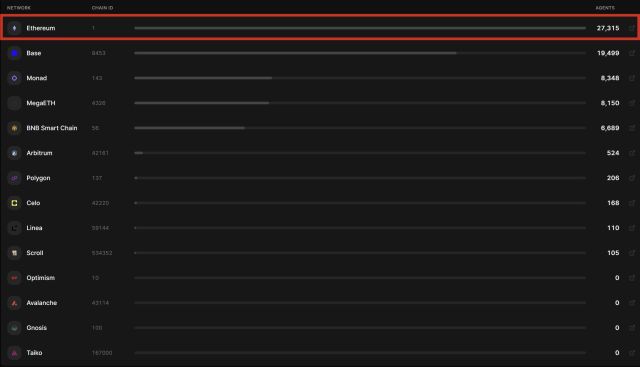
However, this may be larger than it looks. Base, along with Arbitrum, Scroll, Linea, and MegaETH, is an Ethereum LAYER 2, which means the ETH ecosystem accounts for the vast majority of all on-chain AI agents when put together.
During this period, discussions regarding a haven for the AI agents. Providing an answer that aligns with that of the market, Waidmann stated that these agents live where the liquidity is, where the smart contracts are battle-tested. In addition, this is where the infrastructure is deepest and where the network effects are at their strongest.
Bitmine In The Center Of The AI Agents’ Growth
BMNR Bullz has revealed on X that Bitmine Immersion is positioned for Ethereum’s next phase and AI agents. With the internet shifting from moving information to moving value, the company is emerging as a pioneer of the transition. Previously considered as separate trends, blockchain, stablecoins, and AI are now converging into a programmable economic system where transactions, settlement, and capital allocation occur natively online.
The world is seeing a change with tens, potentially hundreds, of billions of AI agents set to interact and perform economic functions over the internet. These agents will need to work with programmable money, open settlement, and neutral infrastructure, not legacy rails, and this is where Ethereum comes in.
This is structurally bullish for ETH, and Bitmine was built around that reality. Bitmine boasts roughly 4.4 million ETH, marking about 3.7% of the total supply. There is zero debt and no forced selling through cycles from the company; therefore, reserving liquidity to accumulate during drawdowns. Furthermore, the firm has locked away 3 million ETH in staking, earning native yield.
Beyond holding and staking, Bitmine is building a staking and validation network, MAVAN, created to bolster its assets and expand to stake other companies’ crypto over time. This network will position the company at the forefront of ETH’s next phase and AI agent, and as part of the infrastructure layer supporting external capital.
