Bitcoin’s Historic Extremes: Supply In Loss Spikes, Leaving Holders Underwater

Bitcoin's supply in loss just hit historic extremes. That's not a headline you see every day—or every cycle.
The Pain Gauge Spikes
Forget the usual market chatter. This metric cuts through the noise. When the supply in loss spikes, it means a huge chunk of Bitcoin is currently held at a price higher than its current market value. People are sitting on paper losses. And right now, that chunk is massive, reaching levels that make even seasoned traders raise an eyebrow.
What 'Historic Extremes' Actually Means
It signals a market under intense stress. Think of it as a collective portfolio flashing red. This isn't about a few late buyers; it's a broad-based condition where a significant percentage of the total Bitcoin supply is underwater. Historically, such extremes have marked moments of maximum pessimism—or maximum opportunity, depending on your nerve and your timeline. It's the financial equivalent of everyone staring at the same storm cloud, wondering if it'll break.
The Bullish Case in the Bearish Data
Paradoxically, this is where the contrarian playbook gets dusted off. Extreme fear often sets the stage for the next move. Markets don't bottom on good news; they bottom when the last weak hand gives up. A spike in supply-in-loss has, in the past, preceded major trend reversals. It's a brutal cleansing mechanism—shaking out leverage and short-term speculation to build a stronger foundation. Of course, that's cold comfort if you're checking your balance today.
Navigating the Depths
So what's an investor to do? Panic sells at the bottom. Greed buys at the top. The tricky part is figuring out which is which while you're in the middle of it. This metric suggests we're in a zone where emotional decisions are most costly. It's a reminder that crypto investing isn't a straight line—it's a volatility-fueled rollercoaster that occasionally dips into the abyss before climbing again. Just ask anyone who bought the last time this happened.
Ultimately, historic extremes are just that: extreme. They don't last. Markets cycle, sentiment flips, and what looks like capitulation today becomes a forgotten chart footnote tomorrow. The real question isn't about the current price—it's about who's left holding when the tide finally turns. After all, in finance, they call it 'smart money' for a reason; it's usually the money that didn't panic-sell during a statistically predictable downturn.
Record Levels of Bitcoin Now Sitting At A Loss
The pressure on the market and investors has increased following the recent pullback in Bitcoin’s price. Given the price pullback, the BTC supply that is positioned at a loss has spiked sharply, indicating a bearish outlook for the market and the flagship asset.
A recent data reading is showing that bitcoin is coming into a critical stress point, with the percentage of supply held at a loss rising to one of the highest levels ever seen. This dramatic increase, which reflects the severity of the recent price downturn, indicates that an increasing proportion of owners are now underwater.
As seen in the chart shared by James Van Straten, an advisor and senior analyst at the popular CoinDesk news outlet, the number of BTC supply now caught in the loss side just ROSE to 10 million BTC. It is worth noting that this figure marks the fourth-highest reading ever since its existence.
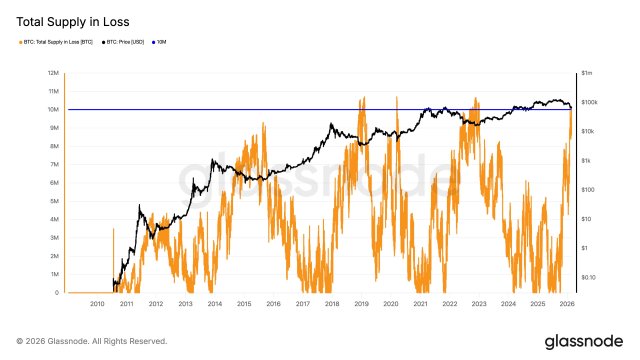
According to the reading, an additional 70,000 BTC from those purchased between February 6 and 24 are in loss. As a result of this, the circulating supply is believed to hit 20 million BTC next week, which represents a 50% in loss. Given the massive supply loss, the potential of a market bottom already taking place is high. This is because history suggests that it WOULD be sufficient capital destruction for a bear market bottom.
BTC’s Investors’ Action In The Current Market State
Darkfost highlighted that it is crucial to continue examining the actions of the various investor cohorts in the market as long as the BTC situation does not improve. BTC Long-Term Holders are the primary investors in the framework, known to be less sensitive to short-term price fluctuations.
The average profit of the long-term holders is currently positioned at 74%, but this is steadily dropping as prices move closer to the LTH cost basis estimated at around $38,900. However, this cost base is static and continues to increase over time as STHs that purchased Bitcoin at higher prices move into the LTH category.
Historic data reveal that a final capitulation phase defined by realized losses of about 20% has been triggered by price breaching below this cost basis in every bear market. Meanwhile, the market tends to rebuild the necessary foundations for a trend reversal after this phase has concluded.
Darfost noted that this should be viewed as an observation based on a small number of instances rather than a rule. However, it remains a scenario worth considering and preparing for. Given how this cycle has evolved, with the arrival of institutions, corporate entities, and even sovereign actors, the possibility of these structural changes being sufficient to shift the outcome becomes high.
Darkfost has warned against following those claiming uncertainty on this matter. “Nothing is predictable, and the market ultimately dictates the outcome,” the expert added.
