MoneyGram Goes Crypto: Joins Cardano’s Midnight as Federated Mainnet Validator in Major Banking Shift

Traditional finance just took a long, hard look in the mirror—and saw a blockchain staring back. MoneyGram, the global payments giant, is officially stepping into the validator ring for Cardano's privacy-focused blockchain, Midnight. This isn't a toe-dip; it's a full-scale plunge into the mechanics of decentralized trust.
The Validator's Seat at the Table
Forget passive investment. By becoming a federated mainnet validator, MoneyGram isn't just holding a token—it's running the software that secures the network. Think of it as moving from a bank customer to sitting on the Federal Reserve's board. The firm will now participate in consensus, helping to validate transactions and produce blocks on Midnight's mainnet. It’s a hands-on technical commitment that signals a deeper operational shift than a simple partnership announcement.
Why Midnight? Privacy Meets Compliance
Midnight isn't your typical 'everything is public' chain. It's built for data-protective smart contracts and confidential transactions. For a regulated entity like MoneyGram, that’s the golden ticket: exploring blockchain efficiency without broadcasting every client detail to the world. It allows them to test core banking functions—settlement, compliance checks, cross-border flows—in a shielded environment. A smart hedge, really, against both legacy system obsolescence and the regulatory glare of fully transparent ledgers.
The Bigger Picture: Banks Are Building, Not Just Buying
This move cuts through the usual corporate 'we're exploring blockchain' fluff. Validation is infrastructure work. It suggests MoneyGram is betting that future payment rails will be a hybrid of traditional and decentralized finance (DeFi). They're not waiting to see who wins; they're helping to build the track. Other remittance and banking giants are now on notice: the competitive edge may soon depend on your node count, not just your branch count.
A Cynical Finance Jab
Let's be real—it's also a brilliant way to get a front-row seat to the technology that might eventually render their old fee-based corridors obsolete. Better to own a piece of the wrecking ball than wait for it to hit your headquarters. After all, in finance, the best way to survive a revolution is to issue the new currency yourself.
The takeaway? The line between tradfi and crypto is blurring into irrelevance. When a pillar of the old system starts helping to mint the blocks for the new one, the narrative flips. It's no longer about 'if' major finance adopts blockchain, but how fast they can pivot to control it. Watch for other household names to follow—not with press releases, but with validator keys.
Why MoneyGram Matters For Cardano’s Midnight
Midnight describes MoneyGram as a cross-border digital P2P payments leader operating in more than 200 countries and territories. Beyond simply running a node, the Foundation said the two organizations are also exploring how established payment networks could MOVE onto blockchain rails while preserving regulatory trust. The specific focus is on confidential transactions where settlement can function as verifiable proof of compliance without exposing sensitive user data.
Luke Tuttle, MoneyGram’s chief product and technology officer, framed the move as a continuation of the company’s existing crypto strategy rather than a new experiment. “MoneyGram has been delivering real-world crypto solutions for years, focusing on making the benefits of digital finance accessible to the people who actually need them,” Tuttle said. “Working with Midnight and running blockchain nodes fits naturally into this strategy, allowing us to help ensure that privacy, compliance and reliability are built in from day one.”
The Foundation’s announcement repeatedly ties the federated model to launch reliability. Its argument is straightforward: operators that already manage high-volume, mission-critical systems in payments, telecom and regulated fintech are better suited to support early mainnet performance while developers begin deploying privacy-preserving applications. Midnight also says this phase is part of a longer path toward community-driven decentralization, not the endpoint.
That framing comes through clearly in comments from both eToro and the Foundation. eToro Chief Blockchain Officer Omri Ross said, “We were excited to learn about Midnight’s novel approach to programmable data protection and selective disclosure, designed to balance user confidentiality with regulatory compliance. We believe technologies enabling granular control over data visibility will be foundational to the next generation of blockchain infrastructure. Midnight’s architecture for confidential smart contracts with built-in verifiability aligns with our long-term view that, over time, all asset classes will increasingly move on-chain.”
Midnight Foundation President Fahmi Syed made the same point in more strategic terms, arguing the mix of operators itself is the signal. “When a global payments network, a leading technology company backed by a Fortune 500 telco, and a publicly traded fintech all choose to operate nodes on the same privacy-enhancing blockchain, that tells you where this industry is heading,” Syed said, adding that the consortium is only the beginning.
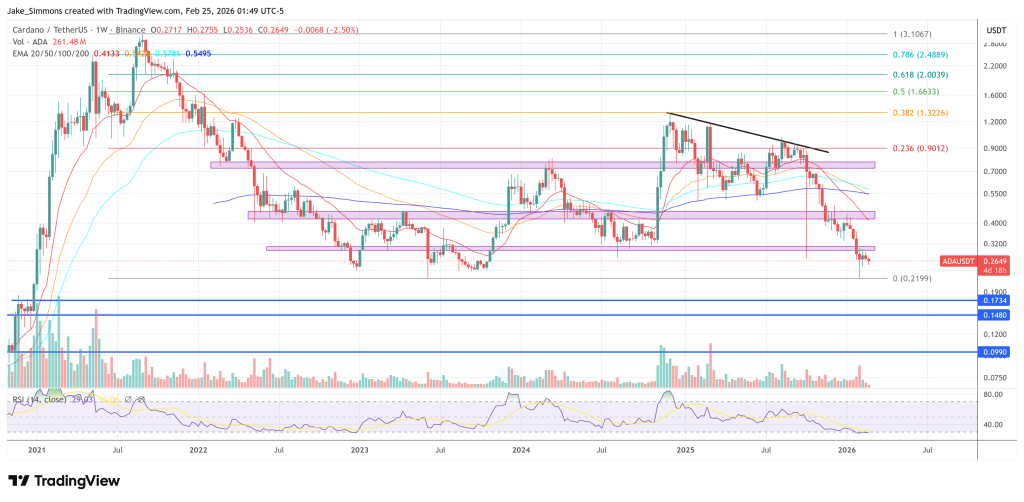
At press time, cardano traded at $0.2649.