Bitcoin’s Network Distribution Factor Plunge Signals Major Redistribution Event - What It Means for 2026

Bitcoin's network distribution just flashed a signal that's shaking institutional desks from Wall Street to Hong Kong. The metric that tracks how concentrated Bitcoin holdings are among large holders—the Network Distribution Factor—has plunged. Not a dip. A collapse.
The Whales Are Moving
When this factor nosedives, it doesn't mean coins are vanishing. It means they're changing hands. Big time. We're talking about a redistribution event where major holders, the so-called 'whales,' are either taking massive profits or strategically repositioning their stacks. The data screams one thing: capital is being reallocated across the Bitcoin network at a pace that suggests a fundamental shift in ownership structure.
Decoding the Market Mechanics
Forget the noise on social media. This is on-chain, immutable evidence. A plummeting distribution factor often precedes or coincides with periods of high volatility. It indicates that large, historically dormant wallets are becoming active. They're sending Bitcoin to exchanges, to new wallets, or to a growing cohort of smaller buyers. It's the digital equivalent of watching billion-dollar blocks of stock get crossed on a dark pool tape—only everyone can see it.
The 2026 Implications: Accumulation or Distribution?
The trillion-dollar question for 2026: Is this smart money selling into retail euphoria, or are new institutional titans building foundational positions? History offers conflicting playbooks. Sometimes this signals a local top as early investors cash out. Other times, it marks the transfer from weak hands to strong, setting the stage for the next leg up. Given the regulatory clarity finally emerging in key jurisdictions, the smart bet leans toward the latter—a messy, necessary consolidation of ownership before the next cycle.
The cynical take? Watch the traditional finance pundits who spent years calling Bitcoin a 'fraud' suddenly become experts on network distribution metrics—just in time to recommend the ETF they're getting paid to promote. The network, however, remains blissfully indifferent to the narrative. It just records the truth: ownership is changing. Power is shifting. Again.
What The Network Distribution Factor Actually Measures
An advanced on-chain data analytics firm, Alphractal, noted on X that the NDF of bitcoin is declining sharply, and revealing an important structural shift in how the asset supply is distributed across the market. The NDF measures the proportion of the total BTC supply held by larger holders controlling at least 0.01% of the entire circulating supply.
When the metric declines, it indicates that the BTC supply concentration among large holders is decreasing. In practical terms, this shift represents a reduced relative dominance of large holders over the total supply and broader redistribution of BTC among smaller participants and new market entrants.
A declining extreme concentration is often seen during early accumulation phases, and a natural redistribution process follows the periods of strong accumulation by large entities. Historically, extended declines in the NDF tend to occur during phases when the market is mature, and the asset becomes more widely distributed.
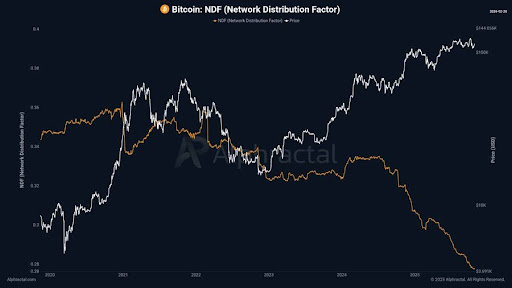
This often occurs after major bull cycles, when large players accumulate supply and are gradually absorbed by the broader market. Rather than signaling weakness, this dynamic can strengthen BTC economic decentralization and reduce structural risk tied to excessive concentration.
At the same time, it reflects a transition phase where supply is being redistributed globally, reinforcing BTC’s evolution from a relatively concentrated asset into a widely distributed global financial network. However, this does not signal structural weakness, but rather signals maturation and the expansion of BTC’s ownership base.
Why Bitcoin Represents A True Financial Revolution
The clearest reasons Bitcoin remains the most compelling asset of our generation are its ownership structure and fixed supply. According to Crypto Patel, roughly 63% of the total circulating supply is held by everyday individual participants, not Wall Street, not the government, or even the institutions.
At the Core of this thesis, there are only 21 million BTC in existence, and the number is fixed permanently; no central bank can inflate it, no politician can alter the code, and no corporation can dilute holders.
In a world characterized by aggressive money printing and currency debasement, BTC stands alone as mathematically enforced scarcity, and the majority of that asset belongs to ordinary individuals. Crypto Patel frames BTC’s decentralized ownership and fixed supply not just as a technology, but as a structural revolution.
