Bitcoin Whale Exchange Ratio Skyrockets to 11-Year Peak — What the Big Money Knows That You Don’t

Whales are making moves unseen in over a decade.
The Signal in the Surge
When the Bitcoin whale exchange ratio hits its highest level in 11 years, it's not just a statistic—it's a tremor through the market's foundations. This metric tracks the proportion of large-holder Bitcoin moving to exchanges. A spike typically signals one of two things: preparation for a major sell-off or strategic repositioning for the next leg up. Given the timing, the smart money leans toward the latter.
Decoding the Depth
Forget the noise from talking heads on financial networks—real capital votes with its wallet. This 11-year high isn't about retail FOMO; it's about institutional and whale-scale calculus. These players aren't day-trading based on Elon Musk's latest tweet. Their moves are glacial, deliberate, and often prescient. When they collectively decide to increase exchange presence, liquidity is being primed. It's the calm, orchestrated movement before a symphony, not a panicked stampede.
The Liquidity Pre-Game
Moving such vast sums onto trading venues isn't done lightly. It incurs fees and creates visibility. So why do it? It sets the stage. It means whales are preparing for significant transactions—whether that's taking profits at a perceived peak, collateralizing assets for leveraged plays in DeFi, or swapping into altcoins. This massing of forces on exchange borders is a hallmark of a market gearing up for volatility and major price discovery. They're not fleeing; they're suiting up.
A Cynical Note on Traditional Finance
Meanwhile, in the legacy system, fund managers are likely still debating their first 'tactical' 1% portfolio allocation to crypto—a stunning display of risk management that consistently manages to be both too late and too timid. The future isn't built by committee.
The whale ratio is a leading indicator, not a lagging one. When the titans of crypto shift their weight, the entire ocean feels the wave. Ignore it at your peril.
BTC’s Future In The Hands Of Large Investors: CryptoQuant
In the last bull cycle, the price action of Bitcoin was heavily influenced and impacted by the increased influx and activity of institutional investors (primarily through the spot exchange-traded funds). Similarly, it appears that the large investor cohort will still be at the wheel even during the bear market.
According to CryptoQuant’s latest market report, the bitcoin exchange inflows — and the immediate selling pressure — have normalized since the capitulation spike in early February. This trend can be seen in the decline in exchange inflows from around 60,000 BTC at the start of the month to around 23,000 BTC now.
While the acute sell-off phase appears to be easing off, a troubling trend seems to be brewing among Bitcoin’s largest investors. In its market report, CryptoQuant highlighted that the BTC exchange whale ratio has climbed to 0.64, its highest level since 2015, suggesting that whale inflows account for a significant portion of the exchange deposits being seen.

Meanwhile, the average BTC deposit size has also reached a level not seen since mid-2022, during the heat of the last bear market. This trend further reinforces the idea that institutional or large investors are behind the increasing exchange supply.
CryptoQuant noted that the altcoin market is still facing elevated distribution pressure, with the average daily number of altcoin exchange deposits rising from 40,000 in Q4 2025 to 49,000 in 2026. This continuous capital rotation out of riskier assets reflects weakened market confidence and increases the risk of downside volatility.
![[20 February 2026] Exchange Flow Redistribution: Whale Deposit Activity Grows Amid Declining Stablecoin Inflows](https://i0.wp.com/bucket.cryptoquant.com/research/vhKU3eAo_f9d6c7c031686bfd623832b4a9af0d3e55ed890a23e747cab76d866905521427.png?ssl=1)
Meanwhile, the ongoing flow of stablecoins out of exchanges points to a decline in marginal buying power (or “dry powder”) in the Bitcoin market. According to CryptoQuant data, net USDT flows into exchanges have fallen sharply from a one-year high of $616M in November 2025 to only $27M, turning negative at times (-$469M in late January).
Ultimately, the combination of the increased selling pressure from Bitcoin’s large holders, rising altcoin distribution, and consistent stablecoin outflows suggests that the crypto market structure remains at risk of further downside volatility.Bitcoin Price At A Glance
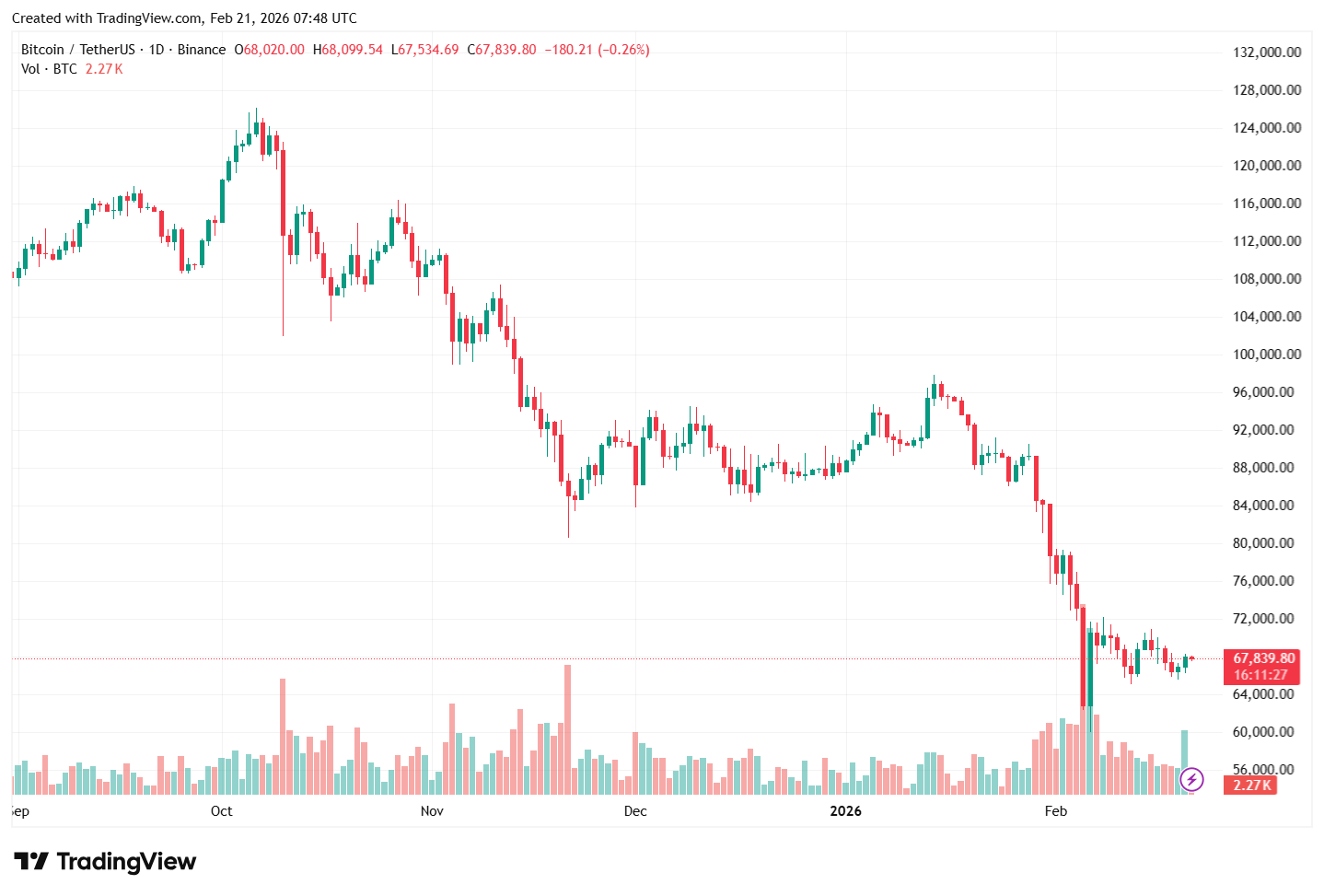
As of this writing, the price of Bitcoin stands at around $67,580, reflecting a mild 1% increase in the past 24 hours.