Every Ethereum Whale Cohort Now Underwater: Is This Capitulation Marking The Final Bottom?

Ethereum's biggest holders are all in the red. Every single whale cohort—from the mega-accumulators to the long-term diamond hands—now sits below their average buy-in price. That's not just a dip; it's a full-blown underwater ecosystem.
What Whale Capitulation Really Means
When even the most patient capital starts waving the white flag, markets listen. Whale selling often isn't a panic move—it's a calculated, painful exit. They're not reacting to daily charts; they're reassessing multi-year theses. This kind of distributed, cross-cohort selling pressure creates a unique market floor. It's the point where weak hands have already folded, and the strong ones are being tested.
The Mechanics of a Final Bottom
Market bottoms aren't born from optimism. They're forged in the fires of maximum pain, where the last bullish narrative finally cracks. Capitulation is the final flush—the moment when selling exhausts itself because there's simply no one left to sell. It's a vacuum. And into that vacuum, the next cycle quietly begins. History doesn't repeat in crypto, but it often rhymes with a heavy, algorithmic beat.
Looking Beyond the Blood in the Water
For the cynical observer, this is just another chapter in finance's oldest story: wealth transfer disguised as volatility. Smart money doesn't buy the dip—it buys the despair. While retail traders stare at portfolio percentages, the infrastructure being built during these periods often defines the next bull run. The real action isn't on the price chart; it's in the developer commits and the governance proposals that nobody's reading.
So, is this the final bottom? Maybe. But in crypto, the only certainty is that someone, somewhere, is writing a 'buy the fear' tweet with misplaced confidence. The whales moving now aren't betting on next week; they're positioning for the next epoch. Whether that's genius or folly will be a story written in blocks, not headlines.

This development is notable because ethereum has not yet revisited its April lows, suggesting the depth of unrealized losses is expanding earlier than in some previous corrective phases. Such conditions can increase market sensitivity, as even traditionally resilient holders may reassess positioning amid prolonged volatility.
Whale Stress Raises Capitulation Risk While Bottom Formation Signals Emerge
Darkfost further notes that if Ethereum extends its decline, large holders could face increasing financial pressure. Sustained downside would deepen unrealized losses across whale cohorts, potentially forcing some participants to reduce exposure or liquidate portions of their holdings. Historically, such capitulation events among large investors tend to amplify short-term volatility, particularly when liquidity conditions are already fragile.
However, despite the negative profit ratios now visible across whale groups, Ethereum has so far managed to stabilize above recent local support zones. This relative resilience suggests that, while sentiment remains cautious, immediate large-scale distribution from whales has not yet materialized. The distinction is important because unrealized losses alone do not necessarily trigger selling unless accompanied by liquidity stress, leverage pressure, or broader market shocks.
Periods in which major holders experience stress have often coincided with medium-term bottom formation phases in previous cycles. As weaker hands exit and leverage unwinds, markets sometimes transition into accumulation regimes characterized by lower volatility and gradual stabilization.
Still, this interpretation should be approached cautiously. Whale positioning is only one element of market structure, and confirmation typically requires improving liquidity, stronger spot demand, and supportive macro conditions before a sustained recovery can take hold.
Ethereum Price Structure Remains Fragile Below Key Averages
Ethereum continues to trade under clear technical pressure, with the weekly chart showing a sustained inability to reclaim the $2,000 region decisively. Following the sharp rejection from the 2025 highs near the $4,800 zone, price action has transitioned into a sequence of lower highs and weakening rebounds, typically associated with corrective market phases rather than accumulation-led recoveries.
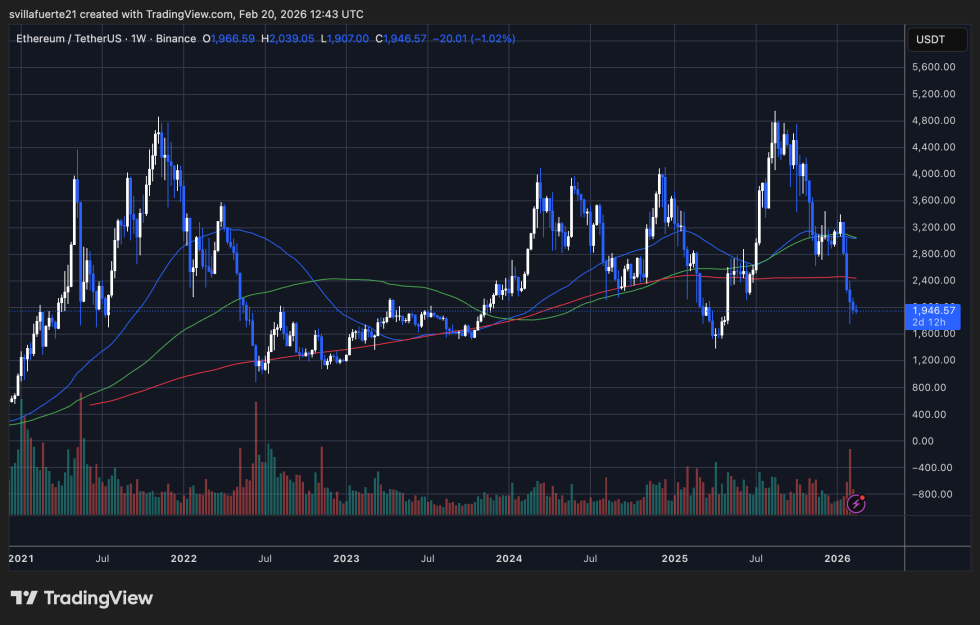
Technically, ETH is currently positioned below several major moving averages that previously acted as dynamic support. These levels now function as resistance, limiting upside attempts unless a strong reclaim occurs with expanding volume. The recent decline toward the $1,900 area reflects persistent selling pressure, while repeated failures near the mid-$2,000 range reinforce cautious market sentiment.
Volume activity has moderated compared with the impulsive rally phase, suggesting reduced speculative participation. While declining volume during corrections can sometimes signal seller exhaustion, confirmation of stabilization usually requires sustained buying interest rather than temporary rebounds.
From a structural perspective, immediate support appears concentrated near the recent local lows around the $1,800 region, while resistance remains clustered between roughly $2,200 and $2,600. Until Ethereum reclaims these levels convincingly, the broader technical outlook remains vulnerable, with consolidation or further downside still plausible.
Featured image from ChatGPT, chart from TradingView.com
