Crypto’s Capitol Hill Crisis: How The ’Shadow Deposit’ War Held The CLARITY Act Hostage

Washington's latest crypto clash isn't about mining or tokens—it's about the money moving in the dark.
The 'shadow deposit' fight—a behind-the-scenes battle over how digital asset firms handle customer funds—just derailed a major bipartisan bill. The CLARITY Act, touted as a landmark framework, now sits stalled. Lawmakers can't agree on whether crypto platforms should operate like banks, or something entirely new.
Banking's Old Guard vs. Crypto's New Rules
Traditional finance wants crypto wallets and exchanges under existing deposit rules. The industry argues that's like forcing a smartphone into a rotary phone's regulations—it breaks the model. They're pushing for a novel custody framework, one that acknowledges digital assets aren't just digital dollars.
The stalemate reveals a deeper truth: regulators aren't just scared of fraud, they're terrified of a parallel financial system they can't control. Every delay in legislation isn't just bureaucracy—it's a strategic win for the legacy players collecting fees while innovation waits in the lobby. The 'shadow deposit' war proves that in finance, the most vicious fights are always over what happens in the shadows.
Regulatory Uncertainty And Stablecoin Policy Frictions Continue To Shape Market Sentiment
Regulatory developments are increasingly shaping sentiment across the crypto market, and recent analysis suggests that the rapid growth of yield-bearing stablecoins has intensified political and financial tensions. Crypto firms are attempting to draw a distinction between interest paid directly by issuers and rewards distributed through exchanges or platforms, arguing that these mechanisms serve different economic functions.

Traditional banks, however, are advocating for tighter restrictions, concerned that such products could accelerate deposit outflows from the conventional financial system. Until compromise language is formally codified in legislation, momentum within the Senate remains uncertain.
At the same time, legislative complexity continues to increase. The Senate Agriculture Committee has already advanced a separate text focused primarily on Commodity Futures Trading Commission oversight. This creates a scenario in which multiple legislative packages will eventually need to be reconciled. Bipartisan vote requirements, questions around federal versus state regulatory authority, and unresolved provisions related to decentralized finance further complicate the timeline. These factors suggest that even broadly supported frameworks may face procedural delays.
If enacted, the Digital Asset Market Clarity Act could reduce regulatory risk premiums in the short term while gradually reshaping market structure over the longer horizon. However, clarity is unlikely to emerge instantly. Historically, regulatory transitions unfold sequentially — first through political signaling, then formal rulemaking, and ultimately enforcement. Until that process matures, regulatory uncertainty will remain embedded in the market environment.
Total Crypto Market Cap Tests Structural Support
The total cryptocurrency market capitalization continues to face downward pressure, with the weekly chart showing a clear rejection from the multi-trillion-dollar peak reached during the 2025 rally. After topping near the $4 trillion region, the market has entered a sustained corrective phase, recently pulling back toward the $2.3 trillion area. This zone now functions as a key structural support level, reflecting the midpoint between the previous expansion phase and the ongoing consolidation.
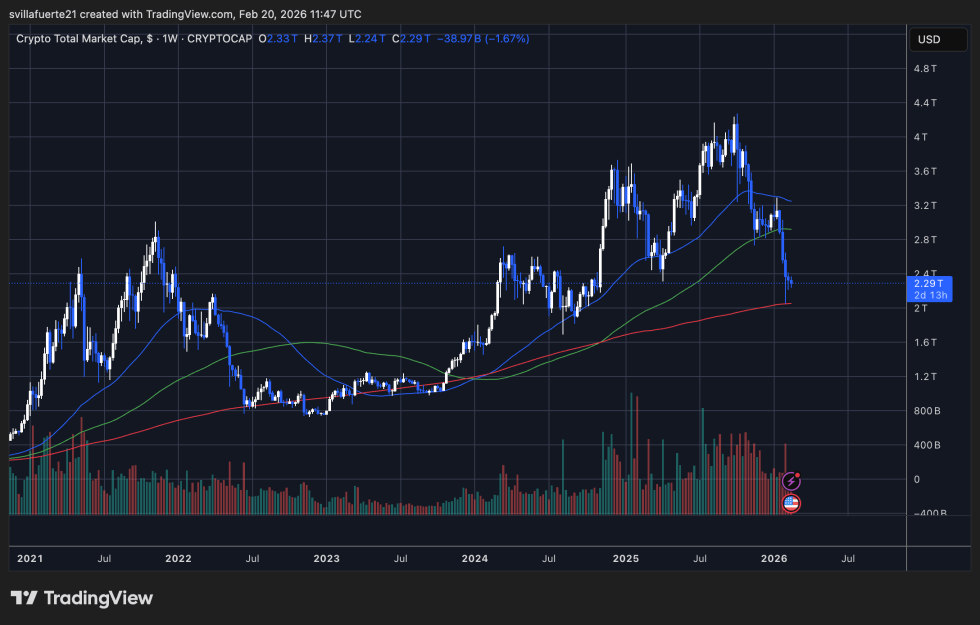
Technically, price action remains below the shorter-term moving averages, which have begun to slope downward and act as dynamic resistance. The medium-term average is flattening, suggesting loss of bullish momentum, while the longer-term trend line still trends upward but with a lag typical of macro support indicators. Until capitalization reclaims these levels decisively, upside follow-through may remain limited.
Volume patterns also reflect caution. Participation has moderated compared with the peak rally phase, although occasional spikes suggest intermittent repositioning rather than uniform capitulation. Historically, such environments often precede extended consolidation periods as excess leverage unwinds.
If support near current levels holds, the market could enter a stabilization phase. A breakdown below this zone, however, WOULD likely confirm continued corrective pressure across the broader crypto ecosystem.
Featured image from ChatGPT, chart from TradingView.com
