Crypto Whales Build A ’Fortress Floor’ As Retail Panic Sells The Altcoin Sector

While retail traders dump altcoins in a frenzy, deep-pocketed investors are quietly constructing a price floor that could reshape the entire market.
The Whale's Gambit
Massive buy orders cluster at key support levels—digital moats filled with capital. These aren't speculative plays; they're strategic defenses. Each purchase absorbs selling pressure, turning panic into opportunity. The altcoin sector churns, but beneath the surface, foundations solidify.
Retail's Reaction Cycle
Fear spreads faster than any blockchain. Social media amplifies every dip, triggering cascading sell-offs from over-leveraged portfolios. It's the same emotional script—greed flipping to terror—while algorithmic wallets execute with cold precision. The divergence creates a historic wealth transfer window.
The Fortress Takes Shape
This isn't about propping up prices. It's about establishing control points where liquidity vanishes and volatility dies. Whales accumulate assets others discard at fire-sale prices, building positions that will dictate the next market cycle's trajectory. Their patience stretches quarters, not minutes.
Market Mechanics Exposed
Watch order books thin at critical levels—then suddenly deepen. That's the fortress wall materializing. These accumulation zones become gravitational centers, pulling prices back repeatedly until breakout momentum becomes unstoppable. The game shifts from chasing pumps to engineering them.
Next time your portfolio bleeds red, remember: someone's probably buying the dip with more capital than your entire network combined. The 'dumb money' panic fuels the smart money's fortress—a fitting tribute to finance's oldest hierarchy, now running on decentralized ledgers.
Retail Capitulation Meets Strategic Crypto Accumulation
The CryptoQuant analysis indicates that much of the current altcoin selling pressure is being driven by retail participants reacting defensively to volatility and prolonged drawdowns. Fear-driven liquidations often emerge during uncertain phases, particularly when liquidity tightens, and price recovery lacks momentum. This behavior tends to amplify short-term weakness, especially across mid- and lower-cap crypto assets.
However, the same data suggests that a portion of this selling volume is being systematically absorbed by larger or more patient market participants. This absorption dynamic typically reflects positioning rather than speculation, as buyers accumulate exposure while sentiment remains fragile. Historically, such phases have preceded structural market transitions, although timing remains uncertain and outcomes are not guaranteed.

Some analysts argue that the current cycle may be characterized by unusually strong preparatory accumulation compared with previous market phases. Elevated spot volumes alongside persistent volatility suggest capital rotation rather than outright market exit in certain segments.
That said, projections about a future altcoin bull phase being significantly stronger than the previous cycle remain speculative. Market structure, macro liquidity conditions, regulatory developments, and bitcoin dominance will all influence whether such expectations materialize. The data primarily supports a market undergoing redistribution rather than a confirmed bullish reversal.
Altcoin Market Cap Remains Under Structural Pressure
The total crypto market capitalization excluding the top ten assets continues to show persistent weakness, reinforcing the view that the broader altcoin sector remains under structural pressure. The chart reflects a clear failure to sustain momentum following the mid-2025 rally, with capitalization steadily declining since the last major peak. Recent price action shows the market hovering NEAR roughly $170B, significantly below previous highs and still trending downward.
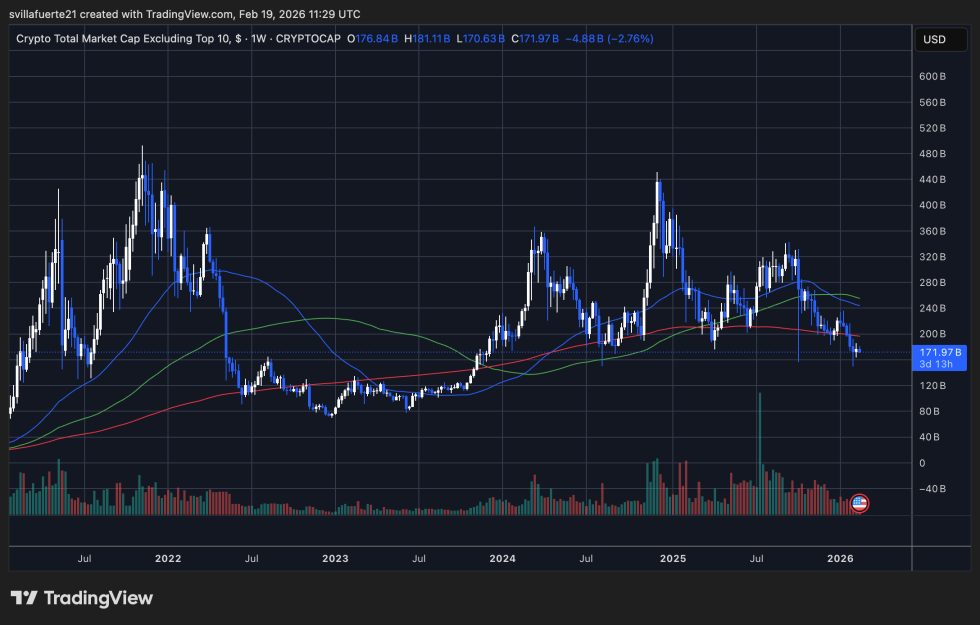
Technically, the structure appears fragile. Price has moved below the shorter-term moving averages and is testing longer-term support zones. The inability to reclaim these averages suggests declining momentum rather than a consolidation phase. Volume spikes accompanying downward moves also indicate that selling activity remains dominant, not merely passive drift.
Historically, similar configurations have occurred during late corrective phases when capital rotates back toward Bitcoin and larger-cap assets. This typically reflects risk reduction rather than outright market exit, but it nonetheless suppresses altcoin performance for extended periods.
Importantly, the absence of strong recovery attempts suggests liquidity constraints remain a key factor. Unless broader market sentiment improves or Bitcoin stabilizes convincingly, the altcoin segment may continue to face headwinds. At present, the data support ongoing redistribution rather than a confirmed cyclical bottom for the broader altcoin market.
Featured image from ChatGPT, chart from TradingView.com
