Major European Banking Giant Chooses XRP Ledger To Launch MiCA-Compliant Stablecoin

A top-tier European financial institution is making a decisive move into the future of money—and it's betting on the XRP Ledger to get there.
Why This Bank Isn't Playing Catch-Up
Forget slow, legacy systems. This bank is bypassing the traditional finance plumbing entirely. By selecting the XRP Ledger, it's tapping into a network built for speed and settled costs, aiming to launch a stablecoin that's ready for Europe's stringent MiCA regulations from day one. It's a clear signal: the race for digital assets isn't about adapting old tech, but adopting the right one.
The Compliance-First Engine
MiCA readiness isn't an afterthought—it's the core requirement. The ledger's inherent features for transparency and auditability provide a foundational advantage. This lets the bank build a compliant digital asset that can scale across borders without getting tangled in a web of future regulatory patches. They're building the highway with the tollbooths already installed.
A Ripple Effect for Traditional Finance
This isn't a side-project. It's a strategic pivot. When a top-10 bank makes this choice, it validates the underlying technology for real-world, large-scale financial use. Watch for other institutions to follow suit, using this blueprint to convert their balance sheets into programmable, instant-settlement assets—finally giving those dormant corporate treasuries something to do besides earning a pathetic fraction of a percent.
The old guard is learning new tricks, and they're skipping the slow, expensive middlemen. The future of European banking just got a major, decentralized upgrade.
XRP Ledger Lands Major TradFi Win
In its February 18, 2026 press release, SG-FORGE described the XRPL integration as part of a “multi-chain deployment strategy,” explicitly positioning the ledger alongside Ethereum and Solana rather than as a one-off experiment. The firm said it expects the move to “increase adoption” by tapping XRPL’s scalability, speed, and low costs on what it called a “secure and decentralized Layer 1 blockchain.”
That line matters because it clarifies the target user: not retail “stablecoin tourists,” but institutions that care about predictable settlement characteristics and operational risk. In parallel messaging shared on social channels, SG-FORGE framed the choice in plain infrastructure terms, performance, cost, and architecture, rather than community affinity or token narratives.
Ripple’s involvement is not merely promotional. SG-FORGE said the XRPL launch is “supported by Ripple’s custody solution,” and it flagged follow-on paths that sound tailored to professional trading and treasury workflows: potential integration into Ripple’s product suite and use of EUR CoinVertible as trading collateral.
Craddock echoed that institutional positioning in the release itself, describing SG-FORGE as “a pioneer… market-leading crypto-assets offering.” She added: “Ripple is proud to have played a part… providing proven and trusted technology.”
Ripple staff also used the moment to underline how these launches tend to happen in practice. One Ripple employee, Luke Judges, wrote that the partnership is real and added: “A top 10 European bank with $1.8TN in assets does not follow XRP ledger community norms or niceties and has their own compliance reqs & timescale for announcements.”
For SG-FORGE, the XRPL rollout also reads like a delivered roadmap item. Back in November 2024, the firm publicly signaled its intent to deploy its MiCA-aligned euro stablecoin on XRPL to broaden adoption, language that closely matches the rationale in today’s announcement.
Jean-Marc Stenger, CEO of SG-FORGE, framed the XRPL go-live as a continuation of that regulated product push. “The successful launch of EUR CoinVertible on the XRP Ledger is a new step. We look forward to further innovation and expanding the reach,” he said.
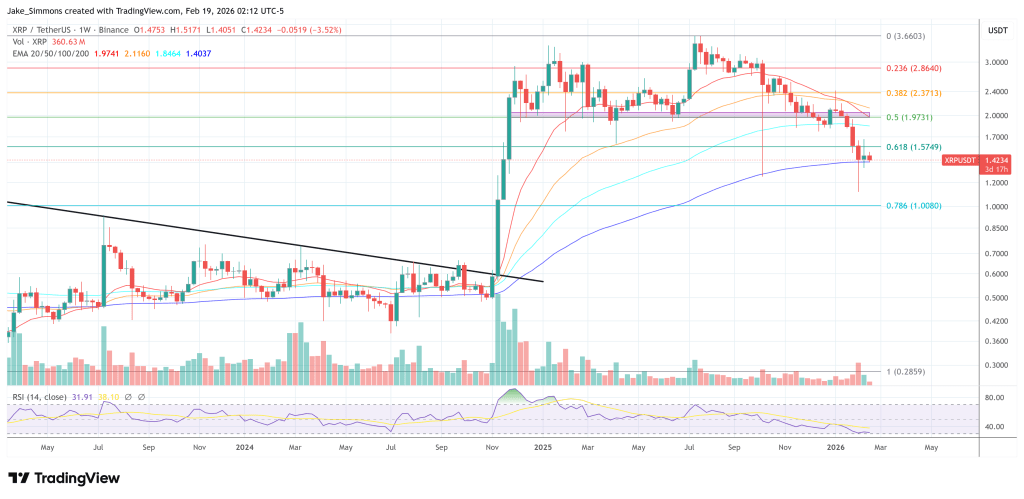
At press time, XRP traded at $1.42.