Crypto’s Great Migration: Stablecoin Liquidity Shifts as Bear Market Deepens – What the Data Reveals

Stablecoins aren't stable—they're fleeing. As the crypto winter bites deeper, the industry's lifeblood is undergoing a dramatic, silent reshuffle. Forget price charts; the real story is in the liquidity flows.
The Flight to Quality
Capital isn't just hiding—it's moving with purpose. The data shows a clear exodus from algorithmic and lesser-known stablecoin projects toward the blue-chip giants. It's a classic risk-off rotation, crypto-style. Traders and protocols are pulling liquidity from the periphery, consolidating holdings in the most battle-tested assets. Survival instinct trumps yield chasing when confidence evaporates.
Chain Wars: The Liquidity Frontline
The battle for stablecoin supremacy isn't just about issuers—it's about blockchains. Liquidity is migrating between networks, searching for the optimal blend of security, cost, and utility. One chain's gain is another's glaring deficit. This isn't mere volatility; it's a fundamental reassessment of infrastructure risk and value proposition in a bear market. The 'multi-chain' narrative gets stress-tested when real money is on the line.
Protocols on Life Support
For DeFi protocols, stablecoin liquidity isn't a metric—it's a heartbeat. Watch it flatline, and the project follows. The data reveals which lending platforms, DEXs, and yield farms are seeing their reserves drain away. The ones clinging to liquidity are the ones with the strongest fundamentals and clearest utility. The rest face an existential crunch, proving that in crypto, as in traditional finance, when the tide goes out, you see who's been swimming naked.
This liquidity migration isn't chaos—it's the market's brutal efficiency at work, separating the robust from the redundant. The bear market isn't destroying value; it's relentlessly redistributing it to where it's deemed safest. The smart money is already positioned for the next cycle, leaving the bag-holders to wonder where all the dollars went. After all, what's a little financial apocalypse between friends?
Stablecoin Liquidity Concentration Highlights Binance’s Dominant Market Role
The data further shows that stablecoin liquidity remains heavily concentrated on Binance, reinforcing its role as the primary hub for crypto market liquidity. Current figures indicate the exchange holds roughly $47.5 billion in combined USDT and USDC reserves, marking a 31% year-over-year increase from about $35.9 billion. This concentration is significant, as Binance alone accounts for approximately 65% of all USDT and USDC held across centralized exchanges, highlighting its dominant position in facilitating trading flows and liquidity provisioning.
Other major exchanges lag considerably behind in stablecoin reserves. OKX holds around $9.5 billion, representing roughly a 13% share, while Coinbase maintains approximately $5.9 billion, or about 8%. Bybit follows with close to $4 billion, equivalent to roughly 6% of exchange stablecoin liquidity. These balances are distributed mainly across ethereum and TRON networks, which continue to serve as the primary infrastructure layers for stablecoin settlement.
Within Binance itself, liquidity remains overwhelmingly USDT-driven. About $42.3 billion of its reserves are held in USDT, reflecting a 36% year-over-year increase from approximately $31 billion. In contrast, USDC reserves stand NEAR $5.2 billion and have remained broadly flat over the same period, suggesting stable but limited growth compared with USDT dominance.
Total Crypto Market Cap Tests Key Structural Support
The total crypto market capitalization chart shows a clear corrective phase following the late-2025 peak near the $4 trillion region. Since that high, the market has retraced significantly, with capitalization recently stabilizing around the $2.3 trillion level. This area appears to function as an interim support zone, although price action remains fragile and characterized by reduced upside momentum.
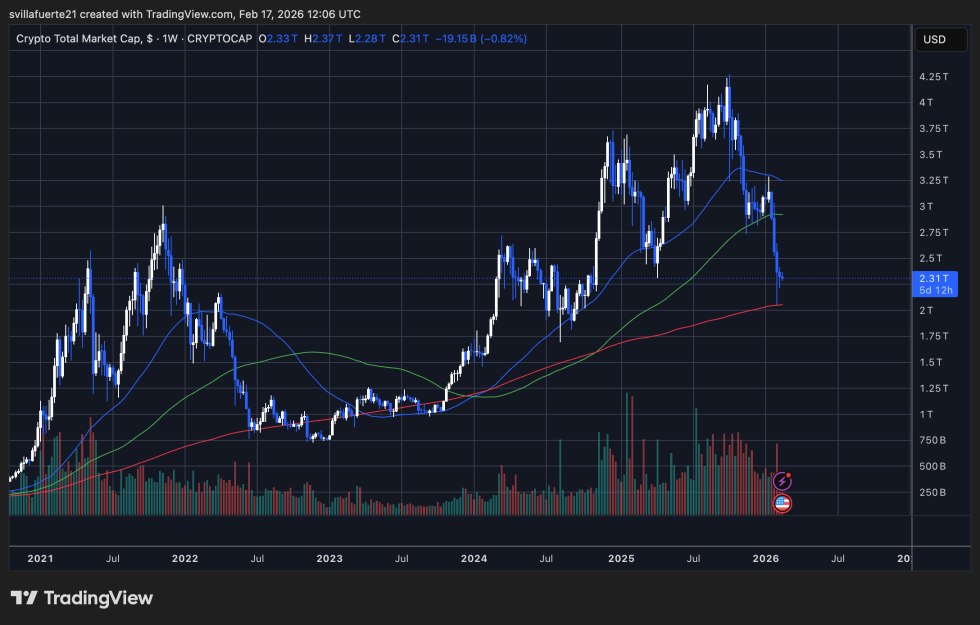
From a trend perspective, the market has broken below shorter-term moving averages and is now interacting with longer-term trend indicators. This shift typically signals a transition from expansion to consolidation or correction. The inability to sustain rebounds above the mid-range moving average suggests that buying pressure remains subdued, while sellers continue to dominate rallies.
Volume dynamics reinforce this interpretation. Elevated selling volume accompanied the most recent decline, indicating active distribution rather than passive drift. However, the subsequent moderation in volume hints that panic selling may be easing, even if conviction buying has yet to return decisively.
Structurally, the broader uptrend remains intact only while capitalization holds above the long-term trend support zone. A sustained breakdown below this level WOULD likely confirm a deeper cyclical correction, whereas stabilization here could support a prolonged consolidation phase before any renewed expansion in the crypto market.
Featured image from ChatGPT, chart from TradingView.com
