Bitcoin Below $10,000? Michael Saylor Reveals Why His Strategy Wouldn’t Wipe Out

What happens if Bitcoin crashes through the $10,000 floor? For most, it's a nightmare scenario. For Michael Saylor, it's just another day in the office.
The Unshakeable Core Thesis
Saylor's playbook never hinged on short-term price gyrations. The MicroStrategy strategy—buy and hold indefinitely—was built for volatility. It assumes drawdowns of 80%, 90%, or more are part of the journey toward Bitcoin's ultimate role as a dominant monetary asset. A dip below five figures? That's not a bug in the system; it's a stress test the plan was designed to survive.
Liquidity, Leverage, and The Long Game
The real risk isn't the price—it's the structure. Saylor's publicly traded vehicle provides a layer of insulation individual holders lack. No margin calls. No forced liquidations. The company can weather the storm, acquire more assets at a discount, and wait. It's a luxury most traders don't have, especially those playing with borrowed money—the first to get wiped out when the tide goes out.
What the Street Isn't Pricing In
Conventional finance still views Bitcoin through the lens of a speculative tech stock. They see a crash as a failure. The Saylor framework sees it as a feature: a brutal, recurring mechanism that shakes out weak hands and consolidates the network's value among steadfast believers. It's a fundamentally different risk calculus, one that looks past quarterly earnings and toward a decades-long horizon.
The strategy only wipes out if the core thesis—Bitcoin as digital property—fails completely. Until then, price is just noise. And as any veteran of Wall Street knows, the market can stay irrational longer than you can stay solvent... unless your balance sheet is built for the siege.
Strategy Says It Can Survive An 88% Bitcoin Crash
Michael Saylor is still bullish on Bitcoin, and according to him, Strategy could continue meeting its obligations even if BTC’s price dropped to $8,000, with the plan being to equitize convertible debt over the next 3 to 6 years.
At the time of writing, Strategy is holding 714,644 BTC in its Bitcoin reserve. Based on the current bitcoin price of around $69,000, those holdings are valued just under $49 billion. According to recent details shared by Strategy, the firm reports around $6.0 billion in net debt, giving it an 8.3x BTC asset coverage ratio under present conditions.
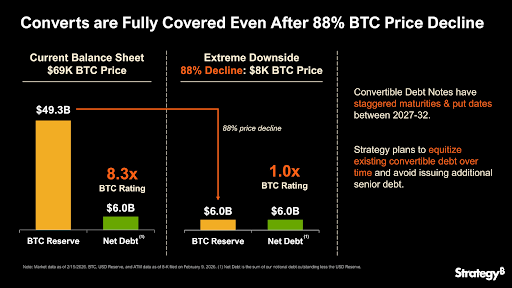
The interesting part of the disclosure is the downside scenario. The company modeled an 88% price decline in Bitcoin, which would push BTC down to around $8,000. Under that assumption, its Bitcoin reserve would fall to roughly $6.0 billion. That figure still matches or slightly exceeds its net debt position, resulting in a 1.0x coverage ratio.
This means that even if BTC’s price were to suffer an 88% collapse from current levels, Strategy’s Bitcoin holdings WOULD theoretically still be sufficient to cover its outstanding debt obligations on paper.
No Immediate Liquidation Risks For Strategy
Strategy’s borrowings are primarily low-interest convertible notes with staggered maturities and put dates stretching between 2027 and 2032. These are not margin loans secured by BTC that trigger automatic liquidations if BTC falls.
Since there are no margin calls associated directly with BTC price fluctuations, Strategy would not be forced to sell its BTC holdings in a sudden downturn. Instead, the company noted that it plans to equitize existing convertible debt over time. That means converting debt into company shares and avoiding issuing new senior secured debt.
Strategy is still in the business of purchasing huge amounts of Bitcoin, despite the recent price crash below $70,000. The most recent purchase was an additional 1,142 BTC for approximately $90 million in early February. Saylor even recently reiterated that Strategy plans to continue buying Bitcoin on a regular basis.
A BTC collapse to $10,000 would represent an extreme crash of 85% to 90% from recent levels. Although Strategy’s model suggests it could technically cover its net debt at $8,000 per BTC, such a scenario would dramatically shrink the value of its equity from $48.5 billion to less than $6 billion.
