Bitcoin’s Next Bull Run: Here’s When It’s Likely To Kick Off

Bitcoin's next bull run is coming—and the countdown clock is ticking.
Forget the noise. Ignore the day traders screaming about dips and pumps. The real move, the one that reshapes portfolios and headlines, follows a rhythm older than most crypto exchanges. It's the halving cycle, and its next beat drops sooner than you think.
The Halving Horizon
Every four years, like clockwork, Bitcoin's code executes a built-in scarcity event. The block reward for miners gets cut in half. New supply slows to a trickle. History doesn't repeat, but it often rhymes—and post-halving periods have consistently ignited the most explosive rallies in crypto.
The last halving was in 2024. Do the math. The stage is set.
Catalysts Waiting in the Wings
This cycle isn't just about programmed scarcity. Institutional adoption has moved from a talking point to a balance sheet reality. Spot Bitcoin ETFs—once a pipe dream—are now funneling real capital. Regulatory frameworks, however clunky, are slowly emerging from the fog. The infrastructure is being built while everyone's distracted by the latest meme coin.
It's the perfect storm: reduced new supply meets a wall of simmering demand. The fuse is lit.
Timing the Tidal Wave
So when does the wave break? Not tomorrow. The halving is the starting gun, not the finish line. Past cycles show a 12 to 18-month incubation period before momentum becomes unstoppable. That puts the ignition window squarely in late 2025 to mid-2026.
Markets need time to absorb the new supply dynamics. They need a narrative. They'll get one—probably wrapped in some shiny new fintech buzzword that makes traditional finance guys nod sagely while completely missing the point.
The Final Countdown
Watch the hash rate. Watch the miner activity. Watch the quiet accumulation on-chain when the headlines turn bearish. The smart money isn't yelling; it's stacking.
Bitcoin's next bull run isn't a matter of 'if.' It's a matter of 'when.' And the clock, set by its own immutable code, is the only calendar that matters. The rest is just noise—and the occasional cynical jab about how Wall Street will finally 'get it' just in time to take all the credit.
History Says Bitcoin Rallies When This Metric Flips Red
After Bitcoin’s steep pullback, investors are now watching closely for the next bullish breakout that could kick off another BTC bull run. On-chain indicators have often been a reliable source for determining the next bull run, and Joao Wedson has highlighted a key metric that stands out in this context.
Specifically, the verified author and founder of Alphractal has shared insights into the matter using the Bitcoin Net Unrealized Profit/Loss (NUPL) for Long-Term Holders. This metric measures the average unrealized profit or loss of the most reliant investors in the market.
According to the expert, the next bull run for Bitcoin usually begins when this metric flips red. Irrespective of how it sounds, previous cycles have demonstrated that the color shift frequently corresponds with times of highest pessimism when selling pressure peaks and long-term accumulation subtly start.
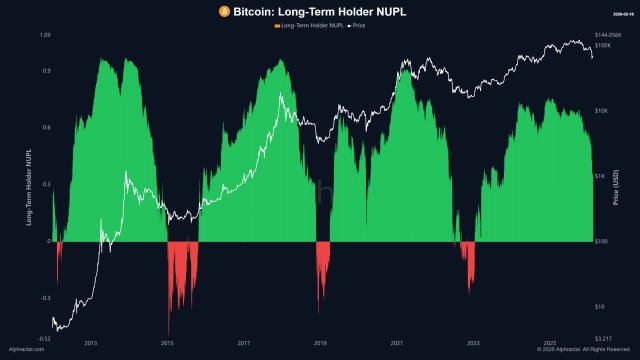
Recent data seen on the chart tells that the metric is currently positioned at the 0.36 level, which implies that long-term holders remain on average in terms of profit. However, Wedson highlighted that the most significant signal often emerges when the metric shifts into negative territory.
It is worth noting that when long-term holders NUPL shifts into negative territory, it indicates that losses continue to mount even among the most convinced participants. In the past, this pattern has marked the phase of maximum market depression. In Wedson’s view, this stage reflects seller exhaustion, the transfer of coins to stronger hands, and the beginning of a new market cycle.
This was the last stage before a fresh Bull Run began in earlier cycles. “Opportunities are not built at the top, they are built in depression,” Wedson added.
BTC Accumulator Addresses Are Rising
Darkfost, an author at CryptoQuant, has shared a detailed analysis of Bitcoin accumulator addresses, which appear to be steadily rising. According to the expert, these addresses represent a specific class of long-term holders, and their recent actions are very noteworthy. A tendency toward increasing accumulation often indicates that supply is being covertly absorbed, reducing the quantity of Bitcoin on the open market.
Data shows that the current average monthly accumulation is a staggering 372,000 BTC. These investors or corporations, who continue to accumulate aggressively, seem to be taking advantage of the current dip in Bitcoin. In contrast, the average monthly accumulation of these addresses was only over 10,000 BTC in September 2024.
Market structure indicates that some investors are responding emotionally to short-term price movements, while others seem to be planning for the long run, which has always been one of the best ways to invest in BTC.
