The Cycle Without A Ceiling: Why Bitcoin’s Missing Peak Rewrites The Rules For The 2026 Bottom

Bitcoin just broke the cycle—and traditional finance is scrambling to catch up.
For years, analysts mapped crypto's trajectory using the same predictable patterns: a parabolic run, a dizzying all-time high, then the inevitable crash. The 2024-2025 cycle threw that playbook out the window. The peak never arrived. Instead of a classic blow-off top, the market plateaued, consolidated, and then began its descent without the usual fanfare. This missing peak isn't a glitch; it's a fundamental rewrite of market psychology.
The New Rules of the Drawdown
Without a clear, euphoric top to measure from, determining the bottom becomes a different game. Old support levels based on percentage retraces from an ATH are suddenly obsolete. The floor is now being set by a complex mix of on-chain metrics, institutional accumulation zones, and macro liquidity flows—not retail sentiment screaming 'to the moon.' The leverage that fueled past collapses has been largely purged, creating a slower, more grinding bear phase. It's a healthier purge, but it makes timing the turn notoriously difficult.
Why 2026 Looks Different
This cycle bypassed the mass FOMO stage, meaning the pool of 'weak hands' is smaller. The sell-off is being driven by strategic profit-taking and macro rebalancing, not panic. This suggests the 2026 bottom may be shallower but longer-lasting—a drawn-out basing period that shakes out the last of the impatient capital. Watch the hash rate, watch the dormant supply, and ignore the pundits still drawing Fibonacci lines on a chart that no longer exists. The market is maturing, and its pain is becoming more sophisticated—almost like a real asset class, just with better memes and worse suits.
The final irony? The very predictability Wall Street craves was crypto's greatest vulnerability. By refusing to peak on cue, Bitcoin didn't break its model—it just graduated to a harder one. Now, the 'smart money' has to do actual analysis instead of waiting for a repeat. How terribly inconvenient.
MVRV Signals Bitcoin Approaching Potential Undervaluation Zone
The report further notes that valuation metrics are beginning to approach levels historically associated with accumulation phases. The Market Value to Realized Value (MVRV) ratio, a widely followed on-chain indicator, is currently near 1.1. Traditionally, readings below 1 have signaled that Bitcoin is trading below its aggregate cost basis, a condition often interpreted as undervaluation. While the indicator has not yet crossed that threshold, its proximity suggests the market may be entering a zone where downside risk gradually compresses.

At the same time, analysts emphasize an important structural distinction from previous cycles. Unlike earlier bull markets, Bitcoin did not surge deep into a clearly overheated valuation zone before the recent correction began. This implies the current drawdown may not follow the same capitulation dynamics seen in prior bear market bottoms, complicating direct historical comparisons.
From a strategic standpoint, the analysis suggests that periods of market weakness often provide the most effective window for long-term positioning. For assets with a persistent upward macro trajectory, preparation during downturns tends to improve risk-adjusted outcomes. However, this does not eliminate near-term volatility risks, particularly while macro liquidity conditions remain uncertain and sentiment continues to shift.
Bitcoin Struggles Below Key Averages As Bearish Momentum Persists
Bitcoin price action continues to show persistent weakness, with the chart illustrating a clear sequence of lower highs and lower lows since the late-2025 peak NEAR the $120K–$125K region. The recent breakdown below the $70K level reinforces the bearish structure, particularly as price remains well below the 50-week and 100-week moving averages, both of which are now sloping downward. This alignment typically reflects sustained distribution rather than a temporary correction.
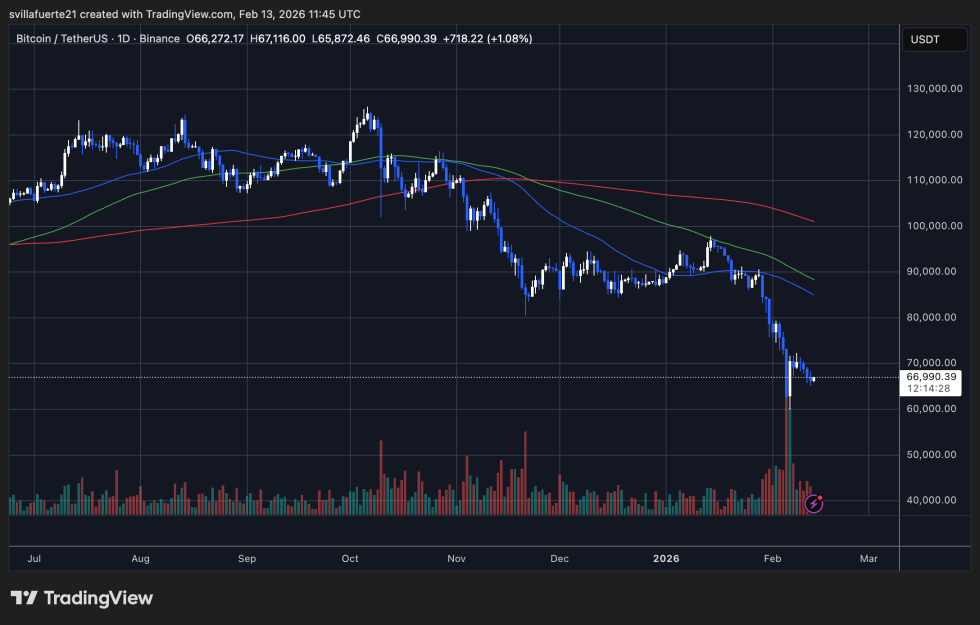
The sharp selloff into the mid-$60K area was accompanied by a noticeable spike in trading volume, suggesting forced liquidations or aggressive spot selling rather than routine profit-taking. While price has attempted minor stabilization around the $65K–$68K range, the lack of strong rebound momentum indicates buyers remain cautious. Historically, such muted recoveries after high-volume declines often signal ongoing market uncertainty rather than immediate reversal.
From a structural standpoint, the next critical technical focus lies near the $60K psychological level, which could act as interim support if selling pressure continues. Conversely, any sustained recovery WOULD first require reclaiming the $70K zone and stabilizing above key moving averages. Until that occurs, the broader trend remains defensive, with volatility likely to persist as the market searches for a clearer equilibrium.
Featured image from ChatGPT, chart from TradingView.com
