XRP Ledger Activates Token Escrow: Here’s What XLS-85 Unlocks for the Future of Finance

XRP Ledger just flipped the switch on a game-changer—and the old guard is scrambling to catch up.
Introducing XLS-85: the native token escrow amendment that's rewriting the rulebook for digital asset management. No more clunky third-party smart contracts. No more praying a centralized custodian doesn't vanish with your funds. The ledger itself now handles the lock-up, with cryptographic precision baked into the protocol.
What This Actually Unlocks
Think automated, trust-minimized everything. Vesting schedules for team tokens that execute flawlessly. Escrow for OTC deals that settles without a bank in sight. Collateral management that doesn't rely on a 'trusted' intermediary—because in crypto, that's often an oxymoron. It cuts settlement layers, bypasses legacy gatekeepers, and injects programmable certainty into every transaction.
The Ripple Effect
This isn't just a tech upgrade; it's a direct shot across the bow of traditional finance's fee-heavy escrow services. Why pay a law firm and a bank to hold keys when math can do it better, faster, and for pennies? Developers are already sketching out use cases that would make a Wall Street paper-pusher's head spin—if they could even understand the code.
One cynical finance jab? This does to corporate trust departments what the spreadsheet did to ledger clerks—it renders them obsolete. The future of asset custody isn't in a vault; it's in verifiable, unstoppable code. The XRP Ledger just built the vault, and threw away the key to the middlemen.
Escrow, But For Every Asset On XRP Ledger
RippleX framed the change as a broadening of XRPL’s settlement primitives from one native asset to the wider token stack via X:
“Token Escrow (XLS-85) is now live on XRPL Mainnet! This feature extends native escrow functionality beyond XRP to all Trustline-based tokens (IOUs) and Multi-Purpose Tokens (MPTs). From stablecoins like RLUSD to Real World Assets, the XRPL now supports secure, conditional, onchain settlement for all assets.” It added: “The toolbox for Institutional DeFi just got bigger.”
Token Escrow (XLS-85) is now live on XRPL Mainnet!
This feature extends native escrow functionality beyond XRP to all Trustline-based tokens (IOUs) and Multi-Purpose Tokens (MPTs).
From stablecoins like RLUSD to Real World Assets, the XRPL now supports secure, conditional,… pic.twitter.com/DNCJxZsoK2
— RippleX (@RippleXDev) February 12, 2026
XRPL.org describes escrow in familiar terms, then emphasizes what the ledger automates: “Traditionally, an escrow is a contract between two parties to facilitate financial transactions… The XRP Ledger takes escrow a step further, replacing the third party with an automated system built into the ledger.” With the TokenEscrow amendment, that same approach now applies to fungible tokens, not just XRP.
For Trust Line Tokens, the issuing account must enable the Allow Trust Line Locking flag so the issued token can be escrowed. For MPTs, the issuer must set Can Escrow and Can Transfer flags at issuance so those tokens can both be held in escrow and transferred when released. One notable constraint: issuers cannot create escrows using their own issued tokens, though they can receive escrowed tokens as recipients.
Authorization gating also matters. If a token requires authorization, the sender must be pre-authorized by the issuer before creating an escrow, and must be authorized to receive the tokens back if an expired escrow is canceled—regardless of who submits the cancellation. Separately, the recipient must be pre-authorized before an escrow can be finished.
XRPL supports time-based, conditional, and combination escrows. The Flow is anchored around EscrowCreate to lock funds, EscrowFinish to release them when conditions are met, and EscrowCancel to return funds once an escrow expires. For token escrows specifically, an expiration time is mandatory.
The feature is not free. XRPL.org flags that escrow “requires two transactions” and that Crypto-Conditions increase fees. While the ledger supports Crypto-Conditions, it currently only supports PREIMAGE-SHA-256, and fulfillment verification raises EscrowFinish costs. The documentation gives a concrete minimum: an EscrowFinish with a fulfillment requires at least 330 drops of XRP plus an additional amount based on fulfillment size, with the formula scaling if fee settings change.
RippleX highlighted use cases spanning vesting and grants, conditional payments and OTC-style swaps, treasury workflows like legal holds and collateral, and tokenized rights and RWA-style unlocks. The common thread is a native, on-ledger “lock until X” mechanism now available to the token layer, useful for structured settlement, compliance-shaped flows, and predictable release conditions without relying on a third-party custodian or purely off-chain coordination.
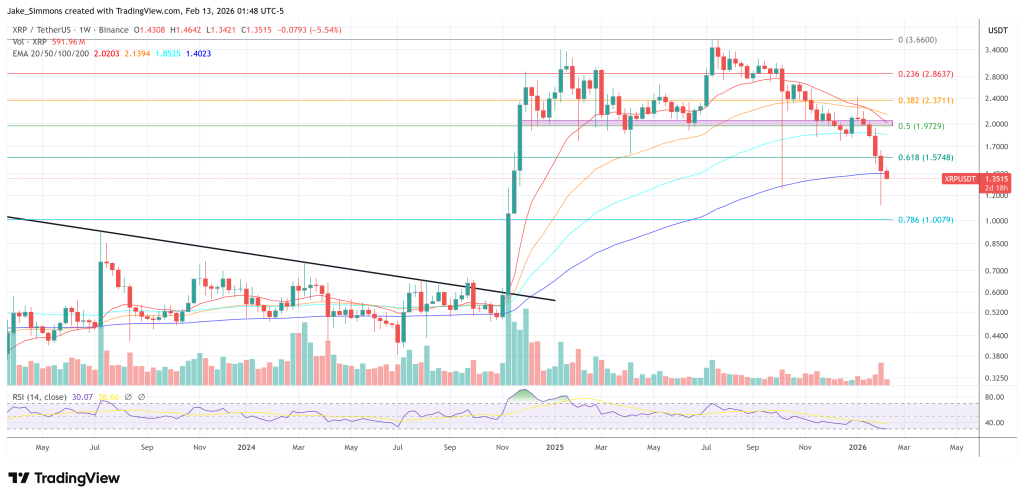
At press time, XRP traded at $1.35.