XRP Traders Dump Leverage, Embrace Caution: What’s Next for the Market?

Leverage flees the XRP market as traders slam on the brakes. The high-octane fuel that powered rallies is draining fast—replaced by cold, hard cash positions and a collective pause. It's a classic risk-off pivot, the kind that turns a market from a casino into a library.
The Great Unwind
Open interest in leveraged derivatives is plummeting. Traders aren't just trimming sails; they're throwing entire positions overboard. The data screams one thing: de-risking. This isn't a tactical retreat—it's a strategic withdrawal from the front lines of volatility.
Cash is King (Again)
Spot buying is soaking up the slack. Money is moving from the speculative futures arena to the relative safety of direct asset ownership. It's a quality shift—from betting on price movements to actually holding the keys. The smart money is parking in what it can touch, not what it might owe.
Waiting for the Catalyst
Now, the market holds its breath. This caution creates a coiled spring. Low leverage means less forced selling, but also less explosive buying. The next major move needs a real-world spark—a regulatory nod, a major partnership, something beyond chart patterns and influencer hype. Until then, it's a waiting game, punctuated by the quiet hum of sidelined capital. After all, in crypto, 'prudence' is just the word traders use between reckless bull runs.
What comes next? A cleaner, leaner market—one built on actual conviction, not borrowed momentum. The leverage exodus might just be the boring, necessary detox before the next leg up. Or, in typical finance fashion, it's the calm before everyone forgets the last crash and does it all over again.
XRP Derivatives Market Shows Broad Deleveraging Across Major Exchanges
The CryptoQuant report provides a detailed breakdown of recent changes in futures open interest, highlighting a broad contraction across leading derivatives platforms. Over the past 30 days, Binance recorded an estimated decline of about 1.6 billion XRP in open interest, while Bybit saw a larger reduction of about 1.8 billion XRP.
Kraken also posted a substantial drop, approaching 1.5 billion XRP. Meanwhile, OKX registered a more moderate decline of roughly 446 million XRP, and BitMEX showed a comparatively small decrease of 36 million XRP.

These figures indicate that most position unwinding has occurred on the largest and most liquid exchanges, meaning their activity carries disproportionate influence over overall market structure and short-term sentiment. When deleveraging is concentrated in high-liquidity venues, price stability often becomes more sensitive to shifts in spot demand and macro conditions.
From a behavioral standpoint, declining open interest typically reflects a preference for risk reduction rather than aggressive directional speculation. This pattern is frequently observed during transitional market phases, either preceding local bottom formation or before a new trend begins to emerge. Instead of building leveraged exposure, traders appear to be prioritizing capital preservation, contributing to a calmer derivatives environment with reduced reliance on leverage and lower speculative intensity.
XRP Tests Key Support As Downtrend Structure Persists
XRP’s price structure remains under pressure on the higher-timeframe chart, with the asset recently dropping toward the $1.30–$1.40 zone after failing to sustain recoveries above former support levels. The chart shows a clear sequence of lower highs since the mid-cycle peak, indicating weakening bullish momentum and a gradual shift toward a more defensive market structure.
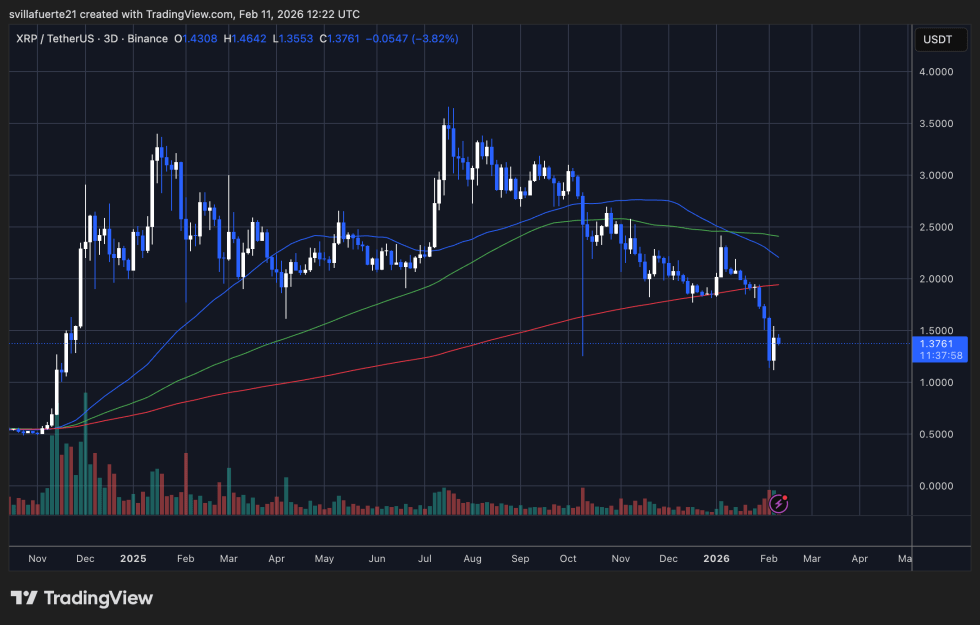
Technically, the price is trading below major moving averages, which now act as dynamic resistance rather than support. This positioning typically reflects sustained bearish control, especially when accompanied by declining upside follow-through during relief rallies. The latest decline also coincides with increased trading activity, suggesting distribution or leveraged position unwinding rather than organic accumulation.
From a structural perspective, the current price zone aligns with a historical liquidity area that previously supported consolidation. Holding this range could allow XRP to stabilize and potentially transition into sideways price action. However, a decisive breakdown below this level WOULD increase the probability of deeper retracement toward earlier cycle support zones.
XRP remains sensitive to broader market sentiment, derivatives positioning, and macro liquidity trends. A sustained recovery above key moving averages would be required to signal renewed bullish momentum and restore confidence among market participants.
Featured image from ChatGPT, chart from TradingView.com
