Bitcoin’s Ultimate Stress Test: Risk-Off Signals Clash With Market Conviction

Bitcoin's price action isn't just a chart—it's a high-stakes interrogation of investor belief. As traditional safe havens flash warning lights, the digital asset faces its moment of truth. Will decentralized conviction hold, or will legacy market fears prevail?
The Sentiment Standoff
Fear and greed metrics swing wildly, painting a picture of a market at a crossroads. On-chain data reveals a tug-of-war between long-term holders digging in and short-term speculators heading for the exits. Every dip gets bought, but every rally meets resistance—classic consolidation behavior that either builds a springboard or a trapdoor.
Liquidity's Double-Edged Sword
Thin order books amplify moves in both directions. A single large sell order can trigger cascading liquidations, while accumulating bids just below current prices suggest institutional players are waiting in the wings. It's a game of chicken between weak hands and strategic capital, with volatility as the weapon of choice.
The Macro Shadow
Global risk assets wobble as central bankers talk tough on inflation—never mind that their track record on predictions makes weather forecasters look like oracles. Bitcoin's correlation with equities remains a nagging concern for proponents of its 'digital gold' narrative. When traditional markets sneeze, crypto still catches a cold, proving old financial habits die hard.
Technical Crucible
Key support levels become battlegrounds. Each test either fortifies the floor or confirms its fragility. Trading volume tells the real story—are participants accumulating or distributing? The answer often comes too late for those waiting for 'confirmation,' the market's favorite way of making you pay for your hesitation.
Bitcoin doesn't care about your portfolio. It's testing whether the market truly believes in its value proposition or just enjoys the rollercoaster ride. The coming weeks will separate tourists from residents in the digital economy—no refunds for those who bought the hype but can't handle the volatility.
Macro Slowdown And Weak Spot Demand
The report also highlights a deteriorating macro backdrop that continues to shape Bitcoin’s market behavior. Recent data point to simultaneous slowdowns in both consumer spending and wage growth. The downside surprise in US retail sales increases risks to corporate revenues and employment trends, while the Employment Cost Index (ECI) came in below expectations, signaling easing wage inflation.
This combination tends to shift the Federal Reserve’s focus toward growth risks, but it can also maintain pressure on risk assets as economic momentum cools.
Manufacturing employment adds another LAYER of concern. The sector has been in a gradual long-term decline, often interpreted as a cyclical recession signal. When combined with softer consumption data and moderating wages, the broader picture suggests a phase of disinflation occurring alongside slowing economic growth rather than a rapid recovery.
Within this environment, Bitcoin remains susceptible to short-term risk-off moves, often behaving similarly to equities when liquidity tightens. Although expectations of eventual monetary easing can trigger rallies, the sustainability of those rebounds remains uncertain. Notably, the Coinbase Premium Gap has stayed persistently negative since late 2025, indicating weak US spot demand and price action driven largely by derivatives.

A sustained shift toward positive premium levels, supported by ETF inflows, WOULD likely be required to materially improve the outlook.
Bitcoin Tests Critical Support As Weekly Structure Weakens
Bitcoin’s weekly chart shows clear deterioration in price structure after losing the $70,000 level, with BTC now attempting to stabilize around the mid-$60,000 range. The breakdown below this psychological threshold marks a shift from consolidation to a more defensive market posture, especially as price trades beneath shorter-term moving averages that previously acted as dynamic support.
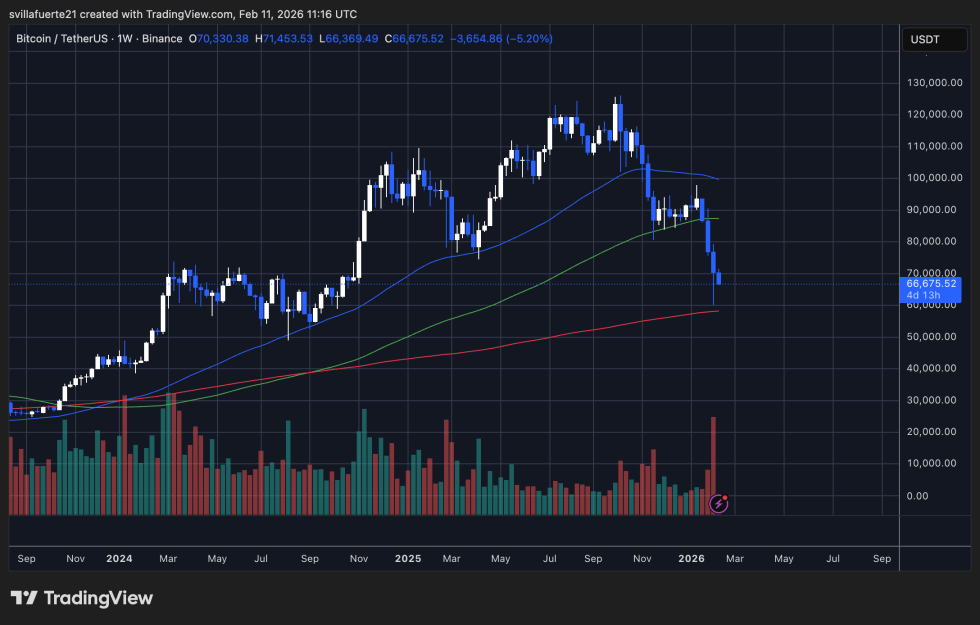
Momentum indicators inferred from price behavior suggest declining upside strength. Recent candles show persistent selling pressure, with lower highs forming since the late-2025 peak. Volume spikes accompanying the latest drop reinforce the idea of distribution or forced deleveraging rather than orderly profit-taking. Historically, such patterns tend to precede either extended consolidation phases or further corrective moves unless strong spot demand reappears quickly.
From a structural perspective, the next relevant support zone appears NEAR the $60,000 region, roughly aligned with longer-term trend support and prior high-liquidity trading ranges. Holding above this level would preserve the broader bullish market structure despite the correction. Failure to do so, however, could open the door to deeper retracement scenarios.
Featured image from ChatGPT, chart from TradingView.com
