Alibaba’s High-Performance RPC Demo Sends Massive Infrastructure Signal for Solana

Solana just got a heavyweight endorsement from the traditional tech world.
Alibaba Cloud—the cloud computing arm of the Chinese e-commerce giant—has publicly demonstrated high-performance Remote Procedure Call (RPC) services specifically optimized for the Solana blockchain. This isn't a quiet partnership announcement buried in a press release; it's a live tech demo that screams institutional validation.
Why This RPC Move Matters
RPCs are the critical gateway between users and the blockchain. Think of them as the on-ramps to the network. A slow, unreliable RPC means a clunky wallet experience, failed transactions, and frustrated developers. Alibaba's demo focuses on high throughput and low latency—the exact metrics where Solana stakes its reputation.
This move by a cloud infrastructure titan signals a serious bet on Solana's architectural demands. It's not just about supporting another blockchain; it's about dedicating engineering resources to optimize for its unique, high-speed needs. For developers, it promises more robust, enterprise-grade node infrastructure options.
The Bigger Picture: Enterprise Bridges
Alibaba Cloud's overture is more than a technical upgrade. It's a bridge. It connects Solana's ecosystem to Alibaba's vast network of enterprise clients across Asia and globally, potentially funneling traditional business logic and users onto the chain. It's a direct challenge to the notion that high-performance blockchains can't handle real-world scale.
While crypto-native infrastructure has been heroic, the entry of web-scale giants brings a different kind of firepower—global server networks, 24/7 enterprise support, and compliance frameworks that make corporate treasuries less nervous.
The demo cuts through the usual hype. It bypasses speculative chatter and delivers a tangible, infrastructural proof point. It shows a path where scaling isn't just promised by a blockchain's whitepaper, but actively built by the same companies that run the internet's backbone.
Of course, in finance, a 'signal' is only valuable until the next piece of news hits the tape. For now, the infrastructure just got a major upgrade—and the market's watching to see who uses the new on-ramp first.
Alibaba Flexes Solana RPC Throughput
Zhao framed the talk as a practical example of how large language models can compress development cycles. In the keynote, he said he recently migrated a archive node away from a Google Bigtable setup to an Alibaba Cloud in-house database implementation over a weekend, leaning on AI-assisted coding despite limited prior familiarity with Solana’s usual developer stack.
“Just this weekend, I spent two days — I migrated the Solana archive node from a Google Bigtable implementation to Alibaba Cloud’s in-house database implementation,” Zhao said. “I haven’t even learned Rust before, and I just used web coding to do this in two days. And it will download the data from Hugging Face for the historical slots, and it will synchronize the data with the mainnet, and it can provide the RPC service.”
The remarks landed alongside Alibaba Cloud’s broader messaging around its Qwen family of models, positioned by the company as a general-purpose LLM stack that can be used for coding, assistants, and multimodal workflows.
The more market-relevant part of the demo was the latency claim. Zhao described a setup where users connect to RPC nodes through Alibaba Cloud’s backbone network rather than via general public internet routes.
In a table shown during the talk, he said a “get slot” RPC call latency was reduced from roughly 25 milliseconds to about 10 milliseconds under the backbone-network approach, calling it “a huge reduction.” For “get block,” described as a 4MB block payload, he said latency fell from “more than 200 milliseconds” to “less than 200 milliseconds,” while emphasizing stability and suitability for low-latency workloads.
JUST IN: Alibaba, the world’s largest ecommerce company, demos high-performance Solana RPCs pic.twitter.com/wwqVLelqUv
— Solana (@solana) February 11, 2026
Alibaba Cloud also leaned into geography. Zhao pointed to the firm’s global footprint, highlighting regions such as Frankfurt, the US, and multiple Asia-Pacific hubs including Tokyo, Singapore, and Hong Kong, as a “perfect match” for Solana’s builder base and latency-sensitive applications.
While the clip stops short of announcing a formal partnership or a productized Solana RPC offering with pricing or SLAs, the optics are notable: a major cloud provider using a Solana ecosystem stage to publicly benchmark RPC latency improvements, and explicitly tying that to trading and “co-location for the high frequency calls.”
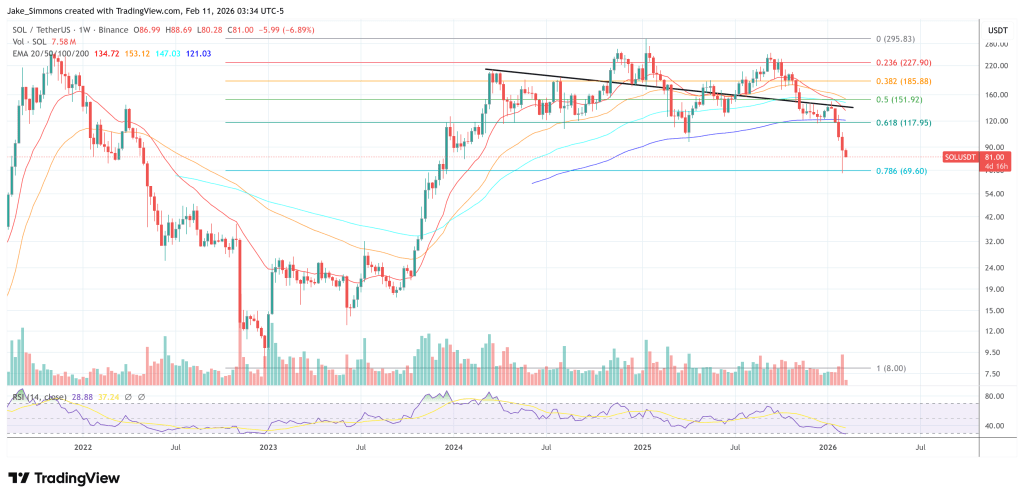
At press time, SOL traded at $81.