SBF Fights Conviction as Crypto Security Enters Quantum Era with $BMIC’s Bold Move

Sam Bankman-Fried's legal team files a last-ditch appeal—just as the crypto world faces its next existential threat.
The Quantum Countdown Begins
Forget exchange hacks and wallet drains. The next-generation security nightmare isn't a phishing email; it's a quantum computer silently cracking the cryptographic foundations of Bitcoin and Ethereum. While regulators chase the ghosts of FTX's collapse, a silent race against the clock has started.
$BMIC's Pre-Quantum Play
Enter projects like $BMIC, positioning themselves not as another memecoin, but as a hedge against cryptographic obsolescence. The pitch? Building or integrating quantum-resistant protocols *before* the hardware arrives. It's a bet on a future where today's 'unhackable' wallets become tomorrow's open books. Some call it visionary; others call it fear-mongering to pump a token—welcome to crypto.
Security in the Spotlight
The timing is poetic. As SBF's appeal tries to rewrite the past, developers are scrambling to future-proof the entire system. The real trial isn't in a New York courtroom; it's in labs and on testnets, proving new math can withstand machines that don't fully exist yet. Traditional finance would form a committee and publish a report in five years. Crypto is throwing speculative capital at the problem today.
One era's defining fraud case meets the next era's defining technical challenge. The market might be distracted by legal drama and price charts, but the smart money is watching the algorithms. After all, what's the point of a bull market if a quantum computer can sign a transaction moving your gains to its wallet?
 Sam Bankman-Fried has officially appealed his fraud conviction, reigniting discussions about security and trust in the crypto industry.
The FTX collapse highlighted the severe risks of centralized custody, pushing the market toward more robust security solutions. BMIC is building a quantum-secure financial stack, including a wallet and staking, to protect assets from future cryptographic threats. The looming danger of ‘harvest now, decrypt later’ attacks makes post-quantum cryptography a critical area of innovation for digital assets.
Sam Bankman-Fried has officially appealed his fraud conviction, reigniting discussions about security and trust in the crypto industry.
The FTX collapse highlighted the severe risks of centralized custody, pushing the market toward more robust security solutions. BMIC is building a quantum-secure financial stack, including a wallet and staking, to protect assets from future cryptographic threats. The looming danger of ‘harvest now, decrypt later’ attacks makes post-quantum cryptography a critical area of innovation for digital assets.Sam Bankman-Fried, the disgraced founder of FTX, is officially appealing his conviction and 25-year prison sentence. The legal filing reopens one of the biggest fraud cases in crypto history, and for an industry still grappling with the fallout, it’s like pouring salt in a very old wound.
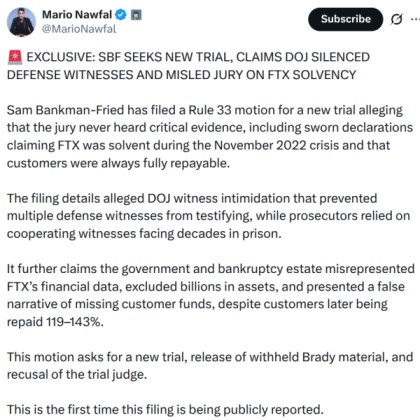
SBF’s appeal challenges various trial decisions, from witness testimony to alleged conflicts of interest. But let’s be clear: the FTX saga was never about tech failing. It was a catastrophic breakdown of trust.
Billions in user funds vanished not because of a sophisticated hack, but due to internal fraud and shockingly poor custody. That collapse forced a painful but necessary conversation across the market: How do we actually secure digital assets?
While the courts wrestle with crypto’s ghosts, innovators are already building for the future. We’re now seeing a clear shift in investor focus toward projects that prioritize provable, next-gen security over pure hype. That’s where the real story is.
The Quantum Threat and BMIC’s Future-Proof Solution
But what most market coverage misses is that while the industry defends against today’s threats, a far bigger one looms: quantum computing. State-sponsored and corporate labs are racing to build machines capable of shattering the encryption that protects everything from bank accounts to crypto wallets.
It’s a threat (one many still dismiss) known as the ‘harvest now, decrypt later’ attack, stealing encrypted data today with the plan to unlock it once quantum computers are powerful enough. For crypto, this isn’t just a problem; it’s an existential risk.
This is the exact problem BMIC ($BMIC) was engineered to solve. It isn’t just another DeFi protocol or meme coin; it’s a foundational security LAYER built for the quantum age. The project delivers a full stack of financial tools, wallet, staking, and payments, all shielded by post-quantum cryptography (PQC).
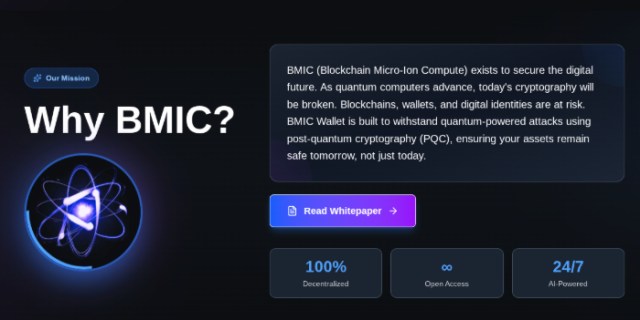
While traditional wallets expose public keys during transactions, BMIC uses ERC-4337 smart accounts and a Zero Public-Key Exposure model to protect users from both current and future threats. It even integrates an AI-enhanced threat detection system to proactively neutralize suspicious activity.
The key difference here is a shift from reactive security to preemptive protection. So, is your portfolio truly SAFE if its core cryptography has a known expiration date?
LEARN MORE ABOUT BMIC AND ITS QUANTUM STACK
A New Security Standard Attracting Early Investment
If history has taught us anything, it’s that after a major market failure like FTX, capital flows toward infrastructure that promises to prevent the next crisis. We’re seeing that play out right now. The early traction for the BMIC presale seems to prove the point, having already raised over $446K, with tokens currently priced at just $0.049474.
Frankly, this doesn’t look like speculative froth; it looks like a calculated investment in a long-term solution. It’s why we picked $BMIC as a best new cryptocurrency.
The project’s utility is centered on its native token, $BMIC, which powers the whole ecosystem. It’s used for staking on the quantum-secure network, participating in governance, and fueling its ‘Burn-to-Compute’ model for access to advanced security features.
The Ripple effect of a successful quantum-proof platform could be immense, potentially setting a new security standard for the entire industry. The risk? As always, it comes down to execution and adoption. But in a market still scarred by FTX, a project building decentralized, future-proof security is a compelling story.
buy your $BMIC here
This article is for informational purposes only and does not constitute financial advice. All investments carry risks, and readers should conduct their own due diligence.
