Bitcoin Correction Accelerates Toward Historic Capitulation Zone – What You Need to Know

Bitcoin's latest price action isn't just a dip—it's a high-velocity slide toward a zone that has historically signaled maximum pain. The market's moving fast, and the charts are telling a story veteran traders recognize all too well.
The Anatomy of a Capitulation Event
When sell-offs accelerate beyond typical pullbacks, they often enter a distinct phase. This isn't about mild profit-taking; it's about leveraged positions getting liquidated and weak hands finally throwing in the towel. The momentum feeds on itself, creating a vacuum where fear becomes the dominant market driver.
Why This Zone Matters
History doesn't repeat, but it often rhymes. Past cycles have shown that when Bitcoin enters this specific territory on various metrics, it has frequently marked a turning point. It's the moment where the last of the over-optimistic speculators get washed out—clearing the deck for the next leg. Of course, past performance is the favorite bedtime story of every finance bro, right before they check their underwater portfolio.
Navigating the Volatility
The key now is watching for a slowdown in the selling pressure and a stabilization in volume. These are the early whispers of a floor being found. Until then, the market's cutting through support levels like a hot knife through butter, reminding everyone that in crypto, the only constant is change—and occasionally, a brutal reminder of risk.
Bear Market Drawdown Signals Transition Into Deeper Phase
Adler notes that the Bitcoin Bear Market Correction Drawdowns chart places the current 2025–2026 decline in historical context, comparing its magnitude with previous bear cycles. The metric tracks percentage drawdowns from each cycle’s all-time high on a logarithmic scale, allowing a clearer assessment of structural market stress rather than nominal price moves alone.

The current bear phase began after Bitcoin topped NEAR $124,450 in October 2025. By November, the market had entered a persistent downtrend, with the correction expanding from roughly −20% to −30% initially before accelerating to around −46% by early February. Notably, the pace intensified sharply: the drawdown moved from approximately −28% on January 28 to −46% by February 6. A modest rebound followed, with price briefly stabilizing near $70,700, still implying a drawdown of roughly −43%.
Historically, earlier cycles saw significantly deeper declines, including roughly −93% in 2011, around −83% in both the 2013–2015 and 2017–2018 bear markets, and about −76% during the 2021–2022 correction. Against that backdrop, the current decline appears less severe so far.
Adler argues that three months of persistent downside momentum signal entry into a deeper corrective phase. Stabilization between −40% and −50% WOULD suggest moderating cycle volatility, while a drop beyond −50% could reopen downside targets toward the −60% to −70% range.
Bitcoin Tests Critical Support As Downtrend Pressure Intensifies
Bitcoin’s latest price action shows a clear deterioration in market structure after the sharp breakdown toward the $65K–$70K region. The chart highlights a decisive loss of short-term support, followed by an aggressive selloff that pushed price well below the key moving averages, signaling sustained bearish momentum rather than a simple correction.
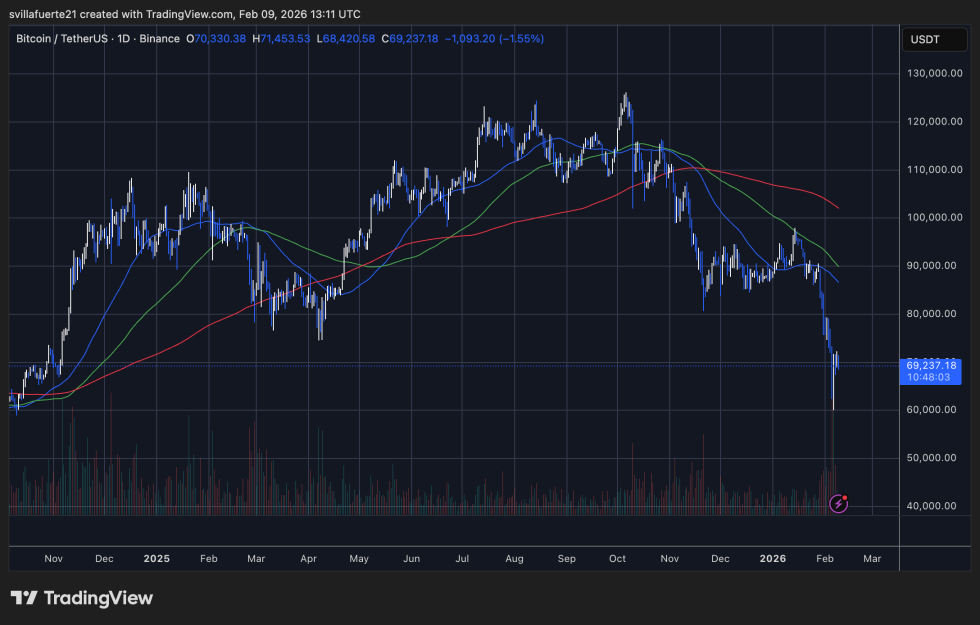
Notably, BTC is trading under the 50-, 100-, and 200-period moving averages, all of which are beginning to slope downward. This alignment typically reflects a transition from consolidation into a more established downtrend. The rejection near the mid-$90K area earlier in the cycle appears to have confirmed a lower high, reinforcing bearish continuation risk.
Volume dynamics also deserve attention. The sharp spike during the most recent drop suggests forced selling, likely driven by liquidations and panic positioning. Historically, such spikes can either mark capitulation or precede further downside if follow-through selling emerges.
From a structural perspective, the $65K zone is now critical. Holding above it could allow stabilization and a potential relief bounce. However, a sustained breakdown below this level would likely expose the next demand region closer to the low-$60K range, where stronger historical support may emerge.
Featured image from ChatGPT, chart from TradingView.com
