Binance SAFU Fund Bolsters Reserves with 4,225 Bitcoin ($300M) as Market Reclaims $70K Threshold

Binance just made a massive move—its SAFU insurance fund swallowed another 4,225 Bitcoin, a cool $300 million at today's prices. This isn't just a routine top-up; it's a statement of confidence as Bitcoin punches back above the $70,000 psychological barrier.
The SAFU Signal: More Than Just Insurance
Forget boring corporate treasury allocations. When an exchange's emergency fund loads up on Bitcoin, it's betting on the asset's long-term resilience. The SAFU fund exists to protect users, but this scale of accumulation during a price surge speaks volumes—it's a hedge, a strategic reserve, and a bullish indicator all rolled into one.
Timing is Everything
The purchase coincides with Bitcoin's latest charge past $70,000, a level that had previously acted as both a launchpad and a ceiling. Adding $300 million in exposure at this precise moment suggests Binance's risk models see more runway ahead, or at least, sufficient stability to warrant parking a massive war chest in the native asset.
What This Means for the Market
Major exchange reserves aren't just idle balances—they're part of the market's liquidity fabric. A chunk this size moving into cold storage for SAFU reduces immediately available supply, adding a subtle, structural layer of buy-side pressure. It's a quiet vote of confidence that carries more weight than any CEO tweet.
In the end, it's a fascinating dance: an exchange built on volatility is using its own safety net to double down on the very asset that defines it. A cynical Wall Street veteran might call it reckless—putting your insurance fund in the thing you're insuring against. In crypto? They call it conviction. As Bitcoin flexes above $70k, Binance isn't just watching; it's locking in its position, one giant, expensive satoshi at a time.

Market participants are now debating whether this accumulation reflects long-term confidence from major players or simply opportunistic positioning within an ongoing corrective cycle. While some analysts interpret the purchase as a constructive signal, others remain cautious, noting that macro conditions, exchange flows, and derivative positioning continue to exert pressure on price. For now, Bitcoin’s ability to sustain recovery above key resistance levels will likely determine whether this rebound evolves into a trend shift or remains a temporary bounce.
Institutional Accumulation Signals Amid Fragile Market Conditions
Data from Arkham indicates that Binance’s SAFU Fund has now accumulated a total of 10,455 BTC, worth roughly $734 million at current prices. This expansion of reserves is notable because it occurs during a period of persistent market fragility, when liquidity conditions remain tight, and investor sentiment is still recovering from recent drawdowns. Such activity from a major exchange-linked fund tends to attract attention, as it can reflect both strategic treasury management and broader confidence in Bitcoin’s long-term market structure.
From a market perspective, these purchases matter primarily due to their signaling effect rather than immediate supply impact. While the acquired volume represents only a fraction of circulating supply, institutional accumulation during corrective phases has historically coincided with stabilization periods, particularly when retail flows remain defensive.
However, this should not be interpreted automatically as a bullish catalyst. Exchange inflows, derivative positioning, and macroeconomic uncertainty continue to influence short-term price behavior.
Currently, the market remains in a transitional phase characterized by elevated volatility, cautious positioning, and selective accumulation. Large entities adding exposure while prices consolidate below key resistance levels can indicate long-term confidence, but confirmation typically requires improving liquidity conditions, declining exchange sell pressure, and stronger spot demand. Until those factors align, Bitcoin’s recovery remains tentative despite visible institutional participation.
Market Structure Weakens: Bitcoin Tests Long-Term Support Zones
Bitcoin’s weekly structure continues to show a fragile recovery attempt after the sharp breakdown that pushed price back below the $70,000 zone. The chart highlights a clear rejection from the region above $90,000 earlier in the cycle, followed by a sequence of lower highs and accelerated downside momentum. This pattern typically reflects distribution transitioning into a corrective phase rather than a simple pullback.
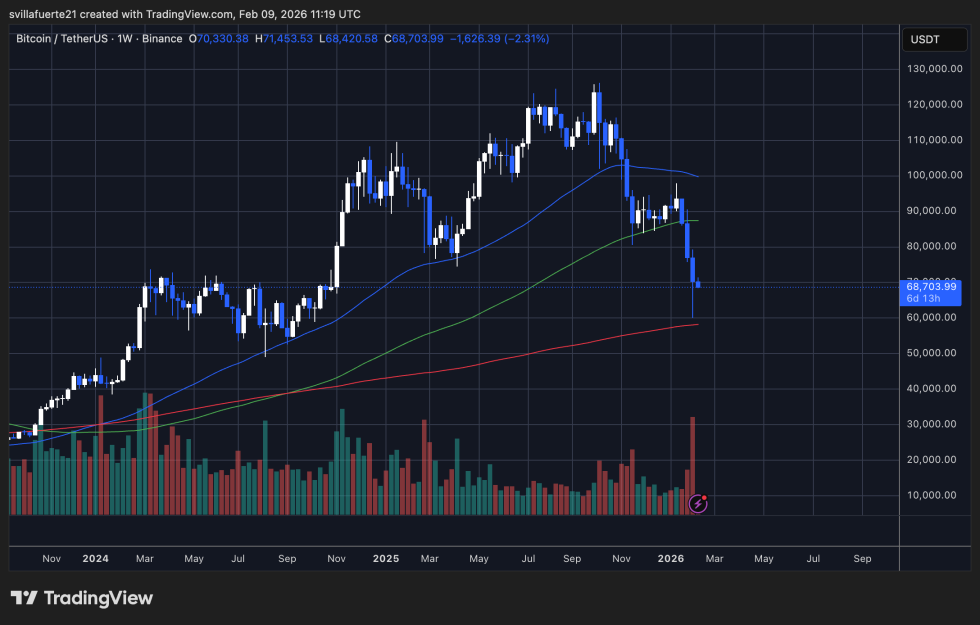
Price is currently trading beneath the short-term moving average cluster while approaching the longer-term trend support represented by the 200-week moving average area. Historically, this zone often acts as a structural support during deep corrections, but it does not guarantee an immediate reversal. Momentum indicators inferred from price behavior suggest sellers still dominate the order flow.
Volume dynamics reinforce this interpretation. The recent decline occurred alongside noticeable spikes in trading activity, indicating forced selling, liquidation cascades, or repositioning by large participants rather than passive drift lower.
If bitcoin stabilizes above the mid-$60K region, consolidation could emerge before a new directional move. However, a sustained breakdown below that zone would likely open the door to deeper retracement levels, potentially testing prior accumulation areas formed earlier in the cycle.
Featured image from ChatGPT, chart from TradingView.com
