Bhutan’s $22M Bitcoin Exit Signals Mining Cost Crisis: Institutions Pivot to High-Yield Layer 2 Solutions

Nation-state miners start feeling the heat.
When even governments can't make the numbers work, you know the landscape is shifting. Bhutan's recent $22 million Bitcoin liquidation isn't just a sale—it's a strategic retreat from an increasingly expensive primary chain. The kingdom's foray into mining, once powered by abundant hydropower, has hit a profitability wall as network difficulty soars and energy economics tighten.
The Institutional Pivot to Layer 2
Capital is restless. It doesn't sit in underperforming assets for long. The narrative emerging from this move is clear: sophisticated players are no longer content with base-layer exposure alone. The hunt for yield has moved to the next logical frontier—high-throughput, low-cost Layer 2 networks. These aren't just scaling solutions anymore; they're becoming the new yield-generating engines for institutional portfolios. Think of it as moving from owning raw land to developing high-rise apartments on it.
Why L2s Are the New Institutional Darling
It's a simple calculus. Why battle for shrinking base-layer rewards when you can deploy capital in ecosystems offering staking yields, sequencer fees, and governance incentives? Layer 2s transform idle crypto assets into productive capital. They offer something traditional finance craves but rarely delivers: transparent, protocol-defined returns uncorrelated to stock buybacks or dividend cuts. The smart money is building positions not just in the asset, but in the financial infrastructure surrounding it.
A Cynical Note on 'Strategic Rebalancing'
Let's call a spade a spade. A 'strategic reallocation' often just means 'we bought high and are selling low to chase the next hot thing.' It's the crypto equivalent of a mutual fund manager's annual bonus justification—rebranding reactionary moves as visionary foresight. That said, even a broken clock is right twice a day, and this pivot towards utility and yield is where the real value accrual happens next.
The bottom line? The era of passive HODLing for large players is over. Active asset management on-chain is in. Bhutan's $22 million wake-up call shows that when mining costs bite, institutions don't just sit and bleed—they migrate to where the efficiency is. The race to build and back the dominant L2 financial stack is now the main event.
 Bhutan’s $22M Bitcoin liquidation highlights the financial pressure on industrial miners due to rising difficulty and costs.
As L1 spot prices face sell pressure, capital is rotating into infrastructure projects that solve Bitcoin’s scalability limits. Bitcoin Hyper uses the Solana Virtual Machine to deliver high-speed, low-cost smart contracts while securing data on Bitcoin L1. $HYPER has raised over $31M so far with smart money positioning heavily in the $HYPER presale.
Bhutan’s $22M Bitcoin liquidation highlights the financial pressure on industrial miners due to rising difficulty and costs.
As L1 spot prices face sell pressure, capital is rotating into infrastructure projects that solve Bitcoin’s scalability limits. Bitcoin Hyper uses the Solana Virtual Machine to deliver high-speed, low-cost smart contracts while securing data on Bitcoin L1. $HYPER has raised over $31M so far with smart money positioning heavily in the $HYPER presale.Sovereign volatility is back. On-chain data confirms that a wallet linked to the Royal Government of Bhutan, managed by Druk Holding & Investments, recently deposited 367 $BTC to Binance. That movement, valued at approximately $22M, isn’t an isolated event. It’s a symptom of a brutal squeeze in the mining sector.
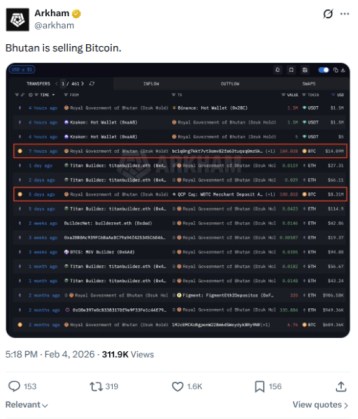
With Bitcoin’s hash price compressing and operational expenditures (OpEx) for industrial miners climbing, even state-backed entities are liquidating reserves to keep their balance sheets healthy.
The market reaction? Mixed. While a $22M sell wall is absorbable in today’s high-volume environment, the signal is undeniably bearish for short-term LAYER 1 price action. It highlights the growing tension between network security costs and miner profitability.
But smart money rarely sits on its hands. As capital rotates out of stagnant spot positions, sophisticated investors are hunting for yield in the emerging bitcoin Layer 2 ecosystem, a sector designed to solve the scalability issues currently choking the main chain.
This rotation is visible in the flows toward infrastructure projects, unlocking Bitcoin’s dormant capital. Leading the pack is Bitcoin Hyper ($HYPER), a protocol using the Solana Virtual Machine (SVM) to bring high-speed execution to the Bitcoin network.
Bitcoin Hyper ($HYPER) Brings SVM Speeds To The Oldest Blockchain
Bitcoin has a utility problem. While it remains the pristine collateral of the crypto world, let’s be honest, it’s sluggish. Transactions crawl, fees spike during congestion, and programmable smart contracts are virtually non-existent on the main chain. Bitcoin Hyper ($HYPER) tackles this by grafting the solana Virtual Machine (SVM) directly onto the network as a Layer 2 solution.
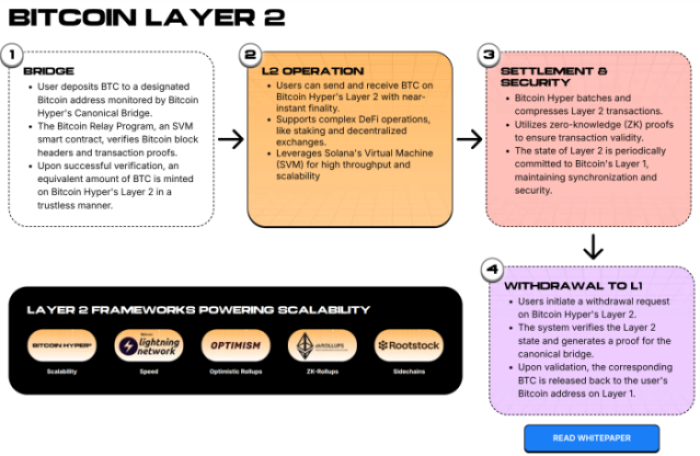
This architecture allows Bitcoin Hyper to process transactions with Solana-grade speeds while anchoring security to Bitcoin’s Layer 1. For developers, this opens the door to building DeFi apps, NFT platforms, and gaming dApps using Rust, all within the Bitcoin ecosystem.
Bitcoin Hyper uses a decentralized Canonical Bridge to ensure trustless $BTC transfers, effectively turning static Bitcoin into a productive asset.
That matters for adoption. By modifying SPL-compatible tokens for L2 execution, Bitcoin Hyper creates a high-speed payment and DeFi environment that Bitcoin has historically lacked. The protocol operates on a modular framework: Bitcoin L1 handles settlement, while the SVM L2 handles real-time execution.
This separation of concerns allows a single trusted sequencer to manage throughput without compromising the underlying security guarantees of the Bitcoin network.
LEARN MORE ON THE OFFICIAL $HYPER PRESALE PAGE
Whales Accumulate As Smart Money Front-Runs The L2 Narrative
While sovereign miners like Bhutan sell to cover costs, a different class of investor is aggressively accumulating early-stage infrastructure. The data surrounding the Bitcoin Hyper presale suggests serious institutional confidence. According to official figures, the project has already raised over $31M.
 This liquidity injection isn’t just retail money. Etherscan records show that whales are also in on the action, with one wallet scooping up $500K’s worth of $HYPER. This data point, large singular buys rather than thousands of micro-transactions, indicates that high-net-worth individuals are positioning themselves before the token hits public exchanges.
With the current token price sitting at $0.0136751 and staking rewards at 68%, these entities are securing positions at a valuation that anticipates major future utility. Our experts also predict $HYPER doing well, possibly making it to $0.32 by the end of 2026. If that happens and you’d invested today, it’s an ROI of 2240%
The incentive structure supports the long game, too. Bitcoin Hyper offers high APY staking immediately after the Token Generation Event (TGE). Notably, the protocol enforces a 7-day vesting period for presale stakers. This mechanism (often overlooked by retail flippers) is designed to prevent immediate post-launch dumping, stabilizing the price floor while rewarding those who participate in governance.
For investors watching Bhutan sell L1 assets, rotating into a yield-bearing L2 represents a hedge against mining-induced volatility.
GET YOUR $HYPER ON ITS OFFICIAL PRESALE PAGE
This article is for informational purposes only and does not constitute financial advice. Cryptocurrencies are high-risk assets. The mention of specific dates, such as January 15, 2026, reflects data provided by the project source. Always conduct your own due diligence before investing.
