Binance Gobbles Up Vast Majority Of Bitcoin Inflows As Investors Pounce On Correction

When the market stumbles, the giants feast. A recent price dip triggered a massive wave of capital movement, with one platform emerging as the clear winner in the scramble for discounted assets.
The Correction Catalyst
Market pullbacks aren't just about red candles and panic selling—they're prime hunting grounds. Savvy players see volatility not as a threat, but as a discount window. The latest downturn proved no different, acting as a magnet for capital waiting on the sidelines.
The Inflow Imbalance
While capital flowed into several major exchanges, the distribution was anything but even. One platform absorbed a wildly disproportionate share of incoming Bitcoin. This wasn't a slight edge—it was a landslide, highlighting where institutional and retail confidence pooled when prices got interesting.
Why the Herd Moved
Liquidity begets liquidity. Traders flock to where the action is, and where they believe they can execute quickly during turbulent times. The platform that captured the lion's share didn't just offer a trading pair—it offered a perceived safe harbor and deep order books, the crypto equivalent of a 'too big to fail' narrative that even traditional finance veterans would cynically recognize.
The takeaway is stark. Market structure is concentrating. When fear or opportunity strikes, the flow of capital tells you who's winning the war for trust—or at least, who's winning the war for order flow. Just don't call it a monopoly; call it 'network effects,' like every other finance buzzword that masks consolidation.
Exchange Inflows Signal Capitulation Pressure
The report adds that the scale of these exchange inflows was substantial. Over just two days, between 56,000 and 59,000 BTC were sent to Binance, marking one of the largest short-term transfer spikes seen this year. A significant portion of this activity came from Short-Term Holders, a cohort historically known for reacting quickly to price weakness. On February 2nd alone, data shows that roughly 54,000 BTC were transferred to exchanges at a realized loss, highlighting the degree of stress among recent buyers.

These flows represent genuine spot-side selling pressure rather than a purely speculative signal. When large volumes of BTC MOVE onto exchanges during corrective phases, it typically reflects a combination of fear-driven exits and forced selling by participants with weaker conviction. Importantly, while such movements often generate heightened fear, uncertainty, and doubt across the market, the magnitude of these inflows is not abnormal in the context of sharp corrections within larger market cycles.
From a structural perspective, this behavior points toward a developing capitulation phase. As Bitcoin becomes increasingly oversold, marginal sellers are flushed out, reducing near-term supply pressure.
Historically, similar conditions have preceded the formation of local or intermediate bottoms, as selling exhaustion gives way to stabilization. While downside risk may persist in the short term, the data suggests that the market is moving closer to a reset point where long-term positioning begins to outweigh panic-driven decisions.
Bitcoin Tests Critical Support As Selling Pressure Intensifies
Bitcoin’s price action on this chart reflects a clear transition from a corrective phase into a broader test of long-term support. After failing to reclaim the $90,000–$95,000 zone, BTC accelerated lower and broke decisively below the rising medium-term structure, pushing price toward the $75,000 area. This move marks a sharp deterioration in momentum, confirmed by the loss of the 50-day and 100-day moving averages, both of which have now rolled over and begun acting as dynamic resistance.
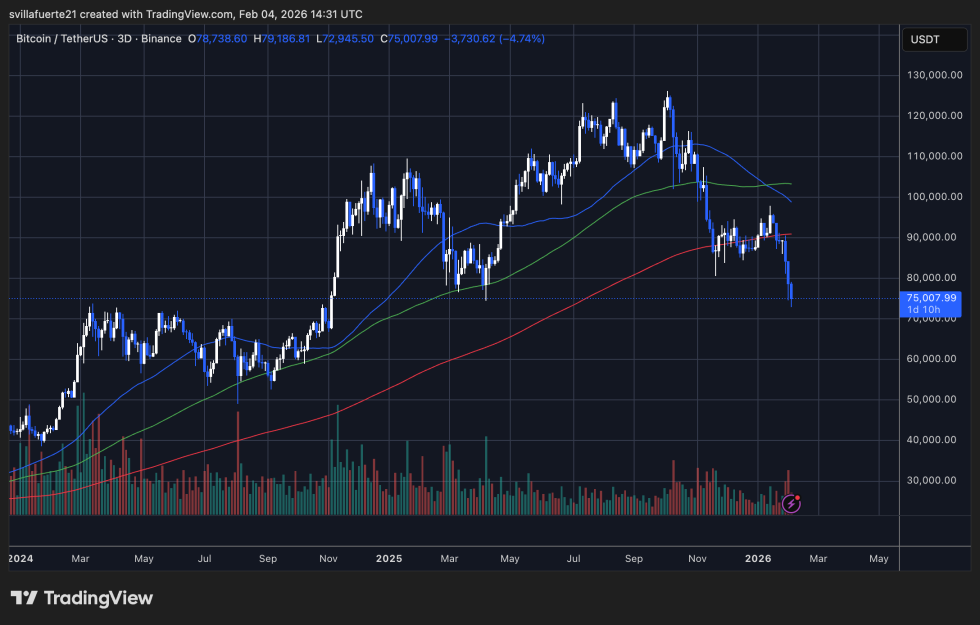
The rejection near the prior consolidation range suggests that buyers were unable to defend higher lows, opening the door to deeper downside exploration. Importantly, the current price is now approaching the 200-day moving average, a level that has historically served as a critical trend filter during late-cycle corrections. A sustained hold above this region WOULD imply a macro pullback within a larger bullish structure, while a clean breakdown would significantly weaken the long-term trend.
Volume dynamics add context to the move. Selling pressure expanded notably during the breakdown, indicating distribution rather than a low-liquidity drift lower. However, volume has begun to stabilize as price reaches the mid-$70,000s, hinting that forced selling may be slowing.
From a structural perspective, Bitcoin is now trading in a high-stakes zone. The market must either absorb supply NEAR $75,000 and form a base, or risk confirming a deeper trend reversal if support fails.
Featured image from ChatGPT, chart from TradingView.com
