CME Group Launches Proprietary Digital Token & 24/7 Crypto Trading: Is $HYPER the Next Major Exchange Listing?

The world's largest derivatives exchange just bulldozed another wall between traditional finance and crypto.
CME Group—the Chicago behemoth that sets the global price for everything from pork bellies to interest rates—is rolling out its own digital token and launching round-the-clock cryptocurrency trading. This isn't just dipping a toe in the water; it's a full-scale invasion of the digital asset frontier.
The Institutional On-Ramp Goes 24/7
For years, CME's Bitcoin and Ether futures operated within the neat, predictable hours of traditional markets. That ends now. The new 24/7 trading desk shatters the time barrier, letting institutional money flow whenever crypto markets move—which, let's be honest, is usually at 3 a.m. on a weekend.
The move effectively creates a regulated, institutional-grade counterpart to the never-sleeping crypto spot markets. Hedge funds and asset managers no longer have to choose between CME's credibility and the market's reality.
Meet the House Token
More intriguing than the extended hours is CME's decision to mint its own digital token. Details are scarce, but the implications are massive. Will it function as a utility token for fee discounts and settlement within their ecosystem? Could it evolve into a collateral instrument for derivatives trades?
This isn't some startup's speculative asset; it's a utility token born inside a $100-billion-plus regulated exchange giant. The message is clear: if you can't beat the token economy, issue your own.
The $HYPER Speculation Frenzy
Which brings us to the speculative elephant in the room: $HYPER. The rumor mill is in overdrive, asking if this hyper-growth token will be the next major asset listed on CME's new crypto platform.
A CME listing has become the holy grail for crypto projects—a stamp of institutional legitimacy that can catapult an asset into the big leagues. For $HYPER's backers, this isn't just hope; it's a calculated bet on the new infrastructure being built by the very giants crypto was meant to displace. The irony is thicker than a Wall Street prospectus.
The New Rules of the Game
CME's play does two things simultaneously. It validates the core infrastructure of digital assets—tokens, global liquidity, 24/7 markets—while preparing to dominate it with traditional finance's rulebook and balance sheet.
They're not just joining the crypto party; they're buying the building and rewriting the guest list. For the rest of the market, the question shifts from 'if' to 'how' you connect to this new institutional pipeline. One cynical take? The 'decentralized' future is being quietly reassembled on the servers of the same old financial titans—they just accept digital currency now.
The gates are open, and the old money is coming in. The real volatility might not be in the prices, but in the power dynamics.
 CME Group is exploring a digital token to enable 24/7 trading and instant collateral movement, signaling a major shift in institutional finance.
The move validates blockchain technology as superior to traditional banking rails for settlement and liquidity management. Bitcoin Hyper addresses the need for speed on the Bitcoin network by integrating the Solana Virtual Machine (SVM) for high-performance Layer 2 execution. Early market interest is evident, with over $31M raised in the presale.
CME Group is exploring a digital token to enable 24/7 trading and instant collateral movement, signaling a major shift in institutional finance.
The move validates blockchain technology as superior to traditional banking rails for settlement and liquidity management. Bitcoin Hyper addresses the need for speed on the Bitcoin network by integrating the Solana Virtual Machine (SVM) for high-performance Layer 2 execution. Early market interest is evident, with over $31M raised in the presale.The line between traditional finance and the decentralized economy is blurring faster than regulators can keep up.
CME Group, the world’s largest derivatives exchange, is reportedly exploring the launch of its own digital token, signaling a fundamental shift in institutional market structure. The objective? Near-instant collateral movement to support 24/7 trading.
Crypto natives take this for granted, but for legacy institutions shackled by banking hours, it’s the holy grail.
It’s less about the token itself and more about what it unlocks. By tokenizing collateral, CME is effectively admitting that the existing plumbing of global finance, T+1 settlement cycles, and weekend closures, is cooked. The risk for traditional banks is real.
If a derivatives giant builds its own settlement rails, who needs intermediary clearing banks? Smart money is watching this not just as an infrastructure upgrade, but as a tacit endorsement of blockchain efficiency at the highest level of finance.
While CME focuses on the trading layer, a critical bottleneck remains on the execution layer of the world’s most valuable asset: bitcoin itself. As institutions demand 24/7 liquidity, pressure mounts on Bitcoin’s network to handle high-frequency volume.
Frankly, the base layer’s 10-minute block times can’t support this throughput alone. That infrastructure gap triggered a rush into high-performance Layer 2 solutions. Leading the charge? Bitcoin Hyper ($HYPER), a protocol explicitly engineered to bring high-speed execution to the Bitcoin ecosystem, is positioning itself as the potential engine room for this new era of institutional liquidity.
Bitcoin Hyper Bridges The Gap Between Security And Speed
The narrative dominating this cycle isn’t just buying Bitcoin, it’s making it productive. CME Group handles how institutions trade; Bitcoin Hyper handles how the asset functions. As the first Bitcoin Layer 2 to integrate the solana Virtual Machine (SVM), the project attempts to solve a decade-old trilemma: maintaining Bitcoin’s security while hitting the sub-second finality modern DeFi demands.
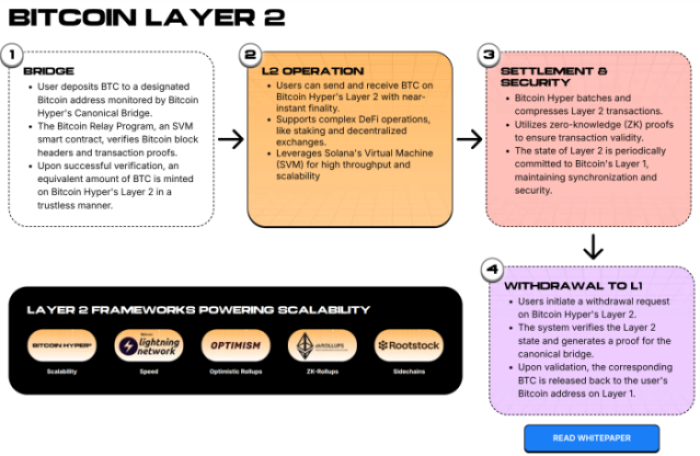
That convergence matters. It allows developers to write smart contracts in Rust, the language of choice for high-performance dApps, while anchoring final settlement on Bitcoin. Think of it as a shift from ‘digital gold’ to ‘digital oil.’
Using a modular blockchain architecture with a single trusted sequencer and periodic L1 state anchoring, Bitcoin Hyper delivers transaction speeds that reportedly outpace Solana itself, all while keeping gas fees negligible. Want a full breakdown of how it works? We’ve got you covered in our ‘What is Bitcoin Hyper‘ guide.
For an institutional market eyeing 24/7 trading, this utility is non-negotiable. A decentralized canonical bridge facilitates seamless $BTC transfers, allowing for the creation of wrapped $BTC payment rails and complex lending protocols that don’t rely on centralized custodians. The data points to a clear trend: as capital flows into Bitcoin via ETFs and futures, the demand for a scalable application LAYER (L2) creates an asymmetric opportunity for infrastructure plays like $HYPER.
EXplore the $HYPER presale
Smart Money Flows Into $HYPER Presale As Whales Accumulate
While legacy markets wait for regulatory clarity on CME’s potential token, on-chain metrics suggest crypto-native liquidity is already front-running the L2 narrative. Bitcoin Hyper has picked up serious steam, with the official presale raising over $31M to date. That level of capital injection hints at high conviction from investors looking for beta plays on Bitcoin’s success.

The current token price of $0.0136751 offers a low entry barrier relative to the roadmap. Whales are taking notice. Check the chain: Etherscan records show 3 whale wallets accumulated over $1M with the largest buy at $500K. High-net-worth individuals are positioning themselves before the token hits open markets.
It’s not just raw capital inflows—the protocol’s staking mechanics are driving retention too. Investors can snag high APY rewards immediately after the Token Generation Event (TGE), with a modest 7-day vesting period for presale stakers.
This structure encourages long-term holding over quick flips, aligning community interests with protocol stability. With the Bitcoin ecosystem evolving from a passive store of value to an active financial layer, projects that can successfully merge speed (SVM) with security (BTC) are likely to capture the lion’s share of developer activity.
HOP ON THE $HYPER TRAIL HERE
This article is for informational purposes only and does not constitute financial advice. Cryptocurrency investments carry inherent risks, including volatility and market unpredictability. Always conduct your own due diligence.
