TRON Integration Supercharges Kolo’s Real-World Stablecoin Payments – Here’s How

Kolo just plugged into the TRON network—and its ambitions for real-world stablecoin payments just got real.
Why This Move Matters
Forget theoretical use cases. This integration is about cutting transaction times and slashing costs where it counts: at the checkout counter. By leveraging TRON's high-throughput blockchain, Kolo isn't just talking about adoption—it's building the rails for it.
The Mechanics of the Move
The play is straightforward. TRON's infrastructure handles the settlement layer, while Kolo's platform manages the user-facing payment experience. It bypasses traditional banking delays, aiming to make digital dollar transactions as frictionless as swiping a card. The target? Everyday purchases, remittances, and business payments—the financial plumbing that, frankly, hasn't seen real innovation since the fax machine.
The Bigger Picture
This isn't an isolated upgrade. It's a calculated step in the broader chess game of crypto utility. Every integration like this chips away at the old guard's dominance, proving that blockchain networks can do more than just host speculative assets—they can actually move value efficiently in the physical world. It almost makes you wonder what the legacy finance titans are doing with all those quarterly profits besides buying back their own stock.
Kolo's bet is clear: the future of payments won't be built on legacy rails. And with this move, they're laying down track at full speed.
TRON’s Growing Role in Stablecoin Payments
Recent data around Kolo provides useful context for understanding TRON’s role in today’s stablecoin market. Kolo has processed more than $250 million in total transaction volume to date, with roughly 30% of that activity executed directly on the TRON network. This concentration is notable given the broad range of chains available for stablecoin transfers and points to sustained usage rather than short-term experimentation.
The platform has also recorded a high number of individual deposits, reinforcing the idea that TRC-20 USDT is increasingly used as a settlement rail for everyday payments and routine transfers, rather than solely for trading or arbitrage.
Lower transaction costs and faster confirmation times make the tron network particularly suited for smaller, frequent payments, which tend to dominate real-world spending behavior. Kolo’s design emphasizes speed and operational simplicity, allowing users to open an account, complete verification, and begin spending within minutes, while remaining fully compliant with global KYC and AML requirements.
At the network level, this activity aligns with a broader structural shift. TRON has now surpassed ethereum in USDT circulating supply, reflecting where stablecoins are actually being held and moved at scale.
TRX Price Holds Key Structure Amid Market Weakness
TRON (TRX) continues to trade NEAR the $0.28–$0.30 zone, a level that has become structurally important on the weekly chart. After a strong advance throughout 2024, price entered a consolidation phase following the sharp spike and rejection above the $0.35 area. Since then, TRX has been moving sideways, suggesting the market is digesting prior gains rather than entering a clear distribution phase.
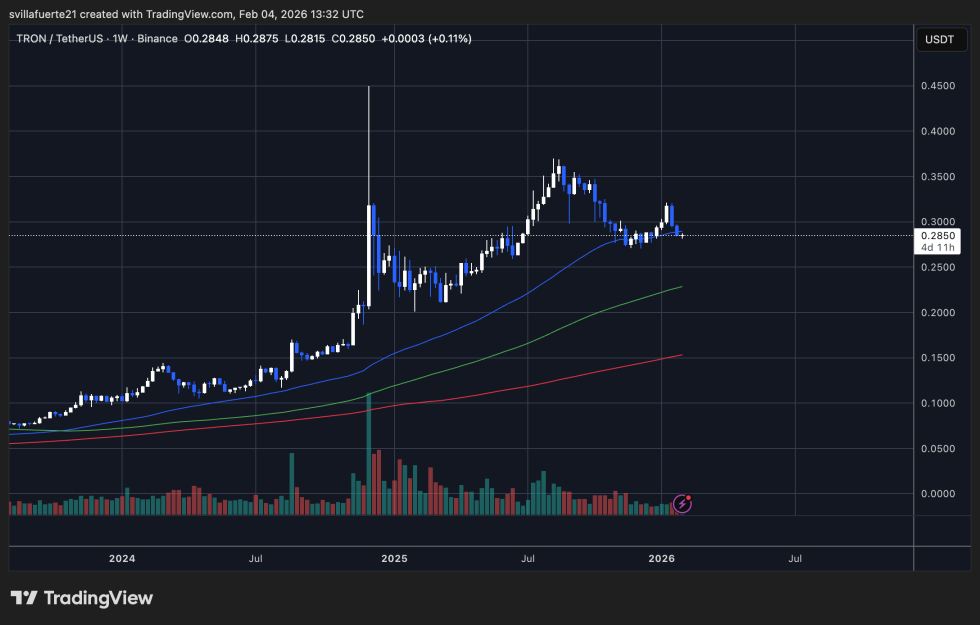
From a trend perspective, the broader structure remains constructive. Price is still holding above the rising 100-week moving average (blue), which has acted as dynamic support during pullbacks. The 200-week moving average (green) continues to slope higher well below the current price, reinforcing that the long-term trend remains intact despite recent volatility. The 50-week moving average (red) also continues to rise, indicating that long-term momentum has not yet broken.
Volume behavior supports this interpretation. The largest volume spike occurred during the impulsive rally, while recent weeks show declining activity, consistent with consolidation rather than aggressive selling. This suggests sellers are not pressing the market with urgency.
However, the inability to decisively reclaim and hold above $0.30 highlights near-term caution. A sustained break below the $0.27–$0.28 range WOULD weaken the structure and expose deeper support near the 100-week average. Conversely, a clean weekly close above $0.30 would signal renewed strength and open the door for a retest of prior highs.
Featured image from ChatGPT, chart from TradingView.com
