Bitcoin’s Sharpe Ratio Plunges Faster Than Price — What’s Behind The Metric Meltdown?

Bitcoin's risk-adjusted returns just hit a wall. While everyone's watching the price charts, the real story is unfolding in a different metric entirely—one that tells you how much pain you're enduring for each potential gain.
The Sharpe Signal
Forget the daily volatility noise. The Sharpe ratio cuts through the hype, measuring returns per unit of risk. When it drops faster than the spot price, you're looking at a market where turbulence is outpacing opportunity. It's the financial equivalent of hitting more potholes while slowing down.
Behind The Numbers
What drives this divergence? Several forces collide: institutional positioning shifts, macro liquidity drying up, or derivative markets getting overheated. Sometimes the smart money exits quietly through the options door while retail traders are still staring at the spot entrance.
Why This Hurts More Than A Dip
A falling price with stable Sharpe ratios suggests a healthy correction. But when risk-adjusted returns collapse? That screams structural stress—the kind that makes portfolio managers reach for the antacid. It's the market's way of saying "this volatility isn't worth the upside anymore."
The Professional's Dilemma
Institutional frameworks live and die by these metrics. Many fund mandates trigger rebalancing or exits when Sharpe ratios deteriorate beyond certain thresholds. That creates reflexive selling pressure—a beautiful example of Wall Street's genius at automating panic.
Silver Linings In The Spreadsheet
Historically, severely depressed Sharpe ratios have marked contrarian opportunities. When everyone's running the same quant models and reaching the same gloomy conclusions, someone's about to be spectacularly wrong. The trick is surviving until the models flip.
Remember: finance professionals would rather explain a missed opportunity than justify a loss—which explains why most alpha evaporates during precisely these moments. The ratio isn't just falling; it's separating the believers from the spreadsheet jockeys.
This Metric Changes First, BTC Price Reacts Later: Crypto Founder
In a January 30 post on the X platform, Alphractal’s founder and CEO, Joao Wedson, revealed that the Bitcoin Sharpe Ratio is declining at a rate faster than the BTC price. The relevant indicator here is the Sharpe Ratio, which assesses the risk-adjusted returns of a particular cryptocurrency (Bitcoin, in this case).
This on-chain metric basically tracks the amount of profit an investment offers per unit of risk (considering risk is measured by volatility), with a high value signaling a higher risk-adjusted performance. Meanwhile, a negative Sharpe Ratio indicates that the returns being realized on an investment are not commensurate with the risk being taken.
Wedson wrote in his post on X:
Simply put: the market is taking more risk for less return.
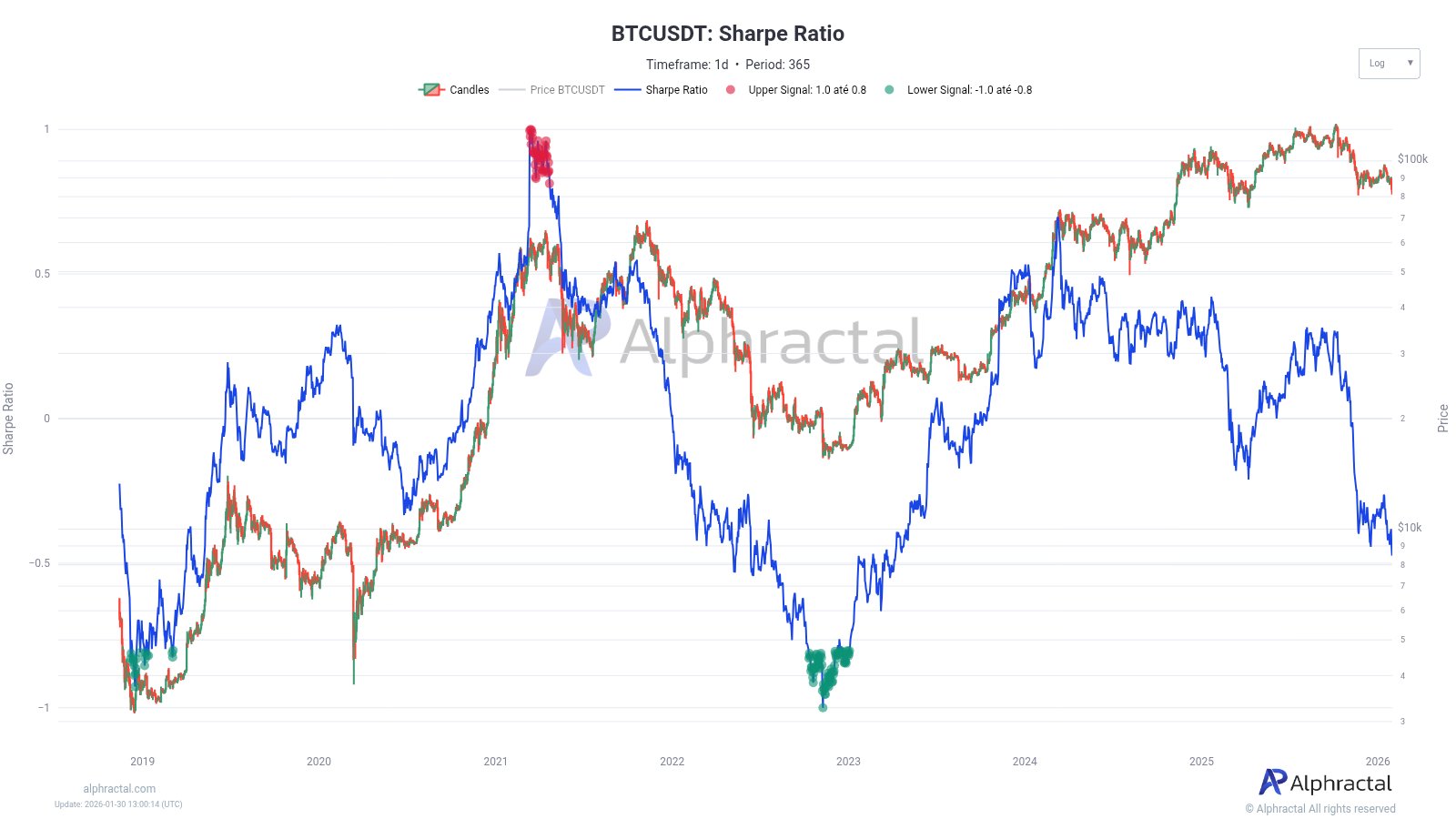
Indeed, the Bitcoin Sharpe Ratio slipped into the negative territory a few days into the new year. However, BTC’s price action still enjoyed an incredible run of FORM — running to as high as $97,000 — after this shift, placing less significance on the on-chain observation.
What’s more interesting is that the Sharpe Ratio is falling and weakening at a pace faster than the Bitcoin price. Historically, this rate of decline has often coincided with extended periods of momentum loss and sideways price movement. In fact, Wedson concluded that the risk-adjusted metrics need to change before price can react positively.
Bitcoin Price Could Fall To $65,500 If This Happens
In a case where the premier cryptocurrency continues its downward spiral, Wedson has projected a target for the BTC price. In an older post on X, the Alphractal founder had revealed that the Bitcoin price cannot lose the $81,000 level under any circumstances.
The on-chain expert stated that a capitulation phase similar to the one seen in 2022 could unfold if the market leader breaks below the $81,000 level. Based on the Fibonacci-Adjusted Market Mean Price, Wedson identified $65,500 as the next major support level.
The $81,000 came under focus as the Bitcoin price approached this level during its decline on Thursday, January 29. As of this writing, though, BTC has recovered above the $83,000 mark, with the price still down by nearly 8% on the weekly timeframe.
