Bitcoin Volatility Alert: Trump Expected To Tap Kevin Warsh As Fed Chair Today

Brace for impact. The world's largest cryptocurrency is gearing up for another white-knuckle ride as political winds shift in Washington.
The Fed's New Sheriff
Markets are buzzing with the expectation that former President Donald Trump will name Kevin Warsh as the next Chair of the Federal Reserve. Warsh, a former Fed governor known for his hawkish views and Wall Street pedigree, represents a potential seismic shift in monetary policy. For Bitcoin, a digital asset born in the ashes of the 2008 financial crisis, the implications are profound.
Why Crypto Cares About the Central Bank
It's simple: interest rates and liquidity. The Fed controls the spigot of the world's reserve currency. A Warsh-led Fed could signal a faster return to tighter monetary policy—higher rates, a stronger dollar, and less cheap money sloshing around the system. Historically, that's been a headwind for risk assets, and Bitcoin, despite its 'digital gold' narrative, often trades like the ultimate risk-on bet. Traders are now recalibrating their models, weighing Warsh's known skepticism of quantitative easing against his understanding of modern markets. It's the classic Wall Street dilemma: fear the hawk, or trust the insider?
The Volatility Playbook
Expect the algorithmic traders to take the wheel. News-driven spikes and plunges become the norm as the market digests every rumor and statement. Liquidity can vanish in a heartbeat, widening spreads and amplifying moves. This isn't for the faint of heart. It's a environment where narratives—about inflation, dollar dominance, and financial sovereignty—will battle it out on the charts minute by minute. Savvy players see opportunity in the chaos, while the over-leveraged get washed out. Another day, another reminder that crypto's independence is still tightly chained to the whims of a few people in a marble building—a delicious irony for an asset class built to bypass them.
So, buckle up. The Fed is about to get a new pilot, and Bitcoin is strapped into the co-pilot's seat, ready for turbulence. Whether this flight ends at new heights or in a corrective dive depends on who you think really holds the yoke: the technocrats, or the code.
What Warsh Means For Bitcoin And Crypto Markets
The fastest repricing has happened not in Treasuries, but in prediction markets. Polymarket’s contract on Trump’s Fed chair nominee is currently showing Warsh at 93%, with the market displaying roughly $302 million in volume, levels traders interpreted as a leak-driven stampede rather than a slow drift.
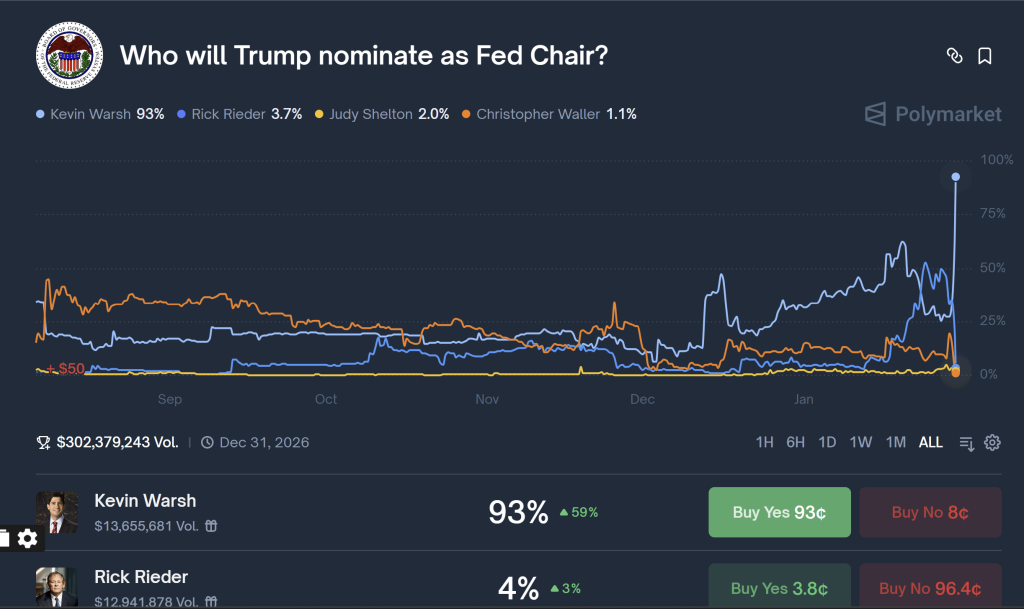
That surge dovetails with a Bloomberg report saying the Trump administration is preparing for a Warsh nomination, and with commentary from macro traders who see the process tightening into a single outcome.
Several market observers frame a potential Warsh chairmanship as dovish on the policy rate but hawkish on the Fed’s footprint. Macro trader Alex Krüger wrote via X: “Warsh has advocated for a structural overhaul of the Federal Reserve and a ‘new Treasury-Fed Accord.’ He posits that an AI-driven productivity boom is inherently disinflationary, providing the basis for aggressive rate cuts. He also contends that the Fed’s balance sheet has been used to subsidize Wall Street and should be reduced significantly, signaling a strong stance against QE.”
Former Fed trader Joseph Wang distilled the trade-off more bluntly: “A Warsh Fed looks to trade lower asset prices for a lower rate path… This is a step to reverse Bernanke’s wealth effect.” That framing matters for Bitcoin and crypto because it separates “rate cuts” from “easy financial conditions”—two concepts markets often conflate during risk-on moves. Wang added an ominous shorthand: Warsh “will get you a lot of cuts, but you might not like how we [get] there.”
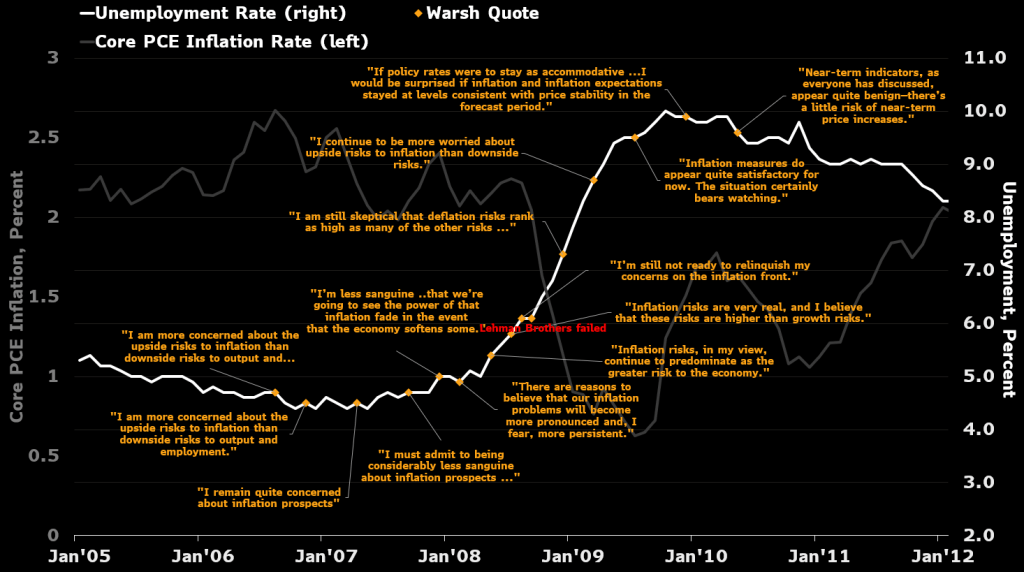
Warsh’s reputation as an inflation hawk also complicates any clean “dovish” label. Bloomberg’s Chief US Economist Anna Wong shared the below analysis and resurfaced a 2009 inflation comment attributed to Warsh, made months after Lehman and with Core PCE still low, arguing that if Trump “wants someone easy on inflation, he got the wrong guy.
Chief Market Strategist at Wellington-Altus James E. Thorne added via X: “Kevin Warsh remains the strongest choice for Fed chair because he uniquely combines market credibility with a clear willingness to reset policy in a more disciplined, rules‑based direction. He is structurally hawkish on inflation and the balance sheet, but tactically flexible enough to support meaningful rate cuts when conditions warrant, which aligns with the Trump–Bessent objective of moving the funds rate lower without sacrificing institutional legitimacy.”
Krüger conceded Warsh’s track record “is not the best,” while still arguing there is “unique credibility in a former inflation hawk advocating for aggressive cuts.”
Warsh, Bitcoin, And ‘Market Discipline’
For Bitcoin and crypto, one underappreciated angle is that Warsh has publicly described Bitcoin in surprisingly non-hostile terms. In a Hoover Institution interview published July 8, 2025, Warsh rejected the idea that Bitcoin threatens the dollar, while still treating it as a policy signal. “Bitcoin does not make me nervous,” he said. “I think of it as an important asset that can help inform policymakers when they’re doing things right and wrong. It is not a substitute for the dollar.”
Kevin Wash on Bitcoin, the WHITE paper and its role alongside the dollar:
“It can often be a good policeman for policy.” pic.twitter.com/bnSSpv0foy
— Natalie Brunell (@natbrunell) January 30, 2026
Warsh also cast Bitcoin’s role as a kind of feedback mechanism for central bankers: “I think it can often be a very good policeman for policy,” he said, before widening the lens to distinguish “real innovators” from “imitators” and “incompetents” in the broader proliferation of crypto tokens.
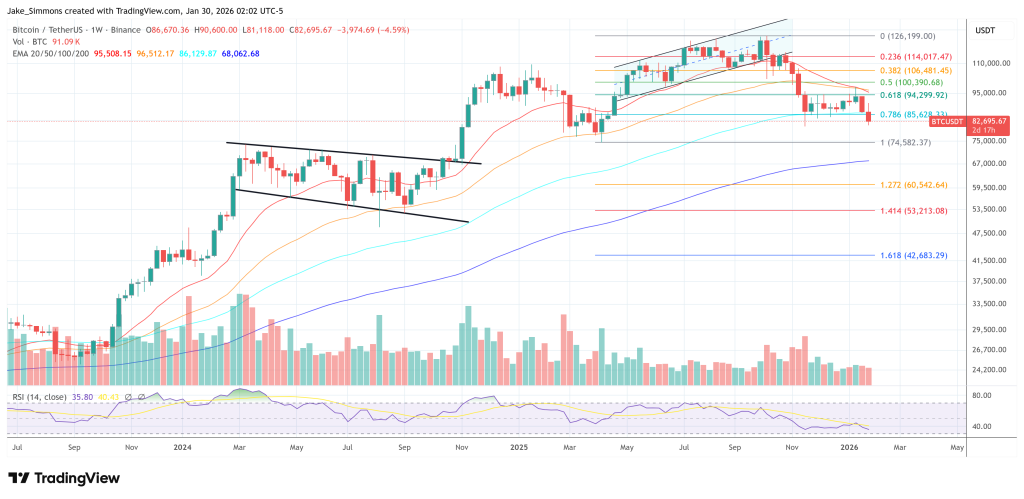
At press time, Bitcoin traded at $82,695.