Ripple Secures Major Legal Victory: Court Dismisses XRP Class Action Lawsuit

Another legal domino falls in Ripple's favor—and XRP holders are breathing easier.
The Ruling That Changes the Game
A federal judge just tossed out the class action suit against Ripple, marking the company's second significant courtroom win in recent years. The decision reinforces a growing judicial trend: treating XRP as something other than a security in certain contexts. This isn't just a legal footnote—it's a precedent that cuts through regulatory fog and gives institutional players the green light they've been waiting for.
Why This Matters Beyond the Courtroom
Forget the legalese. This ruling bypasses a major roadblock for Ripple's core business: onboarding financial institutions. Banks and payment providers hate uncertainty more than they hate volatility. A dismissed class action reduces liability fears and operational risk—two things that make traditional finance executives break out in cold sweats. It's the kind of clarity that gets deals signed.
The Ripple Effect on Markets
Watch the order books. Legal wins have historically acted as rocket fuel for XRP's price, slicing through bearish sentiment. While past performance doesn't guarantee future results—a phrase finance lawyers love—the market's reaction will be immediate. Traders are already positioning for reduced regulatory overhang, betting that fewer lawsuits mean smoother sailing for adoption.
The Fine Print and the Future
Don't pop the champagne just yet. The SEC's broader case still looms, and regulators never take a loss lying down. But this dismissal chips away at the opposition's narrative. Each victory makes Ripple look less like a rogue operator and more like a legitimate—if disruptive—financial infrastructure player. The cynic might say it's another case of legal budgets beating regulatory ambiguity, but in crypto, that's just called Tuesday.
Bottom line: Ripple's legal team is on a hot streak. For XRP, that means fewer headwinds and more runway. For the rest of crypto? It's another data point in the slow, messy march toward clarity—where courtrooms are becoming as important as code.
Ripple Wins: Court Punts XRP Securities Claims
The case was led by Bradley Sostack, who purchased XRP in January 2018 on Poloniex. The underlying class complaint was filed later in 2018; Sostack was appointed lead plaintiff in 2019 and amended the complaint in 2020.
At the center of the appeal was when XRP was “bona fide offered to the public” for purposes of the Securities Act’s repose clock. The ruling sided with Ripple, pointing to early XRP distribution and trading activity tied to the XRP Ledger’s built-in exchange.
“According to the record in this case, Ripple was offering XRP to the public as early as 2013. It is undisputed that Ripple sold over 500 million XRP on the Ledger’s built-in digital asset exchange. Those offers were made ‘to the public’ even if only technologically sophisticated consumers could navigate the Ledger to purchase XRP.”
That framing mattered because Section 13’s statute of repose is unforgiving: once the three years run from the first public offering, later buyers can’t revive a federal Section 12(a)(1) registration claim by filing years afterward. The district court had reached the same conclusion in its June 20, 2024 summary judgment order on the federal class claims.
Sostack’s primary effort to avoid the time bar was to argue Ripple’s conduct in 2017, when the company began releasing its XRP holdings in monthly tranches, amounted to a separate, later offering (or effectively a new investment contract) that should restart the clock.
The panel rejected that attempt to split the timeline, emphasizing the nature of the asset itself and the absence of a factual dispute that the 2013 and 2017 activity should be treated as distinct offerings.
“But Sostack has failed to raise a material issue of fact that the 2013 offering and the 2017 offering were separate offerings. The nature of XRP did not change between 2013 and 2017; all XRP cryptocurrency remained fungible and interchangeable.”
With no separate-offering finding, the panel held the repose period began with the 2013 public offering, leaving the 2018/2019 filings outside the window and affirming judgment for Ripple. The decision is also procedurally narrow: because the district court’s Rule 54(b) certification covered only certain claims, the Ninth Circuit said it was limiting its ruling accordingly.
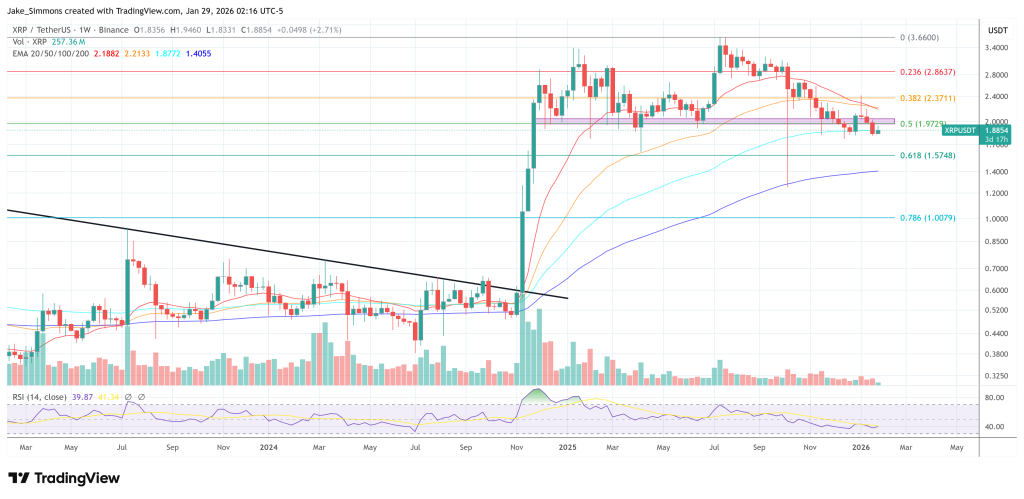
At press time, XRP traded at $1.88.